Showing posts with label listening. Show all posts

Thursday, April 7, 2016

For The Love of God, Please Shut Up … Just For a Little Bit

Leadership to me means duty, honor, country. It means character, and it means listening from time to time. - George W. Bush

Change happens by listening and then starting a dialogue with the people who are doing something you don't believe is right. - Jane Goodall

When you stop learning, stop listening, stop looking and asking questions, always new questions, then it is time to die. - Lillian Smith

It’s been a phenomenally (translation: staggeringly) busy year for me and for this reason, I haven’t had much to say on my blog this year.

That’s what I tell a lot of people who have been following my musings for years and who ask me why I am not writing much these days.

Well, in the spirit of true confession, I have been extremely busy but that’s not why my writing output has dropped significantly this year.

It’s because I am listening.

One of the things I have been known for for years (according to colleagues) is my ability to own a boardroom.  People have told me and others that they have shown up for meetings that I am in just because they wanted to see what I was going to say or do in a meeting, especially the complicated or politically loaded meetings (or to hear my impersonation of Zig Ziglar as I note here In Memory of Zig Ziglar–Building a Legacy).

However, some of those same people, if they didn’t know me well (or at all) have gone to some meetings and were disappointed that I said little if anything.

What disabled my active (sometimes overactive) mouth?

Whenever I meet a group of people for the first time, unless it’s my meeting, I have little to say.  I say little (or nothing) because I am listening to what people have to say, how they say it and hopefully, why they say it.  My philosophy is that if I don’t know who the participants are, what they have to contribute, how they contribute it and what motivates them, then I will have little of value to offer to either supplement their ideas or to correct them.

It’s a style opposite that which is embraced by many people in this connected world – people who feel that there is a competition to be the first or the loudest but where the competition for who is right or impactful in a positive, meaningful way contains a much smaller field.

Once I understand the dynamics and intentions for the meeting and its participants, then I usually have a lot to say.  That’s why people who make trouble for others don’t like it when I go quiet … because I am thinking and they may be the subject of my mental gymnastics. :-)

As my professional world rolls along at its usual hectic pace, I always keep an eye on the “stuff” going on in the world, “stuff” such as:

  • The impact of the Syrian situation, both the war and the refugees, and the potential long term impact on world stability.
  • The impact (or not) of terrorism in general.
  • The concerns over the security of our technology, especially in the areas of protecting our infrastructure from attack.
  • The general preparedness of citizens in case trouble should arrive in society from any one of a number of sources.
  • The fight over global climate change, the fuss over whose data to use, whether it’s real or not and who is to blame (while few wonder how to survive it).
  • The insanity of the US political scene, the raging disconnect between citizens and politicians in general, and the impact on the world as a result.
  • The ability for political correctness to sweep over us to the point where we are so delicate and sensitive that a simple “good morning” might offend us (or launch a lawsuit).
  • The LGBTQ dialog and the sides who are vehemently for and against it with few caring to understand what is happening as a result of this shift.
  • The impact of social media and its ability to actually break down our ability to communicate and be social and respectful to and with each other.
  • The conversion of news media into tools of political and corporate manipulation as well as a source of demeaning entertainment.
  • General conversations that are driven by emotion and intimidation instead of data, respect and collaboration.
  • Why a woman is allowed to abort a baby (even late term) in some places and that is ok and yet in those same places, a person who kills that same pregnant woman is charged with a double homicide (only explainable by the bureaucrats that created this paradox).
  • The inevitable accounting that is coming in our global financial system for not doing the right things for decades (or centuries).
  • Our inability to be honest about aviation security, financial system security and the like.

The list goes on – my apologies for having left out what matters to you.

Do I have opinions on this stuff?

Of course …. who doesn’t?

But would expressing my opinion change things or make a difference?

I’m not sure and so if I can’t be sure of making a positive impact, then I don’t say anything at all, otherwise I’m just contributing more noise to a very noisy world, a world where more people are talking and fewer are listening (and thinking / acting using appropriate data).

However and more importantly, as a long time Wall St. strategy guy, I know that events and the intention of the people behind those events are guiding us towards something either very good or very bad.

And unless we spend more time observing and listening to those events (and the people behind them), we are less likely to have an opportunity to anticipate where those people and events are taking us, thereby reducing our ability to either amplify a great future or reduce or eliminate a bad one.

The dilemma is that is if you don’t wilfully create a future, then one is created for you.

Are you willing to bet on the notion that a good future can be created by accident?

The Bottom Line

People write a lot about terrorism but it continues to disrupt people’s brains and lives.  Meanwhile, we can’t seem to have any dialog around whether it is as big a threat as politicians and the media tell us it is.

People lecture us about the importance of protecting human Life and then take it to prove their point.

We talk about how we are safer than ever from the devastation of war but last year, we set a global record with military spending exceeding $1.7 trillion.

Other people talk about protecting their “minority status” because it is the respectful thing to do and then disrespect others in order to protect their status.

Some people write a lot about how to communicate effectively, respectfully and collaboratively and yet many people are finding it easier to use modern technology to shout others down or intimidate them into not participating in a global dialog.

Politicians lecture us about how they will make a difference and then create careers (with our support) that accomplish little if anything of value to the people they represent (and not even close to what was promised at election time).  We get angry and then elect the next generation of politicians who do the same thing.

We look to entertainers to create our opinions on politics, business, economics and the like, ignoring the fact that they know little or nothing about the subject (have you ever been lectured to someone citing The View as their source?).

Even with something as mundane as weight loss, we have so many experts offering us tomes explaining how to live healthier and yet we are not making a dent in our health as obesity and the diseases related to it continue to overwhelm us.

The list goes on.

The reality is that with billions of smart people talking, we are not solving many important things commensurate with the number of opinions being expressed and the cacophony of noise created by the majority of those opinions.

That’s not to say that our world is ugly nor am I saying that we are short of smart people.

In fact, it is a beautiful world, filled with natural and man-made creations that are stunning in their awe-inspiring construct, impact and potential and many brilliant people walk this beautiful earth.

But we can only continue to have a beautiful world if we work harder to keep it that way and we allow the intelligent words of the brilliant to rise above the noise created by the uninformed, the misinformed and the ignorant.

And that’s why I wonder if we need to pause for a moment, listen a little more attentively, think a little more strategically and then take actions that are more intelligently thought out and less of a reflexive kneejerk nature.

What do you think?

Or are you are too busy preparing to tell me that I am wrong.

After all, too many of us listen with intent to reply rather than to learn, to understand and to make a positive impact on the world around us.

Why and how do you listen to others?

Are you sure?

Now if you will excuse me, I’m going to shut up and listen a little bit more.

How about you? :-)

In service and servanthood,

Harry

Addendum and a Long Distance Dedication

A kind reader strongly refuted my remarks by sending me a lengthy email with a number of motivational poster shots and quotes from famous people. Unfortunately, he did not add any personal content outside of writing his own subject line. It made me laugh and I felt that I needed to respond with a little fun.

Warning: There is no original content in my response either as I share some of the work by the great folks at Despair.com :-).

Create a great day for yourself and others, because merely having one is too passive an experience!


Cluelessness: There are no stupid questions but there are a LOT of inquisitive idiots.


Ineptitude: If you can't learn to do something well, learn to enjoy doing it poorly.


Planning: Much work remains to be done before we can announce our total failure to make any progress.


Preservation: Action will be taken to prevent the next disaster as soon as possible after it has occurred.


Pretension: The downside of being better than everyone else is that people tend to assume your pretentious.


Pride: The art of calling faith in yourself "self esteem" while calling it "conceit" when you see it in others.


Recognition: Having your moment in the sun isn't always a good thing.


Recognition: The more you reward the most trivial of achievements, the more you produce the most trivial of people.


Reliabilithy: It's not really that helpful if all you do is blow up every hour.


Social Media: If the unexamined Life is not worth living, it's certainly not worth broadcasting online 24 hours a day.
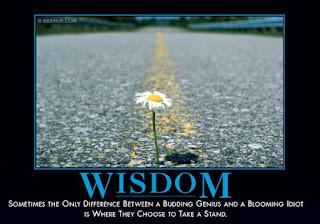


Wisdom: Sometimes the only different between a budding genius and a blooming idiot is where they choose to take a stand.


Monday, October 26, 2015

I’m Still Not Dead … Just Busy

Silence is a source of great strength. - Lao Tzu

Silence is a true friend who never betrays. – Confucius

I’m always fascinated by the people who reach out to me when my blog contributions get light as they have been in recent months.

Some reach out because they miss the content I write – thank you for your kindness.

Some reach out because they want to see if I’m healthy or even alive – thank you for your thoughtfulness.

Some reach out because, in their belief, people who write blogs should (read: must) write blogs everyday and they feel it is important that I know this.

Well, as one can see from my social media feeds, I am alive and well – thanks for asking.

As for those who believe that people who blog must do so daily, I offer the following (tongue-in-cheek):

Blogging: Never before have so many people with so little to say said so much to so few.

Blogging: Never before have so many people with so little to say said so much to so few.

It reminds me of the cartoon floating around on social media a few months back that said “20 years ago, you didn’t take a Polaroid of your oatmeal and then run around the neighborhood bragging about it, so don’t do it now.” Smile

My reality is that I write blogs when the following conditions are met:

  1. I’m not busy with other things
  2. There is a subject that moves me emotionally and is one that I believe will move others emotionally also.
  3. There is a subject where I believe I have a contribution to make in a unique way that has not been satisfied by others.
  4. There is a subject where people need / want to be informed or influenced.

f I can’t satisfy that criteria for publishing a post, I stay focused on what matters around me – family, friends and business.

You know … that thing we used to call reality …. and priorities. Smile

Sometimes the subject I would like to write about concerns things that might alarm people or are things I cannot get permission to write about due to my work background and so I decide (or someone decides for me) that I am better off keeping my mouth shut.  For those, I usually find a way through my #1206 “fiction” series. Smile

In what I do, I spend most of my days giving an opinion – verbally, pictorially or orally.  As a Newfoundlander (from a culture built upon storytellers) who has experienced a lot and been blessed by many people and events, I have collected a lot of stories that I love to share.  My dentist and I had a laugh last week during an emergency oral procedure when I couldn’t speak for over 3 hours.  She said it was like trying to quiet Joe Pesci in Goodfellas.

While many people love to hear themselves speak, it is not uncommon for people to hear me say, “I’m tired of hearing my own voice – it’s your turn to speak.”

There are times in my busy days when I feel called upon to listen and I honor that calling as it always comes for a reason.

And then there are times when cerebral people like me just like to be as I noted in Keep the Noise Down, I’m Thinking.

So I’m not dead …. but I do enjoy the quiet now and then.

We can’t be talking all the time, you know.

Or should I shout that so you can hear me?

Create a great day, because merely having one is too passive an experience.

In service and servanthood, quietly.

Harry

Tuesday, July 15, 2014

Your Life Story–Do You Hear What I Hear?

I remind myself every morning: Nothing I say this day will teach me anything. So if I'm going to learn, I must do it by listening. - Larry King

Wisdom is the reward you get for a lifetime of listening when you'd have preferred to talk. – Doug Larson

Some years ago, I was driving home from work when for some reason I felt strongly compelled to stop into a retirement facility in the area.  It was an odd feeling since I did not have any friend or family member in residence there but I felt it was important to stop by anyway.

After arriving at the facility, I wandered around the grounds, not really engaging with anyone while simultaneously wondering why I was there when suddenly my eyes locked with the eyes of an elderly gentleman sitting alone.

For reasons unknown to me until today, I walked over to him, introduced myself and sat beside him.  He introduced himself as Mr. Green and within minutes he began telling me his Life story.

Mr. Green had outlived his children, his wife and his siblings and was spending the final days of his Life alone at this facility.  He told me stories of growing up in a small outport in Newfoundland, of the days where he would row more than 5 miles one way every day across the harbor (and the same distance back later in the evening) to visit the woman who would later become his wife and the victories and challenges he had experienced raising his family in a small town.

The few hours I spent with him went by quickly and he thanked me for taking the time to listen to his “silly stories”.  I in turn thanked him for sharing with me the most powerful moments of his Life and then I left.

And just as I couldn’t explain at the time why I had stopped by that day, for reasons equally unknown to me, I never returned to visit Mr. Green again.

That interaction took place 30 years ago, remaining dormant and forgotten in my memory until a conversation with someone today about the importance of listening brought the events back to me as if they had happened yesterday.

The power in our story

Mr. Green thought his collection of memories were merely silly stories when in fact they were a beautiful compilation of a Life well-lived.

A Life like his.

A Life like yours.

As he told me his stories, he saw each of them as expressions of stand-alone, unrelated events.  I saw them as an unfolding tapestry of connected events, each event in his Life clearly and obviously equipping him for the next event in his Life.

In speaking to someone about his story today, they made an observation that I thought was powerful.  The observation was this:

After we have survived or experienced a significant event in our Life, is there a hint of our future that is provided to us?

Do we listen to the messages that such events present to us?

Do we see the connection between the events in our Lives?

I found this to be an emotionally stirring series of questions.  << Yes, we tough, cold, ruthless Wall St. ***holes have been known to get misty-eyed in coffee shops.  Please don’t tell anyone – we have a reputation to protect. >>

Mr. Green did not see the connection between the events nor did he see how each event equipped him with new knowledge, wisdom and growth in his character, values and morals to prepare him for the next event.

He didn’t see the importance of the lessons he had acquired through the living of his Life.

He did not understand the true value of the events he had experienced.

He did not fully comprehend the value of his Life story.

And he didn’t understand the impact of sharing his stories with a young stranger who wandered into the retirement facility that day for unknown reasons.

Unknown to me until today ……

It is true that each of us is nothing more than a collection of stories.  It is these stories that define the legacy that we leave behind when we have long-since departed this place.

Our stories represent our perception and expression of our experiences both significant and mundane.  While we are the primary author of our story, many people are brought into or forced into our lives to contribute material to our story while we are simultaneously invited or forced to contribute material to theirs, creating the collection of comedies and tragedies that form the essence of who we are.

Many of our stories are written in the public eye.

Many are written seemingly in private when we think that no one is watching.

Regardless of how we write our stories, there is someone out there who is modeling our behavior or looking up to us in some way.

In those moments, we are not just writing our story.

We are creating or providing the material by which others are writing their story as we knowingly or unknowingly participate as coauthors.

The Bottom Line

Remember when we used to take our high school yearbooks and collect the autographs of our fellow classmates, creating a permanent memory of who they were?

In a similar way, people leave indelible marks on our hearts and Spirits as we make our way through Life, adding material to our Book of Life, inviting us to contribute to theirs or one person being forced to accept the contribution of another.

And as we write our collective stories together, what matters is that we are listening to the story that our Lives are expressing about us, since we never know who is modeling our Life or looking up to us for wisdom, knowledge or inspiration.

The questions then become ….

Are you listening to your story and the impact on others?

Are you listening to the stories of others and their impact on you?

Are you listening at all?

Are you sure?

How do you know?

In service and servanthood,

Harry


Related posts:

Friday, January 24, 2014

Keep the Noise Down, I’m Thinking

Silence is a source of great strength. - Lao Tzu

Silence is a true friend who never betrays. – Confucius

Some years ago at a leadership development seminar I attended, the attendees were paired up to perform an intriguing exercise.

In the exercise, one of the pair describes a real problem that they have.  The other half of the duo listens.  They are not allowed to comment on what they hear.  They are not allowed to ask questions nor are they allowed to attempt to solve the problem being described.  They are also not permitted to gesture or react in any way to what they hear.

They are told to listen and to potentially learn what Marcus Tullius Cicero meant when he wrote:

Silence is one of the great arts of conversation.

The participants in the exercise learn quickly that it is practically impossible for us to keep quiet when someone else is talking.

Yes, it is true that most of us were raised to help others when we can.  However, I found it to be an interesting demonstration of how our ego needs to solve everything that it perceives around us even if it doesn’t really know the answer or hasn’t even been asked to solve the problem.  When someone has a problem, we automatically have a solution and are very quick to vocalize it.  After all, as many of us know, it is much easier (and fun) to solve someone else’s problems rather than our own.

With the introduction of social media, this need for all of us to solve everyone’s problems or to express an opinion about them has become much more apparent and much more irresistible … and sometimes much less respectful.

As someone in the public eye, as a strategy guy, as someone who vigorously challenges those who usurp the rights of others through ignorance, greed or incompetence (especially under the guise of leadership or expertise) and as someone who embraces the ideals as expressed in Proverbs 31:8 where it is noted

"Speak up for those who cannot speak for themselves; defend the rights of all those who have nothing.”

I also find the need to respond to events to be irresistible. After all, it is what passionate “fixers” do automatically. :-)

However, those of us who respond to many things sometimes find that we are dragged into responding to anything whether or not it is in alignment with the reason we walk this Earth.

As a result, it seems that we are constantly proving William S. Burroughs right when he notes:

Silence is only frightening to people who are compulsively verbalizing.

What matters

The ability to unplug matters.

The ability to be silent matters.

The ability to silently observe, absorb, discard, contemplate, reflect and cleanse matters.

As a tested and confirmed near-hyperthymesiac (a person with a superior autobiographical memory), I find that the cleansing that comes from quiet observation and reflection to be a valuable exercise to flush the brain of unnecessary “stuff”.

It is a practice that I practice on a regular basis and one that I strongly recommend for anyone whose vocation, passion or hobby calls for them to be constantly “talking” in any form.

Sometimes when we are doing all the talking, we forget how to listen.

And so begins my semi-regular retreat from social media and making public comments using it.  I take as long as I need.  Sometimes it’s a weekend.  A few years ago, I disappeared from the public eye (not counting clients, family and close friends) for 8 weeks and had to resurface to explain to people that I hadn’t died when rumors started to circulate. :-)

All that being said ……

The politicians as well the incompetent, the greedy and the selfish who espouse their brilliance under the guise of “leadership” get a small reprieve.

But don’t worry.

I’m still watching. :-)

And I will be back soon.

In the meantime, when I say “Keep the noise down, I’m thinking”, I’m not talking to you.

I’m talking to myself. :-)

In service and servanthood,

Harry

Monday, July 22, 2013

Society: Are We There Yet?

Most parents have heard that dreaded question at some point in their driving lifetime, the question that, if left unanswered, gets asked again and again until the parent goes crazy but if answered, probably draws an unfavourable response that the answer is not good enough.

The question is “Are we there yet?” (insert whining tone for effect).

The other common event that many a driving parent has had to deal with are kids who love to argue once they are in the confined space of a vehicle, poking at each other and trying to incite unrest in what would be a blissful drive otherwise.  Many children also have a sixth sense that the longer the drive ahead of them, the more they need to misbehave (at least until they get bored).

Many parents in such situations occasionally look in the mirror and make comments such as “I can see what you’re doing back there”, lose patience and yell at them, attempt to bribe them with teasers like “There will be no treats when we get to grandma’s” or say something more threatening like “You know that distracting the driver is very dangerous and could kill us all, don’t you?”.

And despite how many times this is repeated around the world and barring an unforeseen incident, the vehicle usually makes it way to its destination at the time it was meant to despite the arguing, noise and unrest that was contained within the vehicle during the journey. 

No amount of mindless questioning or making demands of the driver have any significant influence on either the direction, the destination or the arrival time.  The vehicle’s mechanical systems are indifferent to the noise and unrest contained within its passenger compartment and the driver is focused more on getting to the desired destination safely than figuring out how to keep the kids placated unless not responding to them places the vehicle in greater danger. 

The driver is also limited by speed limits, driving conditions and performance characteristics of the vehicle and therefore is not able to get to their destination faster than is possible given these constraints …. no matter how much they wish they could.

Is society any different?

In observing some arguments on social media in recent days, I believe many people fit the description of “the kids in the car”.

They forget that our judicial, legal and financial systems have for the most part, far outstripped us, their creators, in terms of our ability to guide, direct or even predict their behaviour or outcomes.  Such systems operate at their own pace with their own destinations despite our belief that we can define or change them.

And because many people forget this, they spend an inordinate amount of time yelling and screaming at each other, at “the system” or at “the drivers” in an effort to make the system change its direction or get to its destination faster.

In the case of the driving parent, smart children who understand more strategic ways of asking questions discover that they can influence the driver in ways that benefit everyone as opposed to yelling and screaming which for the most part expends more energy but produces a less favourable result.

The same is true about society.

Yelling and screaming at each other will not influence a system that has a life of its own and which is indifferent to our passion and our arguing.  Nor will yelling and screaming influence the people who believe they are “driving the system” unless the person who is “driving” perceives a greater threat by not responding. 

In situations such as the latter, the person “driving” will offer just enough teasers or threats to keep the “passengers” quiet so that the “driver” can return to that which is more important to the “driver”.

The bottom line is this …

Being strategic about asking the right question, the right way, at the right time and with the right intention can produce a much more significant result for the “passengers”.  Otherwise, if we create too much noise and distraction, we may inadvertently cause the “driver” to make an error.

And then a lot of people may get hurt.

We need more focus on the road ahead right now than ever in our known history.  The “drivers” see potholes, detours and delays ahead that may not be immediately obvious to the people sitting in the backseat.

And on the rare occasion that a “driver” is unqualified or unsuitable to be driving, one doesn’t merely overpower the driver to take command of the vehicle.

There are better and safer ways of influencing the “driver” that must be used.

Do you utilize them or are you too busy poking and insulting the person next to you?

How do you know?

In service and servanthood,

Harry

Addendum

It has been said that many people project outwardly what they struggle with inwardly and for this reason, we can often ascertain someone’s demons and struggles based on what they are screaming about the most.

For this reason, we should probably be careful about what we scream and shout about, lest we tip our hand to others regarding a potential weakness within ourselves.

It is for this reason that some “smart” people intentionally evoke emotion, especially anger, in some people in an effort to expedite the revealing of such weaknesses.

Some related musings ……

Asking Questions That Get Answered

Solving Puzzles–Follow the Breadcrumbs

Anger: Setting Yourself Up For Manipulation

Tuesday, June 18, 2013

Psychokinesis and Cellphones–Understanding Cause and Effect

I’ve come across an interesting phenomena with my cell phone battery that I find to be quite intriguing.  As far as I can tell, the more pressure I am under, the faster my cellphone battery runs down.

If I were enterprising enough, I would engage in a government / university study to explore why this is the case and how widespread the phenomenon is.

If my study were to produce a result similar to the many that David Freedman documents in his great book Wrong, I would probably come up with one of the following as the reason for my hastened battery depletion:

1. When I am under pressure, my brain emits strong brainwaves that interfere with my cellphone, thus fouling the battery in some way.

2. When I am under pressure, my brain experiences an energy deficit and draws power from my cellphone battery.

3. I may be a member of a select group of people known as sliders whose very existence interferes with electrical / electronic components.

However, I might overlook the obvious cause of my battery depletion.

4. When I am under pressure, I fiddle with my phone a lot more, thereby running the battery down.

As in this example, using exotic hypothesis to explain away our problems often sound a lot more exciting than the actual problem  definition and therein lies a problematic temptation.

In such situations, a deliberate or accidental misinterpretation or over-complication of cause and effect often lead to the creation of projects that appear to be more glamorous, challenging or resource intensive than is warranted or projects that are a lot more frustrating than they should be. 

With that in mind, people either happily run off in the wrong direction to solve the wrong problem without giving it a second thought or remain mired in “why isn’t this working better” syndrome.

Either scenario could be avoided if the people holding the problem stopped for a moment and asked the right questions, using the right data to answer those questions.

Some examples from my journey

a. A local church, while lamenting the fact that only 10% of their parishioners attend service on a regular basis, wonder what’s wrong with the people who are not attending instead of asking themselves what they can do to attract more people.  The church is suffering financially as they wait for the other 90% to magically come to their senses and start attending weekly service.

b. A business entity that is running a project with two agendas, a public and a private one, that are diametrically opposed to each other and create confusion as a result.  Despite the obvious issue of the conflicting agendas, the leaders constantly express high levels of frustration (and anger) that their team members and the user community always seemed confused for some reason unknown to everyone.

c. A certain charity whose leadership staff members make over $250K each per year and yet they can’t understand why more people don’t want to work for free for such a great community-minded charity.  They are blind to the conflicting message being sent out of deep coffers for internal staff versus an impoverished, barely-getting-by charity status that is projected to outsiders.

While it’s easy to quote Occam’s Razor in these and other situations, the belief that all thing’s being equal, the simplest solution is most likely the right one, the truth is that the real answers can be found in being able to ask the right questions … or allowing an objective observer to ask the right questions.  As an aside, I mused about “Asking Questions That Get Answered” here.

Having allowed the difficult questions to be asked, the second part of the solution is to put one’s ego in check long to enough to listen to the dialog that ensues.

That’s when the real breakthrough occurs.

Now if you will excuse me, I’ve noticed that as my current deadlines approach, my cellphone appears to be levitating about a foot above my desk.

It must be the draft blowing in from the window.

In service and servanthood,

Harry

Thursday, June 6, 2013

How Was Your Day?

One question that is used a lot that I really have difficulty answering is the question “how was your day?”.  In truth, I sometimes feel agitated as I attempt to come up with an answer to the question even though I know the querent means well.

I will use an extreme example to explain why.

On one particular Tuesday, I said goodbye to my son at the train station as I prepared for my daily commute.  The sun was shining, the trains were on time, the train connections were dead-on and I got into NYC ahead of schedule.

How was my day so far?

Blessed.

As I walked to my office on Madison Avenue, the air was fresh (as fresh as it gets in NYC), people were smiling and I thought “A day doesn’t get more beautiful than this”.

How was my day so far?

Filled with gratitude.

An hour later, a sequence of events transpired that left me, my colleagues and the whole city in shock.

How was my day so far?

Numbing.

An hour after that, events continued to escalate and it looked like many of us were in physical danger.

How was my day so far?

Frightening.

As the events of the day sank in and we realized the losses that so many of us had endured, we realized our lives would never be the same again.

How was my day so far?

Filled with grief.

As the day wore on and the reality of who had conspired to create this day for us became clear, many of us began to feel something else.

How was my day so far?

Filled with anger.

And as I finally made it home and was able to reach out to people to tell them I was ok, I was overcome with a different feeling.

How was my day so far?

I was filled with gratitude for being alive.

I was exhausted.

And I wept.

It was 9/11.

So …. how was my day?

Our day cannot be described in one or two words

When people ask “how was your day?”, they are asking us to net out the ups and the downs of our day into a generalized description that doesn’t really speak to the rich experience of Life that is a typical day for many of us.

But if we try to go into any level of detail to explain the day, many people are so busy (or so self-absorbed) that they would prefer a quick answer, which brings me back to the previous paragraph.

And unfortunately, too many people’s lives are so strained that the negative events of the day seem to outweigh the positive ones no matter how many positive ones were experienced.

An extreme example

Now in truth, my 9/11 example is an extreme one and it is impossible to look back on it to see the positives of that day.  Many of us have had days where the negative events were so large that they blew the positive ones away (and vice versa if we are fortunate).

But as I lived the day, despite the difficult things that were being experienced, there were little nuggets to hold onto also … nuggets such as love, gratitude, hope and resilience.

The day simply …… was.

Moving forward, as each day ends for me I am grateful for what the day brought, for the gifts of love, happiness, elation and overcoming, for the mysteries that remain unsolved and for the difficulties that ultimately will make me stronger (even if I don’t believe it for the moment).

And so if you ask me how my day was, I will tell you simply that it was …. and that I was grateful to be on the top side of the turf to experience it.

To net out the ups and downs to a simple expression or a single word would not give it the justice it deserves nor would it adequately encapsulate the richness of the experience of the day.

On the flip side, to recap our day in the detail that it deserves might take as long as it took to experience it in the first place. :-)

So if you want or need to ask someone how their day was, consider asking them how they are feeling instead or if there is anything you can do for them.

Listen to the answer, no matter how long, good or bad.

And then do something …. if the answer calls for it.

Create a great day, because merely having one is too passive an experience. 

In service and servanthood,

Harry

Tuesday, April 23, 2013

Focusing on What Unites or Separates Us

People who know me well know that I have a fascination for politics at all levels and can often be found monitoring various in-session legislatures in Canada and the US while I am working.

If I hear something that sharply resonates with me or disturbs me, I have been known to make an observation or two in social media, observations that often draw a variety of responses and yesterday was no exception.

Some of my observations about the Alberta Legislature drew some comments from a number of people including Rick Newcombe (@RickNewcombe) and we had a light exchange before our dialog grew a little more serious, including appearing to lean towards becoming slightly contentious.

I’m not afraid of nor do I shy away from such dialog and most times after such dialog takes place, I move on, either because I’m busy, the conversation doesn’t seem to be going anywhere or the person I am chatting with is unable to conduct an intelligent, respectful conversation.

However, this exchange seemed different.  I figured out where Rick lived and despite a heavy schedule, I did the improbable in a world that prefers to send (or hide behind the safety of) emails, Facebook messages, tweets and texts.

I called him.

I’m not sure what he expected when he saw my name appear on his caller id but he answered the phone.

What resulted was a great, positive, respect-filled conversation between two men passionately committed to improving the nature of political discourse and with the ultimate intention of creating a better world for the generations that are following ours.

I was intrigued by our conversation since I have repeatedly asked Wildrose Party leader Danielle Smith for answers to various questions, statements and assertions in the past and she has responded by blocking me and others who dare to demand truth, transparency and accountability (even though she demands such things of others).

For this reason, it would be easy for many to believe that a former Wildrose Party election candidate and I couldn’t have a positive conversation and yet we did.

Why?

Because people passionate about the creation of a stronger future for our young people find that they have more in common than not and that intelligent, respect-filled, mature individuals can always find a way to collaborate to build such better futures.

Conversations like the one between Rick and I prove that despite initially perceived differences in political stripes, there are many opportunities for dialog – dialog that is healthy, respectful, intelligent, mature, built upon facts and evidence and that recognizes that we all thrive or die together as a society.

Oftentimes we only become aware of our commonalities when we lay aside the sterile, emotionless (or emotion-mistaking) environment of social media and we actually reach out and make human contact.

It is at that point that we discover that our common foundation in the grander human context unites us and calls us to work together to create a stronger future.

I wish some political leaders, including Danielle Smith and others, could understand this and practice the art of sharing, listening and understanding more than the art of shouting and posturing and start focusing more on citizen solutions and less on government failure / replacement?

I think this is critical if we are going to create the stronger future we have the potential to create and which we must create if we really care about future generations.

I also think we need more leaders like Rick Newcombe in the world, providing role models that our young people and some of our political leaders can learn from.

What do you think?

In service and servanthood,

Harry

Friday, July 6, 2012

The Art of the Conversation

I had an interesting conversation with a gentleman yesterday where we were discussing many of the challenges that confront the business world.

I posited that many of the challenges I see in the business and technology sectors are not because we lack technology, tools, processes, best-practices, methodologies and frameworks but rather because of a simpler and more mundane reason.

It’s because we don’t know how to talk to each other.

Or more importantly, it’s because we don’t know how to listen to each other.

There is a great company in the Republic of Ireland by the name of Vision  that offers a service offering called “Commitment Based Management”.

I like to refer to it as “the art of the conversation”.

While I won’t dig into the details of the offering, it is built around understanding each other’s needs and building mutually acceptable commitments to each other to ensure that each person’s contributions and needs are recognized and honored.

When I examine the many projects I have participated in or observed over the years and seek to understand what separates the successful projects from the disasters (factoring out unforeseen circumstances good and bad beyond the control of people), there is one thing that stands out.

It is the strength of the communication channels and the levels of respect, trust and understanding that are wrapped around the needs and contributions of the project participants.

I’ve watched companies with minimal resources score amazing successes.

And I’ve watched companies with unlimited resources create disasters.

It doesn’t matter how enabled you are in terms of capital, resources, knowledge and opportunities.

It matters how much you are enabled in terms of your ability to speak respectfully, to listen carefully and to build towards a win that honors everyone.

And it matters how you balance sufficient ego to create a success with appropriate levels of hubris that allow you to collaborate effectively.

image

When I look at the broader picture of the challenges that face the world, I have to respectfully disagree with the list that many people reference that includes but is not limited to:

1. Global warming

2. Global pollution

3. Disease and pestilence

4. Poverty

5. War

6. Financial disaster

7. Terrorism

While these are important issues to solve, none of them is the most important one to solve.

The most important one to solve is the need to speak to each other without shouting, listen without interrupting and respect that each side offers a piece in the puzzle.

Now don’t get me wrong.  I’m not a turn-the-cheek-no-matter-what-is-said-or-done kind of person.  Sometimes when someone is in your face screaming some diatribe that we are expected to just accept, we have to push back.  When people do bad things, they need to be held accountable and punished as a result.

If we don’t hold people accountable, bowing down to intellectual bullies or tolerating crimes, we encourage the ignorant or evil to continue doing what they are doing.

However, I see a lot of arguing between good, smart people who are passionately arguing towards a common goal but they are so fixated on labeling the other person that they automatically assume that the other person is wrong.

For example, the “tree hugger” looks at a Wall St. person and blames them and their “corporate greed” for all the world’s problems.  The Wall St. person looks at the “tree huggers” and writes them off as do-nothings who don’t “get it”.

Meanwhile, a solution that will make the world a better place for both sides remains unsolved because they are too busy attacking each other instead of understanding what each side brings to the table in terms of responsibly for the situation and for the solution.

The same could be said for the differences between the left and the right, the atheist and the devout, opposing political parties and any other polarized pairing.

Compromise exists that should be acceptable for everyone as long as we are not intent on proving the other side wrong first.

After all, how would we even know that the other side is wrong if we are shouting so loudly that we can’t even hear them.

Sometimes I wonder if, in the midst of the shouting, we are not actually fighting with the other side but we are in fact locked in a fight with our own ignorance and insecurity.

That’s the fight that must be won before we can solve all the other things in front of us.

In service and servanthood,

Harry

Monday, September 13, 2010

The Importance of Conversation

I was recently reminded of how seemingly unimportant conversations touch others as I sat in a Starbucks in a small town in western Canada and read the handwritten message on the plastic cup that held my iced venti latte.

The message read:

Lethbridge will miss you! – SBUX #4628

For those of you who don’t know me well, I do some of my best work in coffee shops across North America.  They give me an opportunity to stay energized on caffeine, an opportunity to concentrate in a place where my anonymity allows me to focus, a chance to get to know the city or town I am in (all the good and bad news of a city flows through the local coffee shop) and an opportunity to interact with amazing people.  I become a bit of a local fixture -- the mysterious stranger who engages in passionate conversation about any subject before disappearing as suddenly as he appeared.

I am the type of person who engages in conversation with everybody … sitting beside me on the plane, standing in the line at the supermarket, attending to my table in a restaurant and yes, hanging out at the coffee shop.  Some of my greatest friendships have started this way.

When I interact with people like this, I am given an opportunity to gain insight into what makes people happy, sad, angry, perplexed and the whole menagerie of other things we all experience daily.

I also have an opportunity to see that people today, despite all of our connectivity through texting, Facebook, Twitter and other forms of communication, still really appreciate a good ol’ honest-to-goodness face-to-face conversation.

I would almost suggest that we hunger for them more than ever.

Our world is becoming one of instant, quick, often sterile exchanges of information.  Sure we insert abbreviations like LOL (laughing out loud), ROFL (rolling on the floor laughing) and the like, but nothing beats real laughter shared in person.

I am also made aware of how many people out there hunger for someone to listen to them; someone who reaches out to a stranger and says a kind word that suggests that if they need someone to listen to, then the “ear” has just arrived.  This is not an “ear” that will judge but rather, an “ear” of a new friend who cares and who is genuinely interesting in hearing their story.

For many who need that “ear”, they are not necessarily looking for a solution.  However, sharing a burden oftentimes can help lighten someone’s load.  To know one is not alone is a powerful aid to overcoming many of today’s challenges.

In our day-to-day life, we may not be aware of the importance of such spontaneous, often short-lived conversation.  In case you are not aware of the importance of such conversations, allow me to share what a spontaneous conversation can produce.

Back in 2005, I was embroiled in a large international fraud trial in New York Supreme Court.  As key witness for the prosecution, I alternated between being perceived as everyone's best friend and everyone's worst enemy.  I had death threats against myself and my family and at one point, I was offered witness protection by the State of New York.  On a wet, windy Wednesday in August of 2005, I was driving through a small town in Newfoundland, Canada when I received a call on my cell phone from one of the parties in the case.  I wanted to concentrate on the call, so I pulled over at a place known as Topsail Beach to focus on the conversation.

For the hour that I was on the call, I could not believe how Life was so complicated and how I had allowed myself to get caught up in such a mess.  During that hour, I also noticed a lady in a red car to my left.  She was crying profusely with her head in her hands during the whole hour I was on the phone.

When I was finished with the call I started my truck and drove away,wondering what could make my day darker.  When I drove about 150 feet or so, I had a feeling that something wasn't right and so I turned around and went back to the red car.

I walked over to the driver's side and tapped on the glass.  Now you can imagine how a woman would feel in such a situation; a man measuring six-foot-three, wearing dark glasses and approaching her in a remote area.  The lady opened the window about an inch and I asked her if she was ok.  She indicated that she was fine.  I told her that from where I sat, she did not appear to be fine at all.  I also told her that however dark Life appeared to her at that moment, it was in fact filled with love for her and that if she could see that, she would find the way out of the darkness that she saw. 

She thanked me and I walked away.  As I got back to my truck, I thought "Nope, that's still not good enough".  I turned around, went back and gave her my name and phone number on a piece of paper.  I told her to call anytime and that there were lots of people out there who could help her find the light that she needed.  She thanked me again and I left.

A week later, almost to the hour, I was driving past the same spot and realized that my cell phone wasn't on.  I turned it on and it promptly told me that I had a voicemail.  I pulled over and listened to the message, a message so profound that I couldn't speak and so I silently passed the phone to my better half so she could listen to it.

It was a message left at 1:20 that morning.  It was clear by the message from the mysterious lady I had met a week earlier, that while I had been wondering why my Life was so complicated, Lynn, as the caller identified herself, was contemplating why Life was worth living.  She had been waiting for me to leave so that she could permanently end the anguish she was experiencing.

It appeared that my spontaneous act had interrupted plans that would probably have had a much darker result had I not spoken to her.

She indicated in her message that my act of compassion and kindness, the actions of a complete stranger, would stay with her forever.  When my day is difficult I replay her message to help put my day back into perspective.  My act of going over to speak to her had caused her to rethink her actions, to change her perception of the world and to see the beauty in Life.  In return, her act of calling me to thank me caused me to change my perception of my world and the importance of every interaction we have with others.

This spontaneous conversation between two strangers lasted less than five minutes.  The result of the conversation will last a lifetime.

It reminds me to of how important every conversation is.

Every conversation has the opportunity to change a life forever.

Perhaps it is someone else’s.

Perhaps it is yours.

As for the wonderful folks at the Starbucks in Lethbridge, I’ll stop in again soon to say hi.  The same goes for the great people at Coffee Matters in Paradise, Newfoundland, Canada and my favorite little places in New York, Chicago, Atlanta, Ottawa and everywhere else I have parked myself to muse upon the workings of the world.

And when I get there, perhaps I will be blessed to have a conversation with you.  If you’re shy, that’s not a problem.  I will say hi first to get us started. :-)

In service and servanthood.

Harry

For my Musings-in-a-Minute version of “The Importance of Conversation”, please click here.