Showing posts with label strategy. Show all posts

Friday, October 27, 2017

Clarity and the 12 Sins of Poorly Defined Outcomes

It is still not enough for language to have clarity and content... it must also have a goal and an imperative. Otherwise from language we descend to chatter, from chatter to babble and from babble to confusion. - Rene Daumal

At some point, a flash of sustained clarity reveals the difference between what someone would have you believe is true, and what you know from the depths of your own heart to the peaks of your soul to be true. What happens after that is up to you. – Aberjhani

A couple of weeks ago, in the middle of some intense frustration over some  business intentions that have refused to cross the finish line no matter how much nudging and force was applied, I stepped away from social media.

I put my 25 million connections across different platforms on hold, exchanging the useful and the useless (read: mundane or inane) chatter for quiet and replacing the incessant online chatting with people I’ve never met with more high-quality, in-person time.  An observation I made to CBC Sunday Edition regarding this was read (in part) on their show last week.  It is at 43:43 of hour 1 and was in response to this interesting piece - The anti-democratic reign of Facebook, Apple, Google and Amazon.

I also went on a diet from mainstream media.  With President Trump dominating most conversation channels any, I didn’t think I would be missing much.

And in the blessed quiet that ensued, I applied a technique not often used in my industry to explore the delays plaguing my project.

As an uber-left-brained, ultra Type A personality, it is sometimes difficult for me to get the analytical side of my brain to just shut up, stop analyzing everything around it and allow the creative right side of my brain to have a go at something that intense logic alone can’t figure out.

Using a process that borrows from techniques that artists use to maximize their potential, I set about exploring the dilemma that plagued my teams.

The process goes like this, utilizing key strengths of each side of the brain in a structured, strategic way:

  1. First Insight - Back away from deep analysis of the problem and explore key insights with the right side of the brain (non problem-solving mode), allowing the brain to wander “aimlessly” around the problem.
  2. Saturation - Overload the left side of the brain with the background data, context, rules, constraints and other things associated with the issue but but do not try to solve the problem.
  3. Incubation - Wander away from the problem and work on anything BUT the problem, allowing the right side of the brain to creatively wander through the space, unimpeded by the analytical, logical side of the brain that insists it has the solution (an assertion unproven to this point).
  4. Illumination – AHA moments arrive suddenly and out of nowhere as the issue that has been bothering you suddenly has solutions presented from the creative side of the brain.
  5. Verification – Bring the left side of the brain back into play and verify that the AHA solution is appropriate, relevant, viable and actionable and use the left side of the brain to create a new strategy, guided by the creativity from the right side of the brain.

For a deeper explanation of how this process works, I recommend Drawing on the Right Side of the Brain: The Definitive, 4th Edition.

In the clarity and grey-matter wandering that ensued, I came up with 12 sins regarding outcomes that were being committed by all parties involved in my current project and armed with the list, I presented them to inside and outside teams this morning.

Here are the 12 sins – how many are you or your organization(s) guilty of?

  1. Unknown Outcomes – they have been defined but for a variety of reasons, are unknown to some key individuals or have been forgotten by them.
  2. Hidden / Obfuscated Outcomes – an outcome important to one or more people has been intentionally hidden from some people for reasons that benefit the owners of those outcomes.
  3. Poorly Defined Outcomes – almost better than having no outcomes but potentially also more dangerous than having no defined outcomes as they are missing key elements of evidenced-based assumptions, specific measurable components and date-sensitive completion targets.
  4. Undefined Outcomes – some people didn’t even bother to define them for their team(s).
  5. Conflicting Outcomes – outcomes from different individuals / teams are running at odds with each other because of execution or interpretation.
  6. Competing Outcomes – poor prioritization or focus has allowed outcomes to compete within the brains of a single person or team.
  7. Fluid Outcomes – outcomes that constantly change based on observation, perspective and the current weather forecast
  8. Rigid Outcomes – outcomes that should be redefined when data, context and situation call for an intelligent adjustment but people get locked on course, even if they are heading for an open pit.
  9. Immeasurable Outcomes – outcomes based on fuzzy things, emotions or feelings instead of being evidenced-based.
  10. Passive Outcomes – from the “I hope this happens / works” camp even when the data screams otherwise (if there is any data at all).
  11. Aggressive Outcomes – the steam roller approach, ignoring the negative impact on people, organizations and anyone / anything else touched by the results of such outcomes.
  12. Timid Outcomes – leaving important things on the table, unexplored and unleveraged, because a lack of assertiveness, confidence or information.

In my early morning presentations this morning, I could have hammered and insulted everyone involved by actually pointing out who was guilty of one or more of these sins (myself included).

But great teams don’t need to be lectured – they know how to solve their own problems once they are pointed out.  The book Are Your Lights On?: How to Figure Out What the Problem Really Is, written over 20 years ago but still relevant, has some useful information on how to encourage intelligent people to solve their own problems.

Having set my team back on course towards a successful completion of the tasks at hand, I took a look at what is trending on mainstream and social media this morning based on social media’s “what’s trending” links.

Let’s see … in the midst of the Harvey Weinstein debacle, I see that Ellen DeGeneres lit up social media with this item.

@TheEllenShow: Happy birthday, @KatyPerry! It’s time to bring out the big balloons!

Sure it’s only in jest and we are hypersensitive about everything these days.  However, if a privileged Caucasian male (a certain President comes to mind) said this, Twitter would burn to the ground in indignation.

Consistency and fairness are important when we are addressing issues in our world, are they not?

Meanwhile, HBO severed ties with Mark Halperin over his own indiscretions and yet defended a comedy that they ran a few years ago that showed a child drinking from a penis-shaped water bottle. 

Apologies for the offensive picture but it is offered to make a point.

I also explored this in the post Duck Dynasty, Phil Robertson and Ignorance Run Rampant.

I see also that Hillary’s “The Election Was Stolen from Me” tour continues to trend highly and is either a form of therapy for her  (Hillary Clinton’s Book Tour Is a Dose of Much-Needed Therapy for Her Fans) or a source of anger (Fear and loathing on Hillary Clinton's grievance tour).

And finally, I see that the US Intelligence community continues to control the nation as President Trump acquiesces and allows certain JFK assassination reports to remain classified.

Not to be outdone, President Trump continues to stoke fears in many that we are all about to be wiped out in a mushroom cloud.  Whether that cloud is nuclear or ego-based is still being debated.

On the social media side, I see a lot of conspiracy rants and an invitation to determine what my porn star name would be or if an algorithm can guess my age based on my song interests.

There are many useful and important conversations happening in social media but items similar to the ones shown above are the things being fed to many people who consume what is put in front of them rather than choosing to selectively digest that which improves their lives and the lives of others.

It’s too bad that irrelevant and nonsensical drivel drown important things out and that such noise prevents many people from seeing clarity in their own personal or professional situations.

It would be entertaining to reexamine measurable outcomes of society-at-large as it pertains to social and mainstream media, politicians, business and the like.

I would but I have accepted the caveat that such analysis will unlikely move the masses who prefer to deflect attention away from their own worries, laziness, ignorance, apathy or sense of inadequacy (the latter often being untrue or unwarranted) by filling their mind with such distractions.

The Bottom Line

Clarity matters and often to obtain it, we need to create a gap between ourselves and the noise that prevents us from acquiring it.  Unfortunately, too many people are afraid of quiet, solitude and the chatter within their minds.

That’s too bad, because many people have great things aching to be revealed that could make a tremendous, positive difference on this planet.

Measurable outcomes matter and those who refuse to define and communicate them appropriately often bore and irritate others who get tired of hearing them moan about results desired but not assertively, appropriately created.

Consistency in addressing our world problems matters – we can’t be offended by what people say or do if we say or do similar things, somehow holding people to a higher standard that we refuse to hold ourselves to.

And what we fill our brain with matters in regards to the results we create for ourselves and others.

What do you fill your brain with?

I wonder if your answer and your actions express the same thing.

Does it even matter?

In service and servanthood – create a great day because merely having one is too passive an experience.

Harry

Monday, July 10, 2017

When the Little Things Become the Big Things

It's the little details that are vital. Little things make big things happen. - John Wooden

A mountain is composed of tiny grains of earth. The ocean is made up of tiny drops of water. Even so, life is but an endless series of little details, actions, speeches, and thoughts. And the consequences whether good or bad of even the least of them are far-reaching. - Swami Sivananda

I drive my teams crazy regarding the small details of our projects.  While many self-described experts tell you not to worry about the small things, I have found over the years that the small things add up to the big things and can prove to be catastrophic in potential and impact if ignored.  Sometimes the item believed to be small, insignificant or statistically unlikely becomes the thing with the greatest impact as I mused about in Statistics: The Mathematical Theory of Ignorance.

I recently declined an opportunity to work with a not-for-profit because they ignored the importance of the small things, creating documents with legal errors, leaving board members with little or no liability coverage should something go awry and allowing board members to sign documents that they knew contained legal issues.  The board members didn’t seem to have an issue with this either so they had no interest in pushing back, demanding higher standards.

In my polite declining of the opportunity to work with them, they cited the mistakes as minor things falling through the cracks.

The problem is that they are not minor at all.  Creating documents with legal mistakes in them and having board members who have no issue signing them, knowing that there are legal mistakes and loopholes in them, is a recipe for a disaster down the road.

And when the disaster comes, everyone will act surprised as is often the case.

Unfortunately in such situations, the innocent as well as the guilty are hurt and that is the greatest crime of all.

The little things do matter.

Take this example.

This is an airport at an undisclosed location – the photo was taken a few days ago.

Note the excellent security, including cameras, multiple keypads, barbed wire – this entry point is secure within reasonable definition.

Go 100 yards down the street and you come across a second gate.  Everything looks good (again within reasonable definition of security).

Go another 100 yards down the street and you find this – no gate, no fence, no signs – nothing.

Some people will argue that there are likely hidden cameras in place to prevent miscreants from performing an evil deed.  I would argue that if this were the case, you wouldn’t need the excellent security at the other gates either – just a camera and hope.

But if anything should happen at this airport, everyone will act surprised.

And hope is never a strategy.

The Bottom Line

The little things do matter.

The art and science of knowing what is a little thing with great potential versus the little thing that is trivial in potential is worthy of learning.

Otherwise, when you claim that something fell through the cracks or you were caught by surprise as the little droplet of water developed into an overwhelming tsunami, you will have no one else to blame.

They won’t believe you anyway, especially when the details are revealed.

Do you allow the little things to go unnoticed or ignored in terms of potential?

Are you willing to take a chance that they are not as small and insignificant as you think?

Are you sure?

In service and servanthood,

Harry

Small things ....

When I wrote this, I was reminded of these "small" experiences in airport security, noted in my musing Terror: Vulnerability Through Decent Acts.

Friday, June 23, 2017

Things I Wonder About–”Make Believe” Surveillance Oversight, Porn Extortion and Other Stuff

Many ideas grow better when transplanted into another mind than the one where they sprang up. – Oliver Wendell Holmes

Individually, we are one drop. Together, we are an ocean. – Ryunosuke Satoro

By popular demand, I offer round 2 of “Things I Wonder About” (continued from Things I Wonder About).

In between selling a large tech company and starting up a Foundation that will “help NPO’s “do good better” through fact-based decision-making and evidence-based outcome assessments” (quoting friend and colleague, Doug P.), I often have other distractions that cross my mind that I feel merit some attention.

As a long-time Wall St. strategy guy, unsolved problems are always a conundrum for me, especially when the problems are significant in impact and are far / wide reaching in society.  Problems in society affect us all at some point, even if we don’t feel the affect directly (or believe we don’t).

However, I can’t tackle all these thoughts, nor should I (no individual is tagged as the “savior” of the world).  That being said, they are worthy of thought and action and so, with the encouragement of very nice colleagues who kindly never lose patience with me when I muse about other concerns in the world, I’m going to occasionally toss some ideas out with the idea that someone else may feel inspired to own some of them.

This is not a typical blog post for me such as can be found in the #1206 series, the Abigail / Gabriel series or any general post.  It is a grab bag of thoughts that pass through my brain in the course of leading a busy Life.

If you want to own one, I would be glad to help!

A subset of my random thoughts this week:

  1. Winning (Losing) on Principle: How do we help people such as the person who contacted me this week, telling me an unfortunate story of how she has had compromising video / audio taken of her but she can’t report it to police?  The information is such that her personal and professional reputation would be destroyed if it was made public but she has been informed that any action by the police against the miscreant will cause the information to be released to the public.  After contacting the police, I was told that she needed to come forward and file official charges (of course).  But the moment she does so, her Life is destroyed.  The police say “but we will still arrest him”.  The counter, that her Life is still destroyed while she “wins on principle”, doesn’t seem to matter much.
  2. Bureaucrats Who Don’t Think Things Through:  The Liberal Government in Canada is planning sweeping legislative changes to curtail the surveillance authority of various law enforcement groups as provided by the previous government.  Unfortunately, all of the laws can be circumvented, providing unlimited power to surveillance authorities.  For information on how that is accomplished, observe how the NSA has dealt with similar “restrictions”.
  3. Our Over-Spend on Anti-Terror: Over dinner with Gwynne Dyer last week, I explained to him how billions of dollars spent annually on surveillance and decryption technology can be undermined using $100 worth of technology (I wrote about it in National Security – Arming Both Sides).  He just shook his head.  Why are we still pretending (outside of the fact that it keeps people “fat, dumb and happy”)?  The money spent on this could be better spent on …. just about anything.
  4. Our Overstated Fear of ISIS: While random attacks using vehicles as weapons draw great press and create fear that can be used as leverage for various purposes, consider this the next time a “”frightening event” occurs.  You are:
    • 6 times more likely to die from a shark attack (one of the rarest forms of death on Earth)
    • 29 times more likely to die from a regional asteroid strike
    • 260 times more likely to be struck and killed by lightning
    • 4,700 times more likely to die in an airplane or spaceship accident
    • 129,000 times more likely to die in a gun assault
    • 407,000 times more likely to die in a motor vehicle incident
    • 6.9 million times more likely to die from cancer or heart disease (source).
  5. The Disabling Effect of a Good Story: Someone used the story of the fisherman and the starfish on the beach (where the fisherman insists he can’t save all of them but he saves one by throwing it back into the ocean) to explain how every little bit helps.  Many of these feel-good stories can also be used to justify minimal effort under the guise of making a difference when much more could be done.
  6. The Lack of Strategy In People’s Lives: Most people would never set out on a long drive wearing a blindfold, without a working gas gauge, without knowing how much gas they have in the tank and not knowing where they were going.  However, if you look at how much effort goes into planning their Life, they don’t follow the same safety guidelines for their own Life.  It matters – we all reap the reward and pay the penalty for each person’s brilliance, greed and ignorance.  If you don’t believe me, ask your insurance company how your premium is calculated or how many stupid people it takes to get all of us to take our shoes off in airport security (the answer to the latter question is one).
  7. Realistic Use of Strategy: While many people generally accept the importance of strategy, many of those same people prefer to build plans in ignorance of where they are at the moment because where they are reminds them of some failure or shortcoming.  This myopic, over-optimistic view causes them to not realize that knowing where you are going depends entirely on where you are starting from.  If I call you and ask for directions to Penn Station in NYC because I need to be there in an hour, it matters if I am calling you from Chinatown (NYC), Seattle or Moscow.
  8. Failure to Use Data: Many people make choices regarding important things that involve risk (e.g. in investment, buying insurance, extended warranties, implementing new business strategies and the like) based on how they feel at the moment.  Unfortunately, doing so using “your gut” instead of using data may cause you to be too risk averse if you just experienced a bad moment or not risk averse enough if Life is going swimmingly at the moment.  Data doesn’t care how you feel, is not so easily biased and can prevent you from over/under reacting to a specific risk mitigation requirement or being coerced / influenced by someone else who tells you to do something “just because”.
  9. Be Proactive: Stephen Covey was right when he said Habit 1 is to be proactive.  Look around you and ask yourself how often we apply this rule.  Do you?  Don’t forget – we all reap the reward and pay the penalty for compliance / non-compliance.
  10. Awareness of Psychology: Why do so many people have the ability to explain every nuance about how Facebook works but can’t explain the psychology of how people use emotion (particularly anger, fear, envy or greed) to manipulate them or how someone can debate them repeatedly into no-win choices that always benefit the other person?
  11. Multidirectional Respect: Why do people who insist that we all be respectful of one other tend to be the ones who least like counter ideas and opinions and shout the loudest to diminish the ideas of others?  When the Voice of Fire was purchased by the National Art Gallery in Ottawa some years ago (containing three equally sized vertical stripes, with the outer two painted blue and the center painted red), many people stood in front of it and marveled at its insight, brilliance and creativity. I observed to the person next to me, quietly, that it looked like the artist had run out of paint.  Apparently I wasn’t quiet enough because a security guard who had been marveling with the others came over and told me to keep my uninformed opinion to myself or I would be asked to leave the Gallery.
  12. Hyper-Analysis of Zer, Zim et al:  If you don’t know what these mean, you have learned how to tune out the news (which can be a good thing) or you are living under a rock.  We must be careful that we don’t get so distracted by the tail wagging the dog that other things in society (appropriate governance, health care, education, infrastructure, safety and security of society, etc.) are not forgotten.  We thrive or die together.  Focus and priorities will determine which way we are going.  When politicians tell you that they are balancing everything well, ask them about unsustainable budgets, infrastructure security, health care waiting lines, failing grades for education performance …. well …. you get it.  I find that when I use social media to ask (not accuse) a politician how things are going, they block me without trying to answer. Some in the meantime, will then tweet all day about someone’s cat that looks very cute.
  13. Airport Security: A cell phone battery and a glass of water can create a potentially dangerous situation on an aircraft (I won’t say how).  People examining this situation are considering bans of laptops, tablets and potentially cell phones as well as potentially requiring you to submit them for safe transport (and obviously, examination).  Don’t act surprised if this happens …. soon.
  14. And More Airport Security: I explained to someone today how a $60 drone purchased at Walmart can imperil everyone on a large aircraft at an airport.  Bureaucrats who legislate against drone use close to airports ignore the reality that those of us with common sense don’t need to be told this and people who don’t care won’t be told this, so the legislation impacts very few people.  We have avoided a disaster because people have chosen not to do something stupid but unfortunately, hope is not a strategy.  And if something happens, we will still have excellent laws to charge the miscreant but as in the first point in this list, we will win in principle only.

Do these things matter or am I just over-sensitive?

Should we care that these represent symptoms of a society that is not ticking over as well as claimed by politicians or do we ignore them, saving our complaints and intention for action only when we are directly affected as opposed to when our neighbor is being pummeled instead of us?

If they matter, what can we do about them?

The Bottom Line

I’m a big believer in sharing thoughts and encouraging people to dialog about things with an eye towards taking measurable action.  Good intentions and thoughts are worthless without measurable results.

However, we can’t own everything that comes before us, even when it impacts us deeply.  Some of us who work hard to make a difference in the world need others to share the responsibility, especially when many who put little into society want to reap the harvest that comes from a better world.

It’s time for more people to be concerned about society and where it’s going …

… while it’s still a going concern.

In service and servanthood, create a great day because merely having one is too passive an experience.

Harry

Monday, February 13, 2017

Border Security: When Security And Secrecy Legislation Collide

Strange how paranoia can link up with reality now and then. - Philip K. Dick

Sloppy language leads to sloppy thought, and sloppy thought to sloppy legislation. - Dick Cavett

The #1206 “fiction” series continues …


“Look, I simply cannot give up my phone for you”, Joe Salimi exclaimed in frustration, his heart rate increasing quickly.

“Sir, if you do not turn over your laptop and your mobile device, I cannot allow you to enter the country”, the border services agent said firmly but politely.

“I don’t understand this”, Joe said, “My devices have extremely sensitive information on them and I don’t think you have the security classification necessary to look at them.  I’m a Pentagon contractor for bloody sake.”

“My orders are clear, sir”, replied the border services agent calmly, “I have the right to inspect all electronic devices in the possession of people entering the country, I have the right to retain possession of those devices for as long as I see fit and I have the right to deny entry to anyone who does not comply with my request.”

“Well, can I at least call my boss to ask him about it?”, Joe asked.

“No, sir”, replied the border services agent, “No calls are permitted in this area and it wouldn’t matter what your boss said anyway as he doesn’t have jurisdiction in this matter.”

Joe shook his head in frustration, sighed and then passed the border services agent his cell phone and laptop.

The border services agent thanked him and passed the devices to a colleague who connected them to a laptop.

An hour later, Joe was welcomed home by the border services agent and allowed to enter the country with his cell phone and laptop.


Three Months Later

A group of angry, desperate men sat around a boardroom table.

At the head of the table, the leader of the room could not contain his anger.

“I don’t give a rat’s behind how it happened”, he expostulated, “We have traced the leak of highly classified information back to Joe’s laptop and I want his ass on a platter.”

“I’ve spoken to Joe repeatedly”, Joe’s manager responded, “And he claims that his devices have never been out of his possession.  We have inspected his devices and have not found any instance of compromise on any of them.  We have rerun his background checks and he is completely clean.  So Joe and frankly, all of us, are at a complete loss as to how information known only to his group could have been obtained by someone else.”

“Just f’ing great”, the leader exploded, “How in the hell am I going to explain this to the President?”

There were shrugs around the table as no one claimed to have an answer.

“There is one other thing”, someone offered from the back of the room, “Well, actually two more things.”

“Oh?”, asked the leader in an exasperated tone, “What now?”

“Well”, the person in the back of the room began, “We believe the information has made it to the Chinese through North Korea, likely originating from Iran.  And …..”

The person paused for a moment before the leader yelled, “And?”

“Well”, the person said hesitatingly, “The press has found out.”

The room exploded in arguments as the reality of their situation crashed down upon them.


Somewhere in the Middle East

In a hot, stuffy room somewhere in the Middle East, three men discussed the events of the day.

“So where are we?”, their leader asked.

“Well”, began the taller of his colleagues, “In an effort to secure the border, American authorities still require people entering the country to turn over their electronic devices for inspection.  Our brothers inside their border security service have been able to glean quite a bit of information as a result, information that commands quite good money on the black market.  Russia, China and North Korea are paying a lot of money from what we have been able to obtain so far. Beyond classified information there is also sensitive business information of interest to business competitors around the world.”

“Very good”, their leader replied.

“Yes and no”, the shorter of the colleagues responded, “There is talk that their legislation will be amended such that people of a certain security level or higher will soon be exempt from this search.”

“Oh great”, the taller of the colleagues responded, “Our sources of information will dry up when this happens.”

“Not so”, replied the shorter man, “Once this happens, our brothers within those higher security ranks will then be able to pass through border services without being checked, which in turn will enable us to get information in and out of the country undetected.  That is is ultimately our hope in the first place.”

“So you see”, replied the leader, “Either way we win. Rather than sit down and build a comprehensive strategy to defeat us, the Americans have proceeded from one knee-jerk response to another, each one creating loopholes for us as a result of a lack of careful consideration on their part regarding the situation at-hand.  Their citizens continue to be burdened as a result and continue to grow more and more agitated with their government, with larger scale unrest an ever increasing possibility.  At the same time, their country bleeds money in an effort to stop us.  We are still winning.”

The other two men nodded silently in agreement.

To be continued.


© 2017 – Harry Tucker – All Rights Reserved

Blog Post Background / Supporting Data

This musing was sparked by a news item over the weekend where a NASA employee with a high security clearance was forced to reveal the contents of his mobile device to a border services agent with a lower security clearance rating.  The story is here - Border Agent Demands NASA Scientist Unlock Phone Before Entering the Country.

While it could be argued that even with a lower security clearance, border service agents are completely secure, they are in fact only human beings and they themselves can be compromised as noted here (using TSA in this example, but the example stands as a warning) - TSA Fails to ID 73 Airport Employees With Links to Terrorism.

Human beings are always the weakest link and no amount of vetting is perfect nor is incessant legislation a solution.

The more layers of security and legislation we layer onto border security, the more complexity and loopholes we create.

In the end, we will spend billions of dollars more on security and the need for ever-diminishing privacy will continue to prevail.  The ideas of perfect security and total freedom / privacy cannot co-exist, after all.  One has to defer to the other at some point – the one that loses is determined by which of the two we deem to be the highest priority.

And when highly classified material is exposed, who do we blame – the person who had it in their possession when it was obtained or the legislators who created the complexity that allowed the compromise to take place?

Securing our national borders is critical.

Securing classified data is equally critical.

And just as security and freedom / privacy dance for priority in a complex dichotomy, so too does securing our borders and our classified data.

And with anything of this complexity, there is always someone out there waiting to exploit the loopholes.

As I said, human beings are always the weakest link.

When legislators understand this, perhaps they will take the time to look more strategically at things and take fewer knee-jerk reactions that technically don’t actually solve anything but which add additional burden on the average law-abiding citizen who has nothing to do with any of this.  Meanwhile, those whose behavior we are trying to predict and prevent still have an opportunity to execute their intention.

The tail is wagging the dog with this problem.

The big question is – what is the alternative?

And does it serve to someone’s advantage to actually NOT solve this problem while promoting the problem as larger than it really is?

After all, in the last ten years, over 280,000 Americans have died through gun violence but guns are not banned.

Over 300,000 Americans have died in the last ten years in motor vehicle accidents but motor vehicles are not banned.

Over 4.5 million Americans have died in the last ten years from smoking-related illness but cigarettes are not banned.

Meanwhile, foreign-born terrorists accounted for 3,024 deaths on American soil from 1975 through 2015. But 2,983 of those deaths came on 9/11 alone, with the remaining 41 deaths resulting from terrorism on US soil in that 40-year period.

All that being said, the latter attracts a lot of time, energy and money to prevent.

Why?

I don’t know what the answer is.

Do you?

Series Origin

This series, a departure from my usual musings, is inspired as a result of conversations with former senior advisors to multiple Presidents of the United States, senior officers in the US Military and other interesting folks as well as my own professional background as a Wall St. / Fortune 25 strategy advisor and large-scale technology architect.

While this musing is just “fiction” (note the quotes) and a departure from my musings on technology, strategy, politics and society, as a strategy guy, I do everything for a reason and with a measurable outcome in mind. :-)

This “fictional” musing is a continuation of the #1206 series noted here.

Monday, December 5, 2016

Strategic Planning, Execution and Making Chili

Productivity is never an accident. It is always the result of a commitment to excellence, intelligent planning, and focused effort. - Paul J. Meyer

Being busy does not always mean real work. The object of all work is production or accomplishment and to either of these ends there must be forethought, system, planning, intelligence, and honest purpose, as well as perspiration. Seeming to do is not doing. - Thomas A. Edison

Failure frustrates me.

Actually, it’s not failure itself that frustrates me.

It’s how people fall into failure.

In many cases (not all), people are not victims of failure but instead, fall into it, earn it or deserve it because of poor planning or execution.  People like to blame their company failure on poor market conditions (even though other companies in the same space thrive under the same conditions), external events that knocked them over (when they should have seen them coming and had contingency plans), their refusal to accept reality (when reality couldn’t care less about unrealistic dreams), their phenomenal ego and the like.

And THAT’S what frustrates me – the avoidable failures.

A few examples ….

1. The company that, despite my pleas to them to define strategic and tactical roadmaps around measurable outcomes, went off and spent a couple of million creating something only to discover that they hadn’t defined what was really needed.  It was the only money that they had in the bank and now they are in trouble and because they are in reactive survival mode, they are once again scrambling around without a plan, having not learned the first time.

2. The company that, on its last financial legs, made an impressive pitch to investors (including myself) and secured $2 million in funding.  All that was needed were a couple of financial statements which were promised in 5 days.  When the 5 days had elapsed and the documents were requested, company representatives admitted to chasing a newer shiny object, a potential $25,000 sale so that they could pay for their upcoming Christmas party and therefore financials to investors would be delayed.  When reminded that this priority selection didn’t make sense, the response back was a very long email outlining how  “you don’t understand us”, “we are fighters”, blah blah blah.  In demonstrating lack of communication, lack of priority selection (Christmas party over company survival), lack of humility (“you don’t understand our better way of choosing short term entertainment over long term success”) and the like, the company lost a life-saving investment and has reverted back to struggling and inevitable collapse.

3. The company whose senior executive can’t pass a single due diligence exercise, can’t back up his claimed background in the military and is burning every relationship (and dollar) in sight and yet people who have been warned continue to follow him blindly.  Sadly, a lot of innocent people get hurt in such situations.

Strategic planning and effective execution is everything in my world and if you have done everything you can and things go wrong anyway, people can find little fault in failure.

But for the afore mentioned examples, failure is not only inevitable, it is, sadly (and perhaps this sounds mean), deserved.

A Different Way

One of my favorite techniques for determining strategic and tactical direction is by using a process called backcasting (a process that begins with starting at the end-result and working backwards to determine the right tasks to do, when they need to be accomplished and what resources are needed to accomplish them).

While many people are happy to go gallivanting off before they actually know what they are doing, I am not one of those.  I insist, to the intense frustration of many people, that I can’t move on a project until I know where we are going, how we are getting there and what we need to get there and then answering the whole kit and kaboodle with the questions Why? and How do We Know?.

I have mused upon this many times, including:

So when making a pot of sweet and spicy chili today amidst teaching some of my team members the art of backcasting, a thought dawned on me.

Why not mesh the two together and teach them a backcasting exercise under the guise of creating a delicious meal for the guys at the office?

What was born was this backcasting mindmap showing how to use backcasting in a typical scenario (in this case, making sweet and spicy chili).  The mindmap is available here, free of charge, no email address required, blah blah blah!

The first three pages contain an explanation of the backcasting process for those who like a deep-dive, techie explanation.

The fourth page is an application of the backcasting process to create sweet and spicy chili.

The fifth page is the original recipe in plain English for those who couldn’t care less about stuff that excites the techie crowd.

Today’s little exercise reminded me of something.

Every day provides opportunities to convert mundane activities into learning opportunities.

How open are you to creating or participating in such opportunities?

After all, an opportunity missed is an opportunity lost (or wasted).

PS Eagle-eyed techie guys will notice on my backcast that the measurable (and final) outcome was the chili itself when technically, the last step is cleaning the dishes.  I would like to counter their suggestion of an error in the diagram with my assertion that I’m the strategy guy and architect – cleaning up the mess is someone else’s business (inside joke).

The Bottom Line

Failure rarely comes by accident, is rarely unavoidable and is even more rarely unpredictable.

To believe otherwise is setting yourself up for failure which inevitably becomes a success opportunity for someone else.

And no matter how beautiful the strategy looks, the following is also true:

"However beautiful the strategy, you should occasionally look at the results" -Winston Churchill

Which side of the failure / success equation would you rather be on?

Intelligent strategy and tactics are an art and a science.

So is making good chili.

Do you do what is necessary to create success, including ensuring that the right strategic and tactical roadmaps have been created, expressed and agreed upon?

Are you sure?

How do you know?

In service and servanthood,

Harry

Note: The backcast mindmap with the chili recipe can be found here. If you would like the backcast mindmap without the chili recipe, it can be found here.

Monday, October 26, 2015

I’m Still Not Dead … Just Busy

Silence is a source of great strength. - Lao Tzu

Silence is a true friend who never betrays. – Confucius

I’m always fascinated by the people who reach out to me when my blog contributions get light as they have been in recent months.

Some reach out because they miss the content I write – thank you for your kindness.

Some reach out because they want to see if I’m healthy or even alive – thank you for your thoughtfulness.

Some reach out because, in their belief, people who write blogs should (read: must) write blogs everyday and they feel it is important that I know this.

Well, as one can see from my social media feeds, I am alive and well – thanks for asking.

As for those who believe that people who blog must do so daily, I offer the following (tongue-in-cheek):

Blogging: Never before have so many people with so little to say said so much to so few.

Blogging: Never before have so many people with so little to say said so much to so few.

It reminds me of the cartoon floating around on social media a few months back that said “20 years ago, you didn’t take a Polaroid of your oatmeal and then run around the neighborhood bragging about it, so don’t do it now.” Smile

My reality is that I write blogs when the following conditions are met:

  1. I’m not busy with other things
  2. There is a subject that moves me emotionally and is one that I believe will move others emotionally also.
  3. There is a subject where I believe I have a contribution to make in a unique way that has not been satisfied by others.
  4. There is a subject where people need / want to be informed or influenced.

f I can’t satisfy that criteria for publishing a post, I stay focused on what matters around me – family, friends and business.

You know … that thing we used to call reality …. and priorities. Smile

Sometimes the subject I would like to write about concerns things that might alarm people or are things I cannot get permission to write about due to my work background and so I decide (or someone decides for me) that I am better off keeping my mouth shut.  For those, I usually find a way through my #1206 “fiction” series. Smile

In what I do, I spend most of my days giving an opinion – verbally, pictorially or orally.  As a Newfoundlander (from a culture built upon storytellers) who has experienced a lot and been blessed by many people and events, I have collected a lot of stories that I love to share.  My dentist and I had a laugh last week during an emergency oral procedure when I couldn’t speak for over 3 hours.  She said it was like trying to quiet Joe Pesci in Goodfellas.

While many people love to hear themselves speak, it is not uncommon for people to hear me say, “I’m tired of hearing my own voice – it’s your turn to speak.”

There are times in my busy days when I feel called upon to listen and I honor that calling as it always comes for a reason.

And then there are times when cerebral people like me just like to be as I noted in Keep the Noise Down, I’m Thinking.

So I’m not dead …. but I do enjoy the quiet now and then.

We can’t be talking all the time, you know.

Or should I shout that so you can hear me?

Create a great day, because merely having one is too passive an experience.

In service and servanthood, quietly.

Harry

Friday, September 4, 2015

PC Party of Alberta–The Importance of a Post-Mortem

“Survival my only hope. Success my only revenge” ― Patricia Cornwell, Postmortem

Statistics are used much like a drunk uses a lamppost: for support, not illumination. - Vin Scully

Cognitive psychology tells us that the unaided human mind is vulnerable to many fallacies and illusions because of its reliance on its memory for vivid anecdotes rather than systematic statistics. - Steven Pinker

There are two ways of lying. One, not telling the truth and the other, making up statistics. - Josefina Vazquez Mota

When I was a young, impressionable lad growing up in a small town in Newfoundland, I would sometimes sit spellbound as older generations would tell ghost stories designed to frighten anyone.  A theme often used was the notion of someone who had died violently and without warning and as a result, their ghost was doomed to haunt the area where they had died because their spirit did not know that the body had expired.

Watching the PC Party of Alberta go down in a stinging defeat tonight in the Calgary-Foothills election, I wonder if I am witnessing a similar type of ghost – a political party that has died but which doesn’t know it yet.

When the PC Party was unceremoniously dumped in the general election in May of this year, they were accused of many things, including being dishonest, elitist, arrogant, indifferent and ignorant of the needs of the people (and those are the polite comments).

When the by-election process began in Calgary-Foothills, the PC Party candidate had some alleged discrepancies in education claimed versus education obtained, drawing comments from many (including myself in the post PC Party and Blair Houston–Isn’t Honesty Still the Best Policy?) about the potential dishonesty of the candidate.  The comments were never responded to by the candidate or his party.

The PC Party Interim Leader routinely quoted unnamed polls which claimed the candidate to be taking the riding by storm while no verifiable poll showed the candidate as even coming close.  There were even cries of violations of the Elections Act when a robocall from the Interim Leader cited unverifiable poll results without citing the source.

And then there were insidious personal claims regarding the candidate’s past which, fortunately for him, did not make the light of day.  Had the race been closer, I have no doubt that some unscrupulous person would have used them in a desperate bid for a victory over him.

Despite numerous requests for clarification regarding the allegations against the candidate and the sources of data for the so-called poll results, the candidate and the Interim Leader remained silent.

When I questioned an MLA about the dishonesty that was apparent in the campaign, I was told that what mattered was that the candidate needed to win.

It was this level of general dishonesty and values abandonment that caused me to re-examine the PC Party’s values and I came upon these items on their website:

We will be accountable for the responsibilities that we accept. We will consult with Albertans on public policy matters and we will provide Albertans with access to information to allow for an accurate assessment of our actions.

We are a Party for all Albertans. We welcome their thoughts, their efforts, and their support of the principles of progressive conservatism.

Members of the PCAA Board of Directors, PC Alberta Fund, respective committee members, PCAA Constituency Presidents, MLA’s, and MLA candidates/nominees shall treat each other with respect, honesty, dignity and fairness.

It reminded me that there is a significant difference between putting a lot of nice sounding phrases on a website and living them when it counts – when it is tempting to do anything but live one’s professed values.

So what happens next - the courage to examine one’s strengths and faults

The PC Party demonstrated that between the general election and this by-election, they have in fact learned absolutely nothing and repeated many of their earlier mistakes.

In the private sector, when we win or lose big, it is often of value to conduct a post-mortem, either to understand how the big win came about so we can recreate it or how the big loss came about so we can avoid it.

It is clear from how this election was conducted that this was either not done at all after the general election loss, not done well or done well but whose results were completely ignored, making it necessary to revisit the need for a post-mortem analysis to have some shot at improving the future of the Party.

A classic post-mortem has some primary elements in it, including but not limited to the following:

  • Allowing the appropriate amount of time to transpire between the event being analyzed and the post-mortem itself, allowing people to catch their breath and gather data but not allowing so much time to pass that people forget the need to have a post-mortem because “the sting” has faded.
  • Setting an appropriate post-mortem meeting format, including having specific time contracts and agendas that contain realistic, measurable expectations and outcomes.  Meaningless “it wasn’t my fault”, “it was someone else’s fault” or “we are completely helpless victims” messages in the form of witch hunts, gripe sessions or expressions of victimhood merely massage or destroy egos but don’t produce solutions.
  • Honesty in understanding what went right without inflating one’s ego too much.
  • Honesty in understanding what went wrong without destroying anyone’s ego too severely.
  • Understanding the real reasons for the win or the loss and knowing how to apply the right levels of discernment in identifying useful, valid information while rejecting the rest.
  • Inviting the right people to the meeting.  Not everyone deserves a voice and some voices that would prefer to be silent need to be heard.
  • Ensuring that the post-mortem be conducted by an objective, outside observer who has no vested interest in the team itself but instead, has as their purpose the need to produce a valuable post-mortem.
  • Ensuring that the post-mortem is respectful, honest, humble, ego-less, fact-focused and thorough, with measurable action items, assignable accountability / responsibility and delivery dates being a result of the process.
  • Ensuring that the leadership, leading up to, during and following the post-mortem, clearly motivate, communicate and monitor expectations, communication mechanisms, collaboration and results.  Servant leaders who successfully cast a positive vision are much more useful than bullies and dictators.
  • Ensuring that the results of the post-mortem are actually followed up on with appropriate communication and support mechanisms in place to ensure success.  Great ideas with no follow-up or success-focused mechanisms for support become sources of “I told you so” later (if anyone is left standing to say it).

Teams that are not afraid to examine themselves, to identify where they went wrong, to champion where they went right and to find a way to produce better results through intelligent strategic and tactical correction produce winning teams.

The others?

Well – they usually end up as examples for others to avoid:

Mistakes: It could be that the purpose of your life is only to serve as a warning to others.

Mistakes: It could be that the purpose of your life is only to serve as a warning to others.

The Bottom Line:

Winning when the wins come easy often take little effort and little is learned from such victories.

Losing requires a lot less effort than winning and little is learned if one’s ego or resources don’t allow for analysis of the loss.

Winning after having experienced a loss (especially a potentially catastrophic or fatal loss) requires significant levels of effort, courage, honesty, transparency, collaboration, respect, knowledge, data, strategy, intelligence, wisdom and humility.  While many who have experienced easy wins often go on and on about how great they are, the true measure of greatness is in how well one comes back after a difficult or staggering loss.

Will the PC Party of Alberta bounce back from the embarrassing losses of this year or is this how we will remember them?

PC Party of Alberta - "It was a good run while it lasted"

I guess it depends on how well they are able to examine themselves and if they are willing to do whatever it takes to become relevant again.

Do you think they are willing to do whatever it takes to turn their fortunes around?

Do you think they have what it takes to accomplish this?

Do you think they have the humility to see the importance of performing a post-mortem and the importance of executing it well based on their findings?

Does what they think even matter anymore?

How do you know?

In service and servanthood,

Harry


Addendum – The Inevitable Spin and Closing Thoughts

Many in the PC Party of Alberta (and some columnists) are spinning this loss as a victory for the PC Party because their third place finish was so close to the second place NDP.

Unfortunately, when one takes a riding that has always been dominated by one Party (even as recently as the general election four months prior to the by-election) and that same Party finishes almost 17% points behind the winner four months later, that’s definitely not a win.

Unofficial results

That’s an embarrassment, plain and simple.

The truth that the PC Party doesn’t want to discuss is that the Asian voters in the riding almost always vote for the PCs so the Party was guaranteed a certain percentage of the vote – a reality that will change over time as other parties begin to dominate the political landscape in the riding and across the Province.

Such a difference in how one sees such a loss is a primary example of the different lenses that a politician and someone in business use to view the world.

Meanwhile, the Interim Leader of the PC Party noted this on Twitter:

Ric McIver tweet

Unfortunately, this positive spin ignores a dishonest campaign but this will be forgotten in the memory of a Party striving for relevance.

But then again, this is what a politician is best at – spinning a loss into a win no matter what the data says to the contrary.

On a side note but related to the concept of “how does one spin something unfortunate”, the revelation a couple of days before the by-election that sitting PC MLA Sandra Jansen would be speaking at a Federal Liberal Party fund raiser demonstrates that the Party has lost its control over optics, message management and internal communication.  While I applaud her right to be bipartisan (we might be better off if more politicians did this), the poor timing and optics gave the PC Party more jabs to ward off in the critical days leading up to the election.  In politics and in business, we must define our own message lest someone else define one on our behalf, possibly to our detriment.

There is much to do within the PC Party of Alberta.

Do they have the will, the resources, the humility, the intelligence and the time to climb out of the death spiral that they are in?

Time will tell although history in Albert politics is not on their side, since every political party up to now has ceased to exist shortly after being removed from power and their initial stab at proving that they have changed hasn’t demonstrated much if any change at all.

Meanwhile …..

This is likely my last musing on the PC Party of Alberta – it’s time to move onto things that are more relevant.


Related posts:

  • PC Party of Alberta – Bless Me, Father, For I Have Sinned
  • Politics and the Mutability of Human Values
  • PC Party and Blair Houston–Isn’t Honesty Still the Best Policy?
  • PC Party of Alberta–Who Will Bell the Cat?
  • PC Party of Alberta–Proving Einstein and Churchill Right?


  • Monday, February 23, 2015

    Due Diligence: The 7 Deadly Sins and 7 Bountiful Gifts

    The first step in a person's salvation is knowledge of their sin. - Lucius Annaeus Seneca

    Over the years, I have done a lot of due diligence of “stuff”, whether it be of individuals, teams, merger and acquisition targets, start-ups seeking investment, “fact or fiction” assessments and the like and in the process of conducting so many (and having some conducted on me), I have come up with a process that many have found intriguing and infuriating.

    Due diligence in itself is pretty straight forward and pretty much any type is well documented ad nauseum.  For this reason, whenever I conduct due diligence, I am often disappointed when the basic “stuff” is not presented for review, since in absence of a business degree or vast Life experience, a simple Google search can prepare just about anybody for a positive due diligence experience.

    So while I look for all the classic stuff such as cash flow, competitive analysis, business plans, sales and marketing plans, investment to-date, principal backgrounds / bios, partnerships, channels, market opportunity, blah blah blah, I ask two questions that either fascinate or infuriate.

    The two questions are Why? and How do you know?

    The questions matter to me.  How people respond to them provides deep insight into the deadly sins that threaten to derail them or the gifts that they have that provide the potential to create unlimited success.

    Here are the 7 deadly sins I am exploring when asking my two questions:

    Pride – does the entity being evaluated feel that they are just so awesome that they believe that the laws of business, ethics and morals simply don’t apply to them or applies to them in a fashion that suits them?  Do they feel that their understanding of risk and reward is so perfect that they can ignore the classic warning signs that have doomed many before them?  Do they invite people in to help them and then promptly ignore the help offered because “they know better” or tell the person whom they asked for help how the help will be provided (setting the terms when they are in no position to do so)?

    Covetousness – does the entity focus more on the end result (particularly wealth or market dominance) and in doing so forget that there is much discipline, rigor, focus, intelligence and hard work necessary before “the harvest” appears?  Nothing drives me crazier than when questions for data are responded to with things like “I don’t have data but can’t you see how big this opportunity is?”.

    Lust does the entity talk incessantly about power or money as they try to sway customers, investors or team members, forgetting that there are other equally important things being created?  If power and money are the lone sources of inspiration and motivation, success will often become more elusive, especially during times of struggle.

    Anger – is the entity quick to anger, especially when things don’t go as planned or when someone points out that they are doing something incorrectly?  Do they insist on “my way or the highway” even when they have gone to someone for help and then walk away in disgust when the other side doesn’t comply, only to realize later that their anger was a major reason for their demise?  Do they often blame others for their own mistakes?

    Gluttony – is the entity able to share credit, success, equity, etc. in a fair and appropriate fashion when approaching customers, team members, investors and the like or do they insist on harvesting the majority of the harvest while allowing others to obtain a reward far too small for the risk they assumed or for the contribution they made?

    Envy – is the entity so caught up in establishing envy in competitors that they become all form and no function, forgetting that results speak far more loudly than glitzy commercials, dazzling convention booths, slick taglines, sexy mission statements and cool swag?  Does it matter that they believe they have the coolest place to work if they go out of business prematurely because they didn’t focus on what mattered while bragging about stuff that is “neat and cool” but is not the sole reason they existed?

    Sloth – is the entity so caught up in the previous sins that they feel that effort is not required where it matters in the areas of strong strategic planning, tactical execution, obstacle anticipation / resolution, communication, team building / execution, knowledge acquisition / application or any other appropriate business rigor?

    Oh the pain that comes when I am conducting due diligence and see a phenomenal opportunity that will never see the light of day because of these sins in the form of ego as it empowers the sins that destroy instead of the gifts that enable.

    Meanwhile … the gifts ….

    While I am researching whether an entity is guilty of these sins, I also seek examples of brilliance in the following areas:

    Wisdom – does the entity have the Life / business experience to accomplish what they need to accomplish?  If so, how do they leverage / share it to create breadth and depth in their team?  If not, are they able to put pride and ego aside to acquire wisdom from others and to allow others to be compensated appropriately for sharing their wisdom?

    Understanding – is the entity able to process new information in a way that can be applied to make their result better?  Can they work with others (listening more than talking) in order to obtain and apply this information?  Do they show understanding when someone else makes a mistake, not forgetting that they make mistakes also?

    Counsel – does the entity proactively seek / accept counsel from those who have more experience or the right data / connections, can they apply it when it is appropriate to do so and can they reject it when it is inappropriate / incorrect?  Saying yes or no to counsel for the right reasons requires courage and humility.  Does the entity have both?

    Fortitude – does the entity demonstrate that they can persevere through the difficult times in a positive way that builds relationships / opportunities instead of destroying them?  Do they panic at the first sign of challenge or can they methodically, measurably, strategically, tactically, ethically and morally navigate through difficult times?  Do they keep their eye focused on what matters when weaker people would have collapsed or are they easily distracted / retasked based on the emergency / opportunity du jour?  Most people who tell you that success came quickly and easily with little or no struggle (read: terrifying moments) is either a liar or psychotic.

    Knowledge – does the entity believe that knowledge is power and that one must always be attaining and applying knowledge, whether it be in the technology they use, the market they exist in, the customers they target, the competitors that exist, the regulatory changes that occur, the sales and marketing tools / channels that exist, the nature of building strong teams, the state of the investment market, the nature of how information is captured and expressed or any other aspect that can empower or destroy an opportunity?  Do they accept knowledge offered by others and more importantly, do they apply it effectively?

    Piety – does the entity demonstrate appropriate levels of humility and servant leadership?  Victory cannot be achieved by being a doormat but is short-lived when one’s hubris is so strong that they run over everyone with the belief that they know / have everything they need and can succeed without the collaboration of others.

    Fear – does the entity demonstrate a healthy amount of fear and respect for what they are attempting to accomplish?  I’m not referring to fear that paralyzes and makes one paranoid but rather, the right amount of fear and respect that keeps them grounded in the importance of doing the right things ethically, morally and with proper business rigor.

    While none of us are sin-free, it is important that our gifts more than compensate for our sins otherwise the greatest sin is yet to be experienced – the experience of failure in the face of unlimited potential and success and when defeat was snatched from the jaws of victory because our pride or ego made it so.

    Bottom Line

    As a measurable outcomes guy, data is everything to me and if it can’t be created, provided and rationalized, the due diligence process is pretty much over.  If the entity being evaluated can’t explain to me what they are doing, why they are doing it, how they are getting there, who they are partnering with / targeting and when they plan to get there, they are done and the conversation ends.

    But when the data aligns perfectly and the “next big thing” is clearly in front of me, I or the people I represent are still ultimately investing in people and their ability to get stuff done and that’s where understanding the sins and the gifts matter.  On a side note, I measure the sins and gifts mathematically – that’s a long story for another post. Smile

    Success doesn’t happen by accident.

    The art and science of due diligence, both conducting it and surviving it, is in finding the balance between reality versus fiction and passion versus madness.

    Due diligence regarding the financials and other measurables is critical.  Due diligence of the human element is equally important.

    Do you live more by your sins or your gifts?

    The answer is often revealed if failure comes and if it does, whether you have mastered the art illustrated below instead of the ones you should have mastered?

    Blame - The secret to success is knowing who to blame for your failures.

    Blame - The secret to success is knowing who to blame for your failures.

    Are you sure you live by your gifts rather than your sins?

    How do you know?

    To your success, in service and servanthood.

    Harry

    PS The sins and gifts are adapted from the 1962 edition of the Roman Catholic Daily Missal for those who wish to explore further.


    Addendum – The Double Standard – February 24, 2015

    In an interesting conversation with a colleague, we both laughed when we remembered cases of people undergoing due diligence who expected (or insisted upon) little process to be applied against them and yet expected to perform maximum process and oversight against entities that they were reviewing.

    We also shared some funny stories about playing clichƩ bingo with some due diligence targets who were lacking in the areas of facts, knowledge and a basis in reality but they compensated with a superb repertoire of clichƩs intent on convincing someone to take action in lieu of data.

    Ego has the interesting ability to fuel someone to success or to cause them to ignore the essential elements required for success.

    Which way does your ego carry you?

    How do you know?


    Addendum 2 – Leadership – February 25, 2015

    I have always found it important, whether on the execution or receiving end of due diligence, to make sure that the leading partners / principals reach out to the person conducting the due diligence.  Even if the partners / principals are not participating directly (which is unlikely), meeting the person conducting the due diligence, committing any resources necessary, etc., are important elements of relationship building and a successful due diligence experience.

    When I or others conduct due diligence and the significant stakeholders don’t care enough to reach out to establish a relationship, when they negotiate only through their minions or when they protest results through their minions knowing that the deal may be “going south”, it tells me that those stakeholders are either aloof, lazy, incompetent, insufficient leadership material, too busy to understand appropriate prioritization or are hiding something.

    I wouldn’t want to be accused of any of these things.

    Would you?

    Monday, October 13, 2014

    Backcasting–Avoiding Disaster in Government and Business

    Luck is a very thin wire between survival and disaster, and not many people can keep their balance on it. - Hunter S. Thompson

    Our goals can only be reached through a vehicle of a plan, in which we must fervently believe, and upon which we must vigorously act. There is no other route to success. - Pablo Picasso

    This blog is not a typical blog post but is in fact a paper that I wrote that some asked to see.  It is dry and academic - if you don’t like such things, please come back later. Smile


    We live in a world that stands on the pinnacle of science and knowledge and yet despite our deep understanding of things such as human behavior, many things in the world, especially in the areas of business and government, continue to struggle with often-unpredictable results. Governments rise and fall despite their best intentions and businesses, despite their access to knowledge in the areas of business forecasting, customer behavior analysis and such, continue to surprise or disappoint people. Examples include the unexpected success of a small college-centric social media start-up that became Facebook and the quick demise of Blackberry, the company that essentially defined the smart phone market.

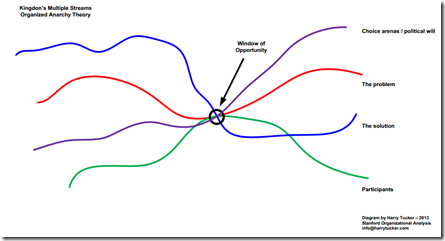
    Why does humanity, with its access to knowledge, idea frameworks, best practices and technology, still appear to be executing randomly, with poor execution still as likely as strong execution? I submit that John Kingdon’s organized anarchy theory (also known as garbage can theory) explains this supposed randomness perfectly. I also submit that in understanding this apparent randomness that perhaps some of the randomness can be strategically removed to produce a better result.

    In his book, Agendas, Alternatives and Public Policies[i], Kingdon suggests that one can recognize an organized anarchy as having the following characteristics:

    • Ill-defined goals, problematic preferences and inconsistent identities
    • Unclear technology
    • Fluid participation
    • Independent streams of solutions, problems, participants, and choice arenas

    The difficulty with such characteristics is not so much the existence of them but rather who defines them.

    For example, if a business or government leader has specific goals, someone who has conflicting goals or intentions might characterize the others as having ill defined or problematic goals. The technology within the problem domain may be clear to someone with expertise in that domain but may be unclear to others who have experience with different (not necessarily superior or inferior) domains.

    When one thinks about the independent streams that Kingdon describes, it almost appears totally random as demonstrated in the attached diagram (click on the image for a higher resolution image).

    Kingdon Theory

    The diagram demonstrates the “Holy Grail” that comes into existence when all of the streams come together – the opportunity to create public policy or make decisions by governments or businesses respectively. Unfortunately, the diagram also suggests a significant amount of randomness present that makes such a Holy Grail elusive.

    Some might suggest that one can simply observe progress along the different streams and prepare to execute as they coalesce, thus removing randomness from the process. Unfortunately, the streams themselves are quite fluid, shifting constantly and so predicting a coalescing of the streams is not easily performed given that the intersection point itself is not static along each of the streams.

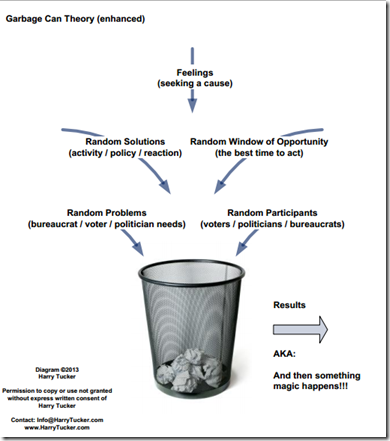
    In addition, I would like to add an additional stream to the mix, the stream being one of feelings, agendas or motives, both on the part of those whose execution will produce a result (represented as intention) and on the part of those impacted by execution (represented as expectation).

    Given that all of these streams coalesce into somewhat of a random collection of events, intentions, problems and solutions, I believe the multiple streams are more accurately represented as a true garbage can as shown in the attached diagram (click on the image for a higher resolution image).

    Garbage Can Theory

    What are the possible ramifications of such random execution?

    In a study conducted by Kathleen Tierney of the Disaster Research Center at the University of Delaware[ii], Ms. Tierney posited that:

    “Of the four key disaster phases or management tasks (mitigation, preparedness, response and recovery), mitigation has been studied the least (Drabek 1986a) and is probably the least well understood.”

    She went on to say that hazards to government and business that could be avoided but which are not are as the result of:

    “Being at the ebb and flow of public and elite interest, and many alternate strategies, including various mitigation approaches, are available to deal with them”.[iii]

    This suggests that disaster avoidance within government and business is almost totally random at best unless an equally random opportunity to address the problem arises.

    Alesch and Petak, in their study “The Politics and Economics of Earthquake Hazard Mitigation” [iv], noted the following:

    “Windows of opportunity are essential for hazard mitigation policy to be enacted. Windows can be pried open with enormous continuing effort but they open automatically in the event of a low probability / high consequence event that demands community attention.”

    In other words, the best time to come up with policy decisions within an organized anarchy seems to arrive after a similar disaster has already occurred. This is cold comfort to those who have lived through the previous disaster. It is also complicated by the fact that even when the perfect window has arrived, it must be executed within constraints that exist at the moment in the areas of time, energy and money before the political will fades or the opportunity is diverted to some other perfect coalescing of the streams as described by Kingdon.

    If we zoom in on governments for a moment, this problem is exacerbated with the knowledge that the problem or opportunity participants form three distinctive camps with three different sets of problems, solutions and expectations:

    The electorate – wanting good schools, hospitals, roads and other infrastructure and wanting it immediately. Electorate needs are often immediate and of short-term duration, with voters tending not to look at the long-term picture.

    The politician – wanting to serve their constituents as well as possible (hopefully true but not always) with their primary focus still being on getting re-elected in 4 years (or whatever the term of office is). Their focus on getting re-elected makes their horizon medium term in duration, acknowledging their electorate’s needs while recognizing that a single term in office may not be sufficient to answer to those needs (or their own needs in some cases).

    The bureaucrat – wanting to execute their long-term strategic intentions without interference (and sometimes knowledge) of the electorate or the politician. This reflects a long-term need, often seeing strategy in 20-year windows or longer.

    The difficulty of such a partnership is shown in the attached diagram (click on the image for a higher resolution image).

    Coalition Theory

    So the question becomes this:

    If the results of our governments and businesses are in fact truly the random coalescing of all of these streams, representing the dark complexity of organized anarchy, what can we do to avoid an inadvertent total disaster that must be statistically inevitable if our execution is reduced to luck?

    I posit that we need a more strategic approach to nullify the randomness that is so well-described in Kingdon’s organized anarchy theory. This strategic approach would have an almost “return-from-the-future” type effect that provides the strategy practitioner with an opportunity to understand the streams as they played out in the future and to work backwards from the end of the streams to identify where the coalescing actually took place.

    While a “return-from-the-future” effect exists primarily in the realms of H.G. Wells or Hollywood, I believe there is a way to be accurate in predicting the outcome from random participants, problems, events and the like.

    It is through the use of a process called backcasting.

    Backcasting is defined as:

    “Defining a desirable future and then works backwards to identify policies and programs that will connect the future to the present. The fundamental question of backcasting asks: "if we want to attain a certain goal, what actions must be taken to get there?" Forecasting is the process of predicting the future based on current trend analysis. Backcasting approaches the challenge of discussing the future from the opposite direction.”[v]

    The attached diagram illustrates a high-level mind map of backcasting (click on the image for a higher resolution image).

    Backcasting

    In the process of executing a backcasting process, one attempts to define a future state as having already occurred and then stepping backward, asking one’s self what has to have happened before the current step in order for the current step to occur. With the previous step defined, one then asks what has to have happened prior to that step in order for the previous step to have occurred and so on until one reaches one’s current state with its collection of participants, problems, solutions and other entities as defined by Kingdon.

    The process of backcasting allows the strategic observer to remove the mystery from a future event by forcing the understanding of all the resources in play; knowledge, money, interdependencies and the most seemingly random resource of all, people. It forces the strategic observer to understand the motivators, intentions, intelligence, knowledge and other elements of the participants and in doing so, takes much of the randomness out of the equation.

    How effective is such a process?

    In March of 2008, the author of this paper, as a long time Wall St. strategy advisor, wrote a blog warning of the coming financial collapse in September of 2008. The blog, entitled “Financial Crisis[vi], publicly identified when the collapse would occur and named the two financial institutions, Lehman Brothers and Merrill Lynch, that would disappear as a result of the event. Financial institutions who foresaw the crash and who read blogs such as this one protected their assets while many people and organizations lost everything.

    Meanwhile, in the months leading up to the crash, groups such as the US Federal Government and other organizations were predicting that the nation was on the cusp of greatness.

    For example, on February 28, 2008, MSN’s real estate column wrote that “now” was the perfect time to buy into real estate[vii] , encouraging young people and renters with this line:

    “Sliding prices and desperate sellers may seem to make this the perfect time for young renters to buy their first home.”

    The Insurance Journal released a study on July 23, 2008 entitled “US Entrepreneurs More Optimistic on Taking Risks”[viii], where they noted the following outlook on entrepreneurs and business:

    “Overall, their outlook is very optimistic,” added Donnelly. “People are choosing a new path of self-direction and welcoming what lies ahead.”

    Less than two months later, most of these businessmen were wiped out.

    And finally, the New York Times on January 23, 2008, quoted[ix] then Secretary of State Condoleezza Rice when she described the US and global economy this way:

    “Its long-term economic fundamentals are healthy,” said Secretary of State Condoleezza Rice of the United States in a speech Wednesday at the World Economic Forum. She declared that President Bush had provided an “outline of a meaningful fiscal stimulus policy.”

    The author of the New York Time article closed the article with this prophetic quote:

    “As I write this, her speech is continuing, uninterrupted by applause.”

    Months later, we experienced the worst economic collapse in world history with its remnants still affecting us today.

    Having sat in many Wall St. and government meetings in the months and years leading up to the events of September 2008, Kingdon’s organized anarchy theory was prevalent everywhere. We were plagued by agenda-less meetings that invited people for no other reason than to make it look like they were contributing to “something”, even though without an agenda, why many people were present was a mystery to all of us and without a problem being defined (the pending crash), their contribution was unknown anyway. We executed meetings daily in blind denial of the events that were unfolding.

    In the end, some of us recognized that garbage can theory in its purest definition was alive and well, but unfortunately, critical deadlines were approaching that the participants in the garbage can seemed unaware of or uncaring about as they focused on personal agendas that were meaningless and trite (and would mean nothing once the economic collapse arrived).

    It was because many of us recognized that garbage can theory was in fact leading us blindly to the abyss that we switched to backcasting theory to predict the time, scope and scale of the pending event, factoring in the same elements as Kingdon describes but doing so in such as way as to remove as much of the randomness as possible.

    In other words, garbage can theory will eventually produce a result but sometimes one has to take the randomness out of it using other theories when critical deadlines appear on the horizon.

    By taking the key elements of garbage can theory, namely,

    • Ill-defined goals
    • Unclear technology
    • Fluid participation
    • Independent streams of solutions, problems, participants, and choice arenas

    and my optional additional element of feelings, agendas and motives and evaluating them strategically using a process like backcasting instead of leaving them to the randomness of the garbage can, one has a better opportunity to make policy or business decisions that are more appropriate, more timely and more effective to the people they serve.

    More organizations are recognizing the importance of finding time-sensitive solutions and are embracing the less random, more accountable results from backcasting, including but not limited to[x]:

    • fms - The Division for Environmental Strategies Research, Royal Institute of Technology, Sweden
    • Global Scenario Group
    • Institute for Sustainable Futures
    • The London Perret Roche Group LLC
    • Pacific Institute
    • POLIS Project on Ecological Governance
    • POLIS Water Sustainability Project
    • Tellus Institute - environmental research group that uses backcasting to develop strategies for sustainability
    • The Natural Step
    • Sustainability department at the Blekinge University of Technology
    • Transport Studies Unit, University of Oxford, UK

    Unfortunately, finding solutions to the challenges from garbage can theory increase public accountability and responsibility, something that often contradicts with the public intentions of businessmen and politicians. I wonder if this is why we still prefer the randomness of garbage can theory when more effective practices exist.

    Only the writers of our history books will know for sure.


    References (some links may be stale)

    [i] Kingdon, J. W., Agendas, alternatives, and public policies, second edition, Pearson, 1995, Print

    [ii] Tierney, Kathleen J., Improving Theory and Research on Hazard Mitigation: Political Economy and Organizational Perspectives (pp 367), International Journal of Mass Emergencies and Disasters, November 1989, Vol 7, No. 3, Print

    [iii] Tierney , Kathleen J., Improving Theory and Research on Hazard Mitigation: Political Economy and Organizational Perspectives (pp 385), International Journal of Mass Emergencies and Disasters, November 1989, Vol 7, No. 3, Print

    [iv] Alesch, Daniel J. and Petak, William J., The Politics and Economics of Earthquake Hazard Mitigation: Unreinforced Masonry Buildings in Southern California, University of Colorado – Institute for Behavioral Science – Program on Environment and Behavior Monograph #43, Print, 1986

    [v] Widipedia, Retrieved from URL http://en.wikipedia.org/wiki/Backcasting on November 8, 2013

    [vi] Tucker, Harry, Financial Crisis, Harry Tucker – Observations and Musings, Retrieved from URL http://harrytucker.blogspot.ca/2008/03/financial-crisis.html on November 8, 2013

    [vii] Editor, February 28, 2008, MSN Real Estate, Retrieved from URL http://realestate.msn.com/article.aspx?cp-documentid=13107821 on November 10, 2013

    [viii] Editor, July 23, 2008, The Insurance Journal, Retrieved from URL http://www.insurancejournal.com/news/national/2008/07/23/92136.htm on November 10, 2013

    [ix] Editor, January 23, 2008, The New York Times, Retrieved from URL http://dealbook.nytimes.com/2008/01/23/entering-a-no-gloom-zone/?_r=0 on November 9, 2013

    [x] Wikipedia, Retrieved from URL http://en.wikipedia.org/wiki/Backcasting on November 8, 2013