Showing posts with label question. Show all posts

Tuesday, November 12, 2013

Canadian Healthcare–Villains Amongst the Heroes

Who is to say who is the villain and who is the hero? Probably the dictionary. - Joss Whedon

Of the many gifts that my parents gave to me when I was young, two stand out.

From my mother, I received the gift of reading and the insatiable need for constant knowledge acquisition.

From my father, I received the gift of constantly asking questions, the need to understand the “why” of things and the need to never stop asking until I was satisfied with the answer.

Both gifts came together suddenly on Saturday past when my father was admitted to hospital in Eastern Canada in septic shock and renal failure.

It turns out that he was suffering from a retroperitoneal abscess, a massive, internal pus-filled infection that has a 75% mortality rate.

Thanks to the healthcare practitioners who quickly and correctly diagnosed this condition, my father is now recuperating, fortunate to be in the 25% and not the 75%.

I am very grateful to them for their quick thinking and the result.

But as my father taught me, after an event occurs it is important to understand why this happened so that it doesn’t happen again to my father or to anyone else.

Blame is not important but prevention is.

So a little due diligence produced this interesting trail of events.

Retroperitoneal abscesses are caused by a number of things including infections introduced via hospital procedures such as routine diagnostics or surgeries.  They are also caused by bleeding within the body, including bleeding from ulcers or micro ulcers.

A little extra digging revealed the fact that my father was on an anti-inflammatory medication for 17 years as a preventative measure against a bout of arthritis he had suffered years ago.

That’s like taking aspirin for 17 years on the off-chance that you might get a headache at some point.

I spoke to a couple of doctors about the use of this medication for this long as a preventative measure and they told me that it is simply not allowed.  One doctor, when I described the use of this medication for this long, replied with one phrase, that being (and forgive the language) “Holy Shit”.

One of the interesting by-products of this medication even in short-term use is the potential for the creation of micro ulcers and bleeding and the risk is especially heightened in the elderly.  For this reason, monitoring for bleeding is required although in my father’s case, no such monitoring was performed.

Hmmmmmm …. the plot thickens.

The documentation accompanying the medication indicates that it must be used in the minimum dosage possible and for as short a duration as possible.  I wonder what the risks are from taking it for 17 years.

Exploring the doctor’s background, one quickly learns that he:

- sought to put a 20 year old male on valium to slow him down because “he works too hard”

- once put a 22 year old male on Dolobid, Feldene and Orudis (all anti-inflammatory medications used for the treatment of osteoarthritis and / or rheumatoid arthritis) and aspirin simultaneously upon receiving complaint of a sore back and without any further testing to justify the use of the medications

- sent the same young male to the hospital a short time later with the diagnosis that he was having a heart attack (he turned out to be fine although the medical team that had been alerted weren’t too pleased with the doctor).  There are known complications from the previously named medications and heart and stroke risk although the connection was never made or explored.

- told a mid 40’s patient after placing him on cholesterol treatment medication that it would be easier to treat the patient if he weren’t an alcoholic.  The patient, a non-drinker, discovered that the initial baseline liver test that is required for this medication had not been performed and the subsequent liver test for monitoring abnormal medicinal impact indicated that the liver was seriously malfunctioning (a known side effect of the medication).  Without a baseline, the doctor was blaming it incorrectly on the lifestyle of the patient and the liver function returned to normal when use of the medication stopped.

- told a female patient that the pneumonia scars on her lungs as seen in a chest x-ray were in fact the signs of lung cancer and that treatment for such was imperative.

People are still emailing me their stories.  I think these are sufficient and are verifiable with doctor-written reports, hospital reports and prescriptions.

So, as a strategy guy who asks a lot of questions (thanks, Dad – it’s all your fault), I look at past performance as a predictor of current / future behavior.

And what I see appears to be much more than coincidence.

All that being said, we must not forget  ……………..

The Canadian healthcare system is filled with many heroes, people who go above and beyond to treat an incredibly diverse collection of diseases and injuries with ever-tightening constraints in the resources that they have access to.

Such are the heroes who saved my father’s Life this weekend and I am grateful to them.

In fact, I believe all Canadians should feel grateful to have such a healthcare system, one of the best in the world.

However, it is doesn’t help the heroes when there are doctors who are actually introducing patients into the system through carelessness or negligence that probably shouldn’t have been introduced in the first place.

Maybe a prescription of litigation such as is used in the US might cure the system of what ails it.  I’m don’t know as I’m not sure if the pandemic of litigation sweeping the US is actually solving anything or just making everything more complicated.

Meanwhile, the Canadian system won’t get better if we refuse to question the actions of a few bad apples merely because we don’t want to offend the heroes in the system, because we are told that we shouldn’t question anyone with more knowledge or authority or because we are told that we should feel so grateful for the entire system that to question anything is to be expressing a lack of gratitude for everything.

And it won’t get better in cases like my father’s when doctors will privately admit that this doctor made mistakes but will not admit so publicly for fear of losing their own jobs.

The bottom line …..

The best way we can help the healthcare system and ourselves is to follow the advice of my parents when they imparted these two key elements upon me many years ago:

1. Learn all that you can – in this case, about your health and any treatment options that a doctor insists you follow

2. Don’t be afraid to ask questions until you’re satisfied, even if it means offending someone.  A good doctor will welcome questions and dialog.  Open dialog brings knowledge and understanding, both of which strengthen the relationship and the results.  Only the weak-minded or those with something to hide will get angry or defensive when the opportunity for dialog arises.  Either are a warning that perhaps a second opinion should be sought.

I was raised to always be respectful of doctors and I am, recognizing the incredible knowledge that many have, the constraints that they work within and their raison d'être, their desire to heal others.

But I think one can have the deepest respect for someone and still not be afraid to ask questions of them.

What do you think?

My questioning continues …..

How about yours?

In service and servanthood,

Harry

Wednesday, September 4, 2013

The Voice of the Rebel

“People are afraid, very afraid of those who know themselves. The masses do not want to be disturbed even though they may be in misery.” – Osho

“Yeah with one foot in the grave and one foot on the pedal, I was born a rebel” - Tom Petty “Rebels

I ask a lot of questions.

People who know me know that my two favorite questions are “Why?” and “How do you know?”. 

I have mused about questions, the need to ask them, how to ask them, etc., many times, including but not limited to the following posts:

Improving the Result

Facts –The Downfall of Many Dreamers

Asking Questions That Get Answered

The Most Important Question of All

Solving Mysteries–The Direct Approach

If My Question Offends You ….

If You Can’t Explain It, Don’t Do It

The Secret of the “Soothsayer”

What Do You Stand For?

Solving Puzzles–Follow the Breadcrumbs

Ouch …. that is only a partial list.  I didn’t realize that I wrote about this subject THAT many times. :-)

I don’t just ask these questions of others.  I ask them of myself …. daily … oftentimes hourly … sometimes more frequently and with far greater intensity than the manner in which I ask others.

I have discovered that when one asks a lot of questions, it makes a lot of people nervous, especially if they have something to hide or they have been asking the same questions but the answer is eluding them.  You always know that something is amiss when the mere existence of a question angers or frightens people.

I remember getting in some hot water on Wall St. once when I pointed out that a particular server, which was required by law to never be allowed to fail, had no source of redundancy at all.  I didn’t realize it had no redundancy but by asking if I could see the redundancy built into the architecture, I created quite a fuss.  The response was almost like “ Alert. Alert. The new guy has dared to ask the forbidden question.  Which is easier – fixing the server or killing the new guy”.  It was close but I won the coin toss. :-)

My persistent asking of questions has produced a Life that I am filled with gratitude for.  In fact, the blessings that have filled my Life often cause me to ask questions about that also!  Ahhhh, the mind of the restless querent. :-)

It has also produced its share of complexities.

For example, I have discovered that ….

1. Musing about emergency preparedness and the importance of it gets you on the Department of Homeland Security’s official reading list (hi guys) merely for discussing it.  I wonder if that means that all Mormons are on their list also.

2. Musing about why a politician would take the action they took gets you investigated by the Department of Justice (anti-terrorism group), who later give you an all clear when they discover that no lines were crossed (I could have told you that in advance, guys). :-)

3. Musing about projects that my former father-in-law (a USAF colonel, now deceased) worked on also attracts some interesting “fans”.  Some are nutbars – some are seriously powerful people who don’t like such musings.  When powerful people reach out, it is not very pleasant.

4. Some business people who become nervous when too many questions are asked make it their singular focus to resist the people who are asking the questions.  Sometimes their business goes out of business as a result because they either wouldn’t answer the question or they turned their focus entirely on burying the question instead of answering it.

5. Related to the previous point, some people would rather see their projects fail than answer difficult questions or allow them to be asked.

6. Witness protection is not as exciting as it appears to be in the movies, for you or your family.

7. Once you pass 100 death threats, you learn to tell the difference between the credible ones (requiring law enforcement action) and the drive-by nutbars.

8. When you point out gaps in security (national security, airline or otherwise), a thank you or a correction of the gap is more appropriate than resisting or burying it.  Problems that are not solved outright always manifest later – usually larger, more impactful and more significant than when they were pointed out.  I-told-you-so’s when people’s lives are at stake bring no satisfaction.

9. Politicians who serve the people and not their own needs are becoming increasingly rare.

10. To not ask questions where people are always fearful that the unspeakable question will eventually derail them makes some people very paranoid.  It’s like the time I was working in a highly politicized environment and had a grievance filed against me for being too respectful.  Why such a grievance?  Because, as I was informed, when one is respectful in a difficult environment, it must mean that you are up to something and so you should stop being respectful immediately so as to allay further suspicion.  I mused about the event here.

11. According to one priest, God hates me.  Apparently the priest has a red phone to the Upper Chamber and issued this edict when I asked a couple of questions about God.  That was when I discovered that asking questions in certain faiths is not permitted …. ever.

12. Hiding behind reasons like “need to know basis”, “national security”, “I don’t need to answer because I am the expert here” or “just because” cause many more questions to be asked.

13. There are many people who, not having the courage to ask their own questions, prefer to prod others to ask questions on their behalf (it’s safer and lower risk for them), ride on the coattails of those with more courage or think that people who ask such questions lead exciting lives and should therefore be glommed onto to bring excitement into their own Life.  They are unnecessary weight that will only slow you down, distract you or get you into trouble.  PS – some are genuinely crazy.

There are many others I have learned but that’s the fun list.

Despite my passion, I play by the rules

The amusing thing is that while I ask questions for a living as a strategy guy, my musings here aren’t  meant to embarrass, reveal security gaps, highlight potentially illegal acts or anything else. 

My questions are always respectful of boundaries and I do my best to be respectful of the feelings of others.  That being said, some people will go out of their way to be offended or intimidated.  Others have massive egos or other issues that call them to defend against anyone who might be perceived as a threat.  I can’t help those people and make no apologies for the impact my questions have on them.

I tend to be pro business (I am a Wall St’er after all), pro government, pro military, pro democracy and the like.  I don’t subscribe to conspiracy theories, I have a strong sense of “live and let live” and I don’t make other people’s problems my own just for the fun of it.  I also don’t support or endorse people who think they are above the law nor do I believe that breaking the law to protest it is a viable option.

I believe highly in honoring confidentiality and respecting the principle of trust.  I don’t share things confided in me or protected by legal covenants – EVER.

I believe that things like national security, emergency preparedness and lifting / helping others are things that we all play a role in – not just the government.

I do not believe in violence but I don’t think that constantly turning the other cheek solves anything either because people take advantage of timidity and weakness.

However …..

I also believe that it is important to think and not allow others to think for you or to form your opinions for you in absence of facts and data.

Sometimes a question is asked innocently, with no knowledge that others fear the question and will despise the querent as a result.

Sometimes one is intrigued by a subject and merely wants to learn more.

And sometimes one sees the emperor walking down the street with no clothing on and while everyone else marvels at his “beautiful clothing”, one feels compelled to cry out and point out that he is naked.

And as a result, some people will cry foul or claim to be a victim merely because the question has exposed something that they would prefer to remain buried.

The ones who cry out the loudest are the ones who need to be examined much more closely.  I refer to this as the Vatican Effect (aka the Streisand Effect):

The more noise someone makes trying to hide or refute something, the more Life they give it, requiring a closer investigation as a result.

Dan Brown’s “The Da Vinci Code” would probably have  died in obscurity had the Vatican not set up a committee to investigate and stymie the popularity of the book.  Of course many people wanted to see why the Vatican would do such a thing and the rest is history regarding Dan Brown’s success.

It is not our right nor do we have the time to question everything

Many things are none of our business or are not on our Path of Purpose and so to question everything becomes a waste of time (both our time and the time of others) or an abuse of privilege.

But when we as individuals, groups or nations stop asking questions completely, we stop learning.

When you stop learning, stop listening, stop looking and asking questions, always new questions, then it is time to die. - Lillian Smith

My questions often come in the form of cranial defibrillators.  But those are the best kind of all as Martin Luther King Jr. pointed out when he said:

Rarely do we find men who willingly engage in hard, solid thinking. There is an almost universal quest for easy answers and half-baked solutions. Nothing pains some people more than having to think.

And so to the many on the receiving end of my questions, I am sorry to say I’m not dead yet. :-)

And yes, I am a rebel.

But in George Lucas’ world, the rebels are the good guys. :-)

What do you think of that?

In service and servanthood,

Harry

Tuesday, June 18, 2013

Psychokinesis and Cellphones–Understanding Cause and Effect

I’ve come across an interesting phenomena with my cell phone battery that I find to be quite intriguing.  As far as I can tell, the more pressure I am under, the faster my cellphone battery runs down.

If I were enterprising enough, I would engage in a government / university study to explore why this is the case and how widespread the phenomenon is.

If my study were to produce a result similar to the many that David Freedman documents in his great book Wrong, I would probably come up with one of the following as the reason for my hastened battery depletion:

1. When I am under pressure, my brain emits strong brainwaves that interfere with my cellphone, thus fouling the battery in some way.

2. When I am under pressure, my brain experiences an energy deficit and draws power from my cellphone battery.

3. I may be a member of a select group of people known as sliders whose very existence interferes with electrical / electronic components.

However, I might overlook the obvious cause of my battery depletion.

4. When I am under pressure, I fiddle with my phone a lot more, thereby running the battery down.

As in this example, using exotic hypothesis to explain away our problems often sound a lot more exciting than the actual problem  definition and therein lies a problematic temptation.

In such situations, a deliberate or accidental misinterpretation or over-complication of cause and effect often lead to the creation of projects that appear to be more glamorous, challenging or resource intensive than is warranted or projects that are a lot more frustrating than they should be. 

With that in mind, people either happily run off in the wrong direction to solve the wrong problem without giving it a second thought or remain mired in “why isn’t this working better” syndrome.

Either scenario could be avoided if the people holding the problem stopped for a moment and asked the right questions, using the right data to answer those questions.

Some examples from my journey

a. A local church, while lamenting the fact that only 10% of their parishioners attend service on a regular basis, wonder what’s wrong with the people who are not attending instead of asking themselves what they can do to attract more people.  The church is suffering financially as they wait for the other 90% to magically come to their senses and start attending weekly service.

b. A business entity that is running a project with two agendas, a public and a private one, that are diametrically opposed to each other and create confusion as a result.  Despite the obvious issue of the conflicting agendas, the leaders constantly express high levels of frustration (and anger) that their team members and the user community always seemed confused for some reason unknown to everyone.

c. A certain charity whose leadership staff members make over $250K each per year and yet they can’t understand why more people don’t want to work for free for such a great community-minded charity.  They are blind to the conflicting message being sent out of deep coffers for internal staff versus an impoverished, barely-getting-by charity status that is projected to outsiders.

While it’s easy to quote Occam’s Razor in these and other situations, the belief that all thing’s being equal, the simplest solution is most likely the right one, the truth is that the real answers can be found in being able to ask the right questions … or allowing an objective observer to ask the right questions.  As an aside, I mused about “Asking Questions That Get Answered” here.

Having allowed the difficult questions to be asked, the second part of the solution is to put one’s ego in check long to enough to listen to the dialog that ensues.

That’s when the real breakthrough occurs.

Now if you will excuse me, I’ve noticed that as my current deadlines approach, my cellphone appears to be levitating about a foot above my desk.

It must be the draft blowing in from the window.

In service and servanthood,

Harry

Tuesday, April 30, 2013

Asking Questions That Get Answered

Many people approach me seeking guidance as to why their questions never get answered to their satisfaction (if answered at all).

As a strategy guy, I’m not a fan of asking questions merely for the sake of asking them nor am I a fan of randomly asking more questions when I don’t find the answers I seek.

I ask questions because I seek knowledge, context or something else that matters to me.

And because it matters, I am cognizant of the importance of the following attributes that a question must honor.

1. Is the right question being asked?
2. Is it being asked in the right way?
3. Is it being directed towards the right person(s)?
4. Is it being asked by the right person(s)?
5. Is it being asked at the right time?
6. Is it being asked with the right intention?
7. Is there a preconceived answer before the question is even asked?

To not honor these fundamentals for a successful question (and thus a successful answer) is to not truly care whether the answer is accurate, timely or even delivered at all and thus leaves one’s results (personal and professional) to chance.

I personally don’t want to leave my Life results to chance.

Do you?

I doubt it.

When it comes to asking questions, more is not necessarily better.  Context, content, delivery, timing and appropriate participant identification is everything.

To not care about this produces as much value as the question:

Are we there yet?

Questions like “why?”, “how do we know?” and others are critical to success.  I once mused that the question “why” is The Most Important Question Of All.

But questions only produce value when we know how to ask them.

Otherwise, you will not receive the desired result you seek OR someone else will ask the same question at a different time, of a different individual or in a different way and produce a result that honors them and not you.

The same rules apply when it comes to offering ideas that are accepted by others, as cleverly shown in the following FedEx commercial.


Do you really care about the answers that your questions are producing?

Are you sure?

Because if you really care, then you will pay more attention to how your questions are asked (or your ideas are offered) in the first place.

In service and servanthood,

Harry

Saturday, July 21, 2012

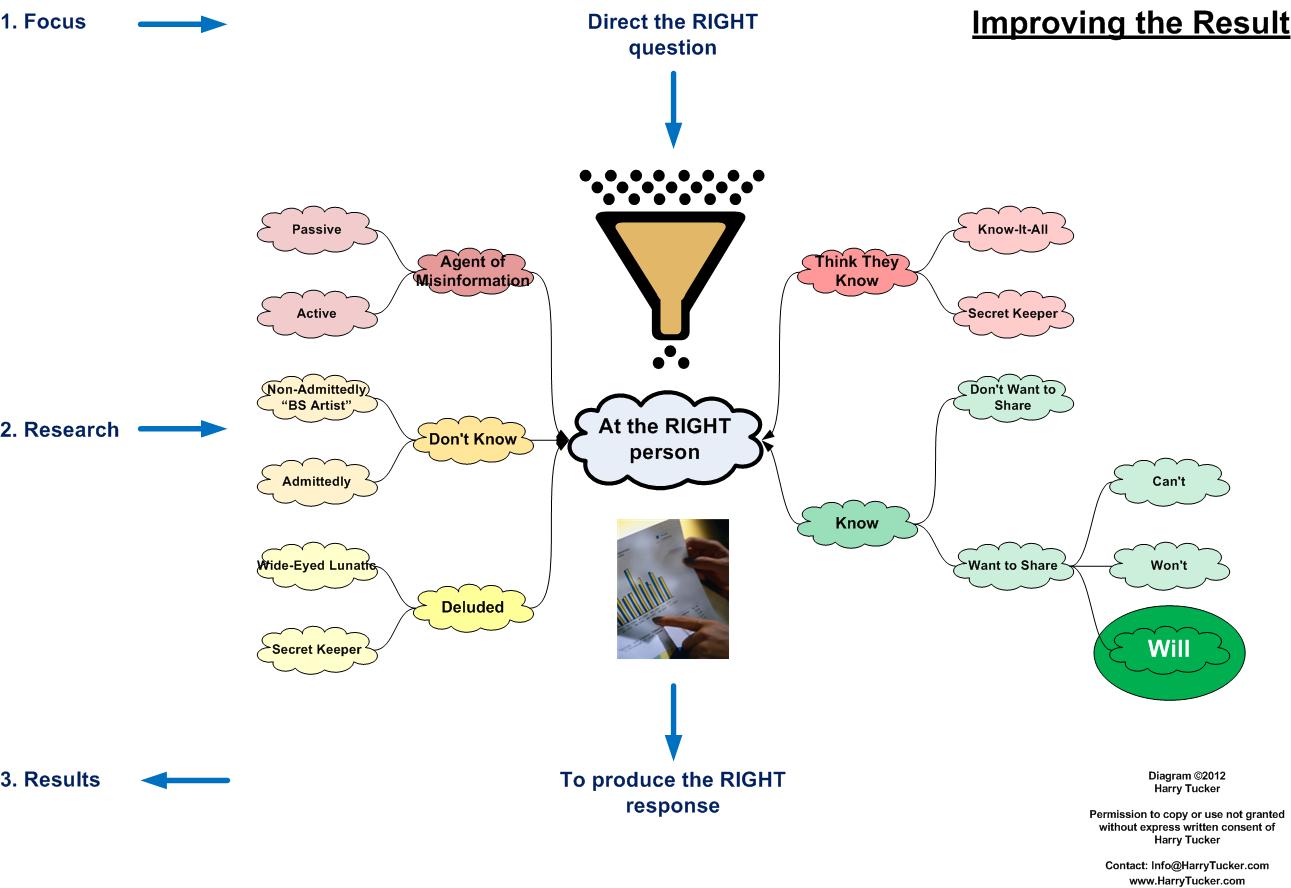
Improving the Result

A colleague of mine the other day was trying to solve a difficult problem with a lot at stake and he was really struggling with why he wasn’t producing the desired result.

In exploring this with him, two things became apparent.

1. In trying to solve the problem, he was not asking the right questions.

2. In asking the questions, he was not directing the questions to the right people who could really help him.

In fact, by not caring if he was directing the right questions at the right people, he has as good a chance at hitting upon a solution as if he consulted one of these:

or one of these:


If one wishes to find a result that meets their needs and expectations, it’s better if one considered a formula similar to the following (click to enlarge):

image

Knowing how to direct the right question to the right person can mean the difference between an answer that looks like this:

or this:

When your reputation, your success, your business, your family or your life depends on it, I think taking the time to do the right thing, the right way, right now is worth it.

Well, it is if you care about the result.

What do you think?

In service and servanthood.

Harry

Addendum

While this was written mostly tongue-in-cheek, a more detailed analysis of this subject can be found here.

Asking Questions That Get Answered

Solving Puzzles–Follow the Breadcrumbs

Friday, July 6, 2012

If You Can’t Explain It, Don’t Do It

I was intrigued but not surprised to see Microsoft’s recent $6.2 billion write-down of its 2007 acquisition of aQuantive.

I was a senior enterprise strategy advisor with Microsoft in 2007 when it acquired aQuantive, a then-premium name in the digital marketing service and technology space. While the deal was being consummated, the rank and file were all ecstatic about how this acquisition would enable Microsoft to catch up and potentially leapfrog Google’s advertising-driven revenue model.

As a strategy advisor and technology architect, I am motivated less by emotion and more by measurable outcomes.

In essence, what matters to me is “How do you know?”.

And so while everyone kept telling me how wonderful this deal would be for Microsoft, people could not give me a single piece of measurable data  that backed up their excitement.

Emotion ruled the day and I was left wondering what such an investment would produce.

It turns out that it didn’t produce much at all.

While this write-down doesn’t hurt Microsoft’s stock price, it’s a reminder to others that if you can’t explain what the reason is for doing something then you may be better off not doing it.

If you can’t explain it, there’s a good chance you don’t understand it.  If you don’t understand it … well … why are you even bothering or better yet, why are you risking the resources and future of others with your lack of understanding?

Sadly, there are a lot more bad business ventures out there than we would like to admit that cannot explain why they are doing what they are doing or why they are doing it the way they are doing it.

And even if one has an answer, we should always be prepared to submit it to scrutiny, to either strengthen the approach or allow people to bail out before too many people get hurt.

The worst scenario I ran into in this regard was a company burning through tens of millions of dollars without a shred of strategy or a plan of any kind.

Why?

Because, according to the owner, having a plan is an insult to God and His plan to guide these people to ultimate success.

Unfortunately, his investors don’t know that his plan is to have no plan.

Those investors aren’t asking enough questions either.

When it comes to not asking enough questions, not asking the right ones or not submitting one’s self to appropriate outcome-focused scrutiny, companies like “the Big M” can survive an occasional write-down on a huge scale when mistakes occur.

The question is ….

…. how many can you survive?

And when people like me come along asking questions or making observations that may make you feel uncomfortable, there may be a reason for the discomfort that is worth exploring.

It may be an invitation to strengthen why you are doing what you are doing and how you are doing it ….

…. but only if you’re open to exploring it

…. if not, you may be this guy.

image

Denial or in some cases, outright ignorance, are not a platform for success.

If that were the case, success would be easier to manifest and a lot more common.

In service and servanthood,

Harry

Monday, January 9, 2012

When In Doubt, Ask - The Answer May Surprise You

I found myself in a difficult situation over the weekend, wondering how to respectfully, professionally resolve an impasse that was holding a project back from its true success potential.

As I was mulling over this impasse, I received an interesting email.  I’ve changed the private information.

Hi Harry,

My name is “C”, I live in “State” - last September 11th, our daughter and my mother went to see the San Francisco Giants play in SF. As a tribute they gave each person at the stadium a 9/11 Remembrance Poster with someones name on it that was killed on 9/11. My daughter received Narender Nath's. I've been doing some digging and it appears that you knew him. I'm hoping you could help me find an address for his sister, who has posted several messages on various websites.

We framed the poster and it has become a permanent picture on our wall in our mountain home. I had taken some pictures of the poster and was hoping to send those pictures to his family (from “State”). Not only is it hanging on the wall, but I've printed off his obituary, etc. and it is a conversation piece for all who visit. I guess it's our memorial from 3000 miles away.

Thanks you for your time.

Sincerely,

“C”

I have written about Narender many times, including in this blog entry.

The timing of this email intrigued me.

Narender was a man of high ideals who believed in the power of doing the right thing, even when it was painful or difficult.  He believed that corrective action delivered with respect trumped ignoring the need to do so just because one didn’t want to hurt someone’s feelings or make waves.  He knew how to deliver such action in a way that was respectful to all, with an eye towards long-term win/wins above short-term pain avoidance.

As I contemplated this email, my thoughts turned to Narender, replaying many of our shared times in my mind and as I did so, I could almost hear Narender counselling me about what I should do in my current situation.

I followed the advice I believe he would have given me.  Who knows where it will go but I did the best I could, with respect to others and with a mutual long-term win as the center of my proposal.

Some people will think that an email like the one above is creepy or inappropriate.  They may wonder why someone would bother to frame the poster of a complete stranger on their wall.  They might also think that the idea that this email could trigger a solution to my problem would be absurd.

Others might see it differently, thinking it intriguing or moving that someone who is no longer with us can impact a complete stranger in such a powerful way or help someone solve a problem without actually being here to help solve it.

Personally, I believe in the latter.

Narender always had a positive influence on everyone around him.  Even more than 10 years after he was taken from us, he continues to have such an influence, a testament to the legacy of a man known for the hearts he touched.

At a moment when I was asking no one in particular about how to deal with a difficult situation, an answer appeared. In addition to that answer, two strangers have been connected and have an opportunity to positively influence each other.

That’s just like Narender – always looking for a way to help others.

Which begs the question …….. was this email:

coincidence or random chance?

a supernatural connection?

a result influenced by the Divine?

Do any of us really know?

More importantly, does it really matter?

Or is it more important to be cognizant of our Life legacy and the impact that we have on others, including those we have not seen in a long time or may never have met at all?

I know what Narender’s answer would be.

In service and servanthood,

Harry

Here is a copy of the poster that “C” is referring to.

IMG_4175

Thursday, April 21, 2011

If My Question Offends You ….

As a long-time strategy and global technology adoption architect, my opinion is often solicited, whether it be by a start-up, a not-for-profit, a Fortune 25 company or anything in-between.

Fortunately (or unfortunately) for the people who solicit my help, I am known as the “asker of audacious questions”. 

People come to me expecting to ask a lot of questions, get a lot of answers and move on.

However, many are surprised that I often have more questions for them than they have for me and if they are unprepared or have weak egos, they will be offended by them.

There is a little secret about why I ask so many questions.

It’s not an attempt to assert one person’s intelligence over another.  We are all gifted in intelligence in different forms.

It’s not an attempt to embarrass them, create a contest of wills or play ego-Olympics.  What a waste of time and energy that is.

Frankly, I find everyone’s ideas fascinating.  I am curious to know if you find your own story as compelling and based on reality as you would like me to believe it is.

However, the most important reason I ask so many questions is because I believe, as I learned from Gerald Weinberg’s writings many years ago, that when people come seeking advice or a solution to a problem, often they as the subject matter expert actually have within their mind the very solution they hope to obtain from someone else’s mind.

Mr. Weinberg posited that if one listens carefully, the owner of a problem will actually state the answer in the first five minutes of dialog.  Mr. Weinberg named this rule …. gasp … wait for it … The 5 Minute Rule.  It is brilliant in its simplicity.

Of course, the owner of the problem is so buried with mental baggage that they can’t see the answer.  The people they approach for help are often so focused on proving that they are the “right person for the job” that they don’t hear it either, since in an effort to demonstrate intelligence or qualifications their own voice drowns out the person asking for help.

However, if the right questions are asked, probing the mind of the person with the problem and one listens carefully to the answers, the solution often presents itself.

People like me don’t just help others find a solution.  Often times they had it within themselves – they just needed a little help finding it, bringing it out and expressing it.

Asking appropriate questions provide an opportunity to explore within another, the strength of an idea, the thoroughness of the foundation that converts the idea into a result and the willingness of an individual to collaborate in making the idea into a reality. 

It is also an opportunity to assess how strongly someone feels about their willingness to do whatever it takes to make their dream come true.

If they get offended by a question, there is a good chance that they prefer not to deal with realities or that their ego doesn’t want to acknowledge that they may need some help.

For those people, being offended by simple questions should sound an alert that they are either not prepared for success or hungry enough for it.

And so if my question offends you, forgive me if I tell you that I won’t apologize to you. 

If you are offended,  you, me or both of us may have been saved from a disaster.

Maybe ……. unless you choose to go somewhere else where you hear what you want to hear and not what you need to hear.

Unfortunately in those situations, reality is a persistent beast.  It tells us what we need to hear repeatedly until we get it.

Or … if we ignore it too long … it gets us.

But then, you already knew that … didn’t you? :-)

In service and servanthood,

Harry

My Musings-in-a-Minute version of “If My Question Offends You ….” is the same as this one and can be found here.

Wednesday, January 6, 2010

The Most Important Question of All

In all of my years of consulting, there is one question that I ask my clients. 

About 20% attempt to answer it.  Of that 20%, 20% of that group does a good job of answering it well.  The rest do their best and I commend them for trying.

The other 80% either say “because” (which is a non-answer), get frustrated by the question or simply don’t try to answer it at all.

It is a complex question after all, although deceptively simple in appearance.

If you can’t answer this question in regards to your personal and professional life, then little alarm bells should be going off in your mind.

If your organization cannot answer the question, then the organization is in trouble.  You may not see it yet but it is coming.

The question is:

Why?

Consider these examples:

1. Why do you believe you are here on this planet?

2. Why are you in business xyz?

3. Why does your organization exist?

4. Why do you believe your product is better than xyz?

5. Why do you believe you offer something that no one else has?

6. Why should this project that is important to you be important to anyone else?

7. Why did you consider this option when so many others were available?

8. Why do you think your teams are motivated? 

Seems like a simple question and yet when I put my strategy hat on and guide clients, it seems that this question gives them the most difficulty.

Consider this paraphrased conversation that I experienced about a year ago.  My responses are in italics.

______________________________________________

My product is the best product in space xyz.

Why do you believe it is the best product?

Because it is.

Have you performed due diligence against competitive offerings?

No – I didn’t need to.

Why not?

Because I know my product is the best product on the market.

Hmmmm.  Ok.  Let’s change direction.  Why does your company exist?  What need does it solve?  What is its purpose?

It exists to create and promote product xyz.

Ahh … I see (now I am getting nervous of the obvious circular reference here).  Why do you believe that such a need exists – what does your research tell you?

Well, I didn’t do a lot of research.  I know this from what I have observed and what I have been told.

Why do you think you can be successful with no market intelligence or competitive analysis?

I just know it.

Ok. Why would a customer buy this product from you?

Because my product does things that the competitor products don’t do as well.

Why do you believe this if you haven’t gathered any competitive intelligence?

Because I just know.

______________________________________________

Usually by now, they are getting agitated.

I never take their agitation personally.  I know that when the agitation sets in, the client is discovering that I have brought something to light that they already knew but didn’t want to admit or face up to.

After all, as Gerald Weinberg, author and consultant once said in “The Secrets of Consulting”:

“The Five-Minute Rule:

Clients always know how to solve their problems, and always tell the solution in the first five minutes.”

Can you answer the question of “Why”?

When you find that  your personal or professional life or perhaps the life of your organization seems to be stuck in a quagmire, can you honestly answer the question?

Do your answers stand up to close scrutiny?

If they do, good for you – you are on your way to eventually wrestling your challenges to the ground.  It may not be easy, but your eye is “on the prize” and this will keep you focused and moving forward.

If your answers do not stand up to scrutiny, take some time to explore this space.  Preferably allow someone to objectively guide you through this exploration.  This keeps your exploration honest and authentic and has the best hope of producing a better result.

If you can’t answer this question, you are only pretending to be moving closer to your personal, professional or organizational goals.

You will indeed get somewhere – it just may not be what you hoped for.

Why would you want this to happen?

Why would you allow this to happen?

Why indeed?

In service and servanthood.

Harry

For my Musings-in-a-Minute version of “The Most Important Question of All”, please click here.