Showing posts with label answers. Show all posts

Wednesday, August 26, 2015

Politics and the Mutability of Human Values

(aka Bad Government – It’s Your Fault)

The foundation stones for a balanced success are honesty, character, integrity, faith, love and loyalty. - Zig Ziglar

Honesty is the best policy - when there is money in it. - Mark Twain

Honesty is the fastest way to prevent a mistake from turning into a failure. - James Altucher

My recent exploration of the by-election in Calgary-Foothills and the potential embellishment of education credentials by one of the candidates in the blog post PC Party and Blair Houston–Isn’t Honesty Still the Best Policy? has generated thousands of emails, private messages and texts to me (not all kind, professional and positive, may I add) and the reaction caused me to think about the general election currently underway in Canada.

In regards to the afore-mentioned by-election and my expression of concern regarding the potentially dishonest representation of education credentials by a candidate, I was told by Party execs and some MLAs that the resume embellishment is known but that it is important that the candidate stay in the race anyway without a public correction since officially addressing the issue may damage his chances.

This suggests to me that the human value of honesty is mutable and wavering within these individuals, being something that can be paraded around when convenient / useful but which can be modified or ignored when required.

But when one explores the larger political scene, is it any different for any political campaign on a municipal, provincial / state or federal level?

We have national politicians in Canada espousing the importance of legalizing pot, sending blankets to refugees in Syria and the like but I don’t hear many voters demanding specific, explicit, measurable, verifiable details regarding the economy, climate change, ever-escalating healthcare / education costs, privacy versus protection (anti-terror) legislation and the like.

And even when a candidate rolls out a half-baked answer or solution to something, it is often full of holes, has no data to back it up and oftentimes has nothing to it at all.

And yet we blindly accept everything without asking the candidate “What are the real issues?  Why do they matter?  What is your solution?  How do you know?

And so political parties, politicians and their blind, Kool-Aid drinking minions continue to send us meaningless distractions which divert our attention away from the truth that most (not all) politicians are either ignorant, indifferent or incapable when it comes to serving the populace or creating solutions to the ever-growing list of “stuff” that needs to be addressed while it still can be addressed.

What does this say about politicians and political parties?

What does this say about us when, not if, we accept it?

Does such a stand on our part remove our right to complain when politicians let us down later, when we suddenly learn all over again that their values and ours, that our needs and their intentions, aren’t in alignment?

Why do we care more when the politician lets us down after being elected instead of caring more about the details regarding the candidates and their solutions / intentions before we elect them?

Why would we rather spend more time complaining after the fact instead of using our time productively during an election to produce the best government possible?

Why indeed.

The likely reason is that it is easier to blame someone else for the failures around us rather than take proactive steps to prevent them in the first place.

In other words, we are running short of personal responsibility when it comes to the issues that we face collectively and so it is easier to wait for the failure of someone else to manifest so that we can point a finger elsewhere instead of at ourselves.

The Bottom Line

Politicians rely on the apathy, indifference and ignorance of the electorate.

What does this say about them?

What does this say about us?

At what point will our apathy, indifference and ignorance produce a government that is actually incapable of solving our problems despite its best intentions because the problems are too large, varied, complex and interwoven?

Why do we tempt fate by potentially allowing such a scenario to be created?

Maybe we have already reached (or passed) that point and politicians have merely become feel-good, “the future is always bright” mouthpieces to serve their own needs and intentions, knowing that our needs are already unsolvable but selling us a bright future can satisfy their own desires.

Would you know the difference between promised solutions and realistic ones?

Would you bet your family’s security and well-being on your answer?

Do you care?

Are you sure?

How do you know?

It takes more than a vote to create a positive future.

It takes an intelligent, informed vote.

And last time I checked, there seems to be a significant shortage of those,

Because in the end, when ineffective, incompetent or dishonest politicians and governments are elected, it’s not their fault.

It’s ours.

In service and servanthood,

Harry

Tuesday, July 28, 2015

Too Many Questions–Not Enough Answers

Before you start some work, always ask yourself three questions - Why am I doing it, What the results might be and Will I be successful. Only when you think deeply and find satisfactory answers to these questions, go ahead. – Chanakya

I don't pretend we have all the answers. But the questions are certainly worth thinking about. - Arthur C. Clarke

The wise man doesn't give the right answers, he poses the right questions. - Claude Levi-Strauss

We have no right to express an opinion until we know all of the answers. - Kurt Cobain

The #1206 “fiction” series continues …


He stared at the mind map before him, an encapsulation of more than 45 years of unusual events in his Life and in the lives of people close to him.  For years he had sought answers to the mystery contained within these events and despite asking as many people as he could, their answers were fleeting, sparse, questionable and lacked any kind of supporting evidence.  As someone grounded in the 21st century who had built his entire life around information, he needed irrefutable data to accompany their answers and there was none.

He sought clarity to all of the events and so he had drawn a mind map to help him obtain the clarity.  After he had drawn it, he realized the enormity and complexity of the mystery.

“Now I see why this bothers me as it does”, he thought to himself as he stared at the mind map in front of him.

Mind Map

He allowed his eyes to roam randomly over the mind map as each bubble in the map triggered a memory for him.

He thought of the face he saw through his bedroom window when he was four years old.  The face was not human and stared at him coldly as the only thing between the 4 inches of space between himself and the face was the pane of glass itself.  He had leapt from his bed then and run for his bedroom door, screaming for his parents.  As he ran from his bedroom, he turned and looked towards the window.

The face stared at him unsmiling.

His parents went outside, searching around the house, but had found nothing.

Another bubble reminded him of the time he found himself getting out of bed in the middle of the night, looking through the window for “something” and seeing someone outside press up against the outside wall as if desiring not to be seen.  Suddenly, “others” were in the room with him and despite his struggles, proceeded to carry him outside through the closed window.

He woke up standing on the front lawn watching a group of lights retreat into the night sky.

Another bubble brought back a memory of driving down a highway in the rural town where he had grown up and as he came around a turn, he suddenly stopped his car when he thought he saw an accident blocking the road.  He was blinded by bright flashing lights and stopped quickly when he realized that a group of people were spread across the road and slowly advancing towards him.  They approached slowly and methodically and it wasn’t until he realized that someone was standing by his car that he became aware that something was wrong.  The figure beside the car started to bend down as if to look into the car window and his awareness of the event suddenly stopped.

He awoke two hours later parked on the side of the road and the “accident” and the people on the road were gone.

And yet another bubble reminded him of the night he and wife were sleeping with their newborn child asleep in the crib.  He had had a disturbing dream that night and over the course of breakfast the next morning, began to relate the dream to his wife and she interrupted him by completing the dream.  They were startled by the realization that they had both dreamt the same dream, of a group of “people” standing around their child’s crib while they were unable to get up and find out what was going on.  Later hypnosis would reveal that they both had experienced an event where they had been prevented from getting up by someone with its face in theirs telling them repeatedly “don’t be afraid” as “others” stood around their child’s crib for a reason unknown to them.

His eyes flicked randomly over the mind map again.

He remembered the time when his child was two and they were reading a Dora the Explorer book together.  For reasons unknown to him, there was an image in the book of an alien in the middle of the jungle and his child pointed to it, unprompted, and said “friend”.  He remembered with a chill that his child said “friend” every time the child saw that image.

And then about a year later, while reading that same book, his child pointed to the alien image and said “scary”.  Shortly after that, the child began having nightmares about “the invisibles” that came into their room to do “bad things”.  The child, while obviously frightened, could never remember details.

Then there was the time he was driving in the White Hills of New Hampshire about 11pm one midsummer’s night when suddenly the inside of his vehicle was bathed in an intense blue light.  Assuming that it was from a police helicopter above him, he looked through the windshield and couldn’t see anything nor was there anything shining a light in through any of the windows.  He also realized that the light inside the vehicle had no shadows, as if emanating from many sources simultaneously.  He shivered and thought, “I’ve been driving too long today – I need to find a hotel and get off the road.” and at that moment, the light winked out.  His wife slept in the passenger seat beside him, not stirring, and as he reflected on how fatigued he must be to be imagining such things, his son, sitting in the car seat behind him, asked in a quiet voice, “What was that blue light, Daddy?”

Another bubble brought back a memory of one morning when his child, at the age of four, came screaming into his bedroom that “an ugly man” was staring at him through his bedroom window.  He shivered when memory of that morning triggered another thought, that his child had experienced other unusual events at the same times in his Life and in the same order as he had when he was young.  He had never told anyone about them but had written them down.  He had checked them off one by one as his child experienced them in the same order.

He never told his child anything, preferring to observe rather than feed the potential imagination of a child who might make up things to make a father happy.

Their parallel lives and the shared events continued for years.

The mind map represented decades of a mystery that he had accumulated and that had accompanied his family wherever he went.

Unusual events, unusual dreams and even physical evidence left on his body that had been questioned and examined by doctors – all which yielded no answers to the many questions asked.

It tormented his mind – a mind driven to understand the “why” of things.

And yet no answers of any credibility came.

People offered theories of aliens, guardian angels, demons and practically everything else, each suggestion based on their Life experiences and their personal biases but to his frustration, were always presented without evidence to support their theory.  Some had suggested mental illness of some form or perhaps a brain tumor but opinions expressed by some of the best doctors in the arenas of psychiatry and psychology had strongly rejected any such suggestion.

And now he sat in front of his keyboard, burning with a desire to share his experiences while cognizant of the impact of possibly being lumped together with the mentally unwell, the faker looking to make a quick buck or the person whose life was so empty that they would do anything to claim their 15 minutes of fame.

He wanted nothing to do with any of them.

He only wanted answers.

Why had these things happened?

Why were they still happening?

Was his family in danger?

The bubbles on his mind map each contained a story – stories that ranged from the odd to the unusual to the terrifying.

The stories described events that had been experienced by others in addition to himself - events that intrigued him, frightened him, annoyed him and made him angry.

He had been frightened by it as a child but now he was concerned for the safety and well-being of his family.

And besides, he didn’t like mysteries in his Life.

Now this mystery burned in his mind, insisting on being shared and demanding to be solved.

He had no idea where to start.

And so he stared at his screen and wondered, “What do I do now?”

To be continued.


© 2015 – Harry Tucker – All Rights Reserved

Background

This piece of “fiction” actually describes personal experiences that I have lived with for my entire Life.  What is the origin of the events described here and the many other events not described?  I have no idea.  Many suggestions have been made as previously noted – I have dismissed them all without data and had my sanity corroborated by people who know more about such things than I do.

I have subjected myself to hypnosis which terrified those present during the session.  I have no recollection of the events described in the session but occasional flashbacks from the session have not been pleasant.

I have subjected myself to analysis by some of the best minds in the psychiatry / psychology industry and all have come to the same conclusion – I am normal (whatever that means), have no physical or mental illnesses of any type and they believe that I have experienced the events as I described them.

Why I am sharing these events now?

Again, I have no idea – perhaps my mind believes that someone out there can provide the data that answers the questions I have asked for decades.

Perhaps my sharing will help others understand that they don’t need to hide from others who suggest that they have lost their mind.

And maybe it just feels good to get it off my chest.

Or maybe it’s all of the above.

Some have told me that it takes great courage to share such a story.  Maybe although I disagree.  Why is courage required to share a personal truth when many people fill the world with negativity, misinformation, hate or confusion without a second thought? 

People often fear what they don’t know or understand and are often uncomfortable around people who act in a courageous manner while they secretly wish they had the same level of courage to share their own story or pursue their own dream.  Lack of courage on their part then becomes their MO to discredit or disparage the alleged courage of others since it is often easier and “safer” to attack the courage of others than it is to exhibit one’s own sense of courage.

I know posting this will attract the crazy people – that’s what spam filters are for.  Some people are so crazy that merely saying “good morning” can launch them into a diatribe that demonstrates their insanity so I’m not concerned about them.

But perhaps someone out there can offer a nugget of knowledge to someone who requires data for practically everything he does.

Perhaps.

Series Origin

This series, a departure from my usual musings, is inspired as a result of conversations with former senior advisors to multiple Presidents of the United States, senior officers in the US Military and other interesting folks as well as my own professional background as a Wall St. / Fortune 25 strategy and large-scale technology architect.

While this musing is just “fiction” and a departure from my musings on technology, strategy, politics and society, as a strategy guy, I do everything for a reason and with a measurable outcome in mind. :-)

This “fictional” musing is a continuation of the #1206 series noted here.

Wednesday, September 4, 2013

The Voice of the Rebel

“People are afraid, very afraid of those who know themselves. The masses do not want to be disturbed even though they may be in misery.” – Osho

“Yeah with one foot in the grave and one foot on the pedal, I was born a rebel” - Tom Petty “Rebels

I ask a lot of questions.

People who know me know that my two favorite questions are “Why?” and “How do you know?”. 

I have mused about questions, the need to ask them, how to ask them, etc., many times, including but not limited to the following posts:

Improving the Result

Facts –The Downfall of Many Dreamers

Asking Questions That Get Answered

The Most Important Question of All

Solving Mysteries–The Direct Approach

If My Question Offends You ….

If You Can’t Explain It, Don’t Do It

The Secret of the “Soothsayer”

What Do You Stand For?

Solving Puzzles–Follow the Breadcrumbs

Ouch …. that is only a partial list.  I didn’t realize that I wrote about this subject THAT many times. :-)

I don’t just ask these questions of others.  I ask them of myself …. daily … oftentimes hourly … sometimes more frequently and with far greater intensity than the manner in which I ask others.

I have discovered that when one asks a lot of questions, it makes a lot of people nervous, especially if they have something to hide or they have been asking the same questions but the answer is eluding them.  You always know that something is amiss when the mere existence of a question angers or frightens people.

I remember getting in some hot water on Wall St. once when I pointed out that a particular server, which was required by law to never be allowed to fail, had no source of redundancy at all.  I didn’t realize it had no redundancy but by asking if I could see the redundancy built into the architecture, I created quite a fuss.  The response was almost like “ Alert. Alert. The new guy has dared to ask the forbidden question.  Which is easier – fixing the server or killing the new guy”.  It was close but I won the coin toss. :-)

My persistent asking of questions has produced a Life that I am filled with gratitude for.  In fact, the blessings that have filled my Life often cause me to ask questions about that also!  Ahhhh, the mind of the restless querent. :-)

It has also produced its share of complexities.

For example, I have discovered that ….

1. Musing about emergency preparedness and the importance of it gets you on the Department of Homeland Security’s official reading list (hi guys) merely for discussing it.  I wonder if that means that all Mormons are on their list also.

2. Musing about why a politician would take the action they took gets you investigated by the Department of Justice (anti-terrorism group), who later give you an all clear when they discover that no lines were crossed (I could have told you that in advance, guys). :-)

3. Musing about projects that my former father-in-law (a USAF colonel, now deceased) worked on also attracts some interesting “fans”.  Some are nutbars – some are seriously powerful people who don’t like such musings.  When powerful people reach out, it is not very pleasant.

4. Some business people who become nervous when too many questions are asked make it their singular focus to resist the people who are asking the questions.  Sometimes their business goes out of business as a result because they either wouldn’t answer the question or they turned their focus entirely on burying the question instead of answering it.

5. Related to the previous point, some people would rather see their projects fail than answer difficult questions or allow them to be asked.

6. Witness protection is not as exciting as it appears to be in the movies, for you or your family.

7. Once you pass 100 death threats, you learn to tell the difference between the credible ones (requiring law enforcement action) and the drive-by nutbars.

8. When you point out gaps in security (national security, airline or otherwise), a thank you or a correction of the gap is more appropriate than resisting or burying it.  Problems that are not solved outright always manifest later – usually larger, more impactful and more significant than when they were pointed out.  I-told-you-so’s when people’s lives are at stake bring no satisfaction.

9. Politicians who serve the people and not their own needs are becoming increasingly rare.

10. To not ask questions where people are always fearful that the unspeakable question will eventually derail them makes some people very paranoid.  It’s like the time I was working in a highly politicized environment and had a grievance filed against me for being too respectful.  Why such a grievance?  Because, as I was informed, when one is respectful in a difficult environment, it must mean that you are up to something and so you should stop being respectful immediately so as to allay further suspicion.  I mused about the event here.

11. According to one priest, God hates me.  Apparently the priest has a red phone to the Upper Chamber and issued this edict when I asked a couple of questions about God.  That was when I discovered that asking questions in certain faiths is not permitted …. ever.

12. Hiding behind reasons like “need to know basis”, “national security”, “I don’t need to answer because I am the expert here” or “just because” cause many more questions to be asked.

13. There are many people who, not having the courage to ask their own questions, prefer to prod others to ask questions on their behalf (it’s safer and lower risk for them), ride on the coattails of those with more courage or think that people who ask such questions lead exciting lives and should therefore be glommed onto to bring excitement into their own Life.  They are unnecessary weight that will only slow you down, distract you or get you into trouble.  PS – some are genuinely crazy.

There are many others I have learned but that’s the fun list.

Despite my passion, I play by the rules

The amusing thing is that while I ask questions for a living as a strategy guy, my musings here aren’t  meant to embarrass, reveal security gaps, highlight potentially illegal acts or anything else. 

My questions are always respectful of boundaries and I do my best to be respectful of the feelings of others.  That being said, some people will go out of their way to be offended or intimidated.  Others have massive egos or other issues that call them to defend against anyone who might be perceived as a threat.  I can’t help those people and make no apologies for the impact my questions have on them.

I tend to be pro business (I am a Wall St’er after all), pro government, pro military, pro democracy and the like.  I don’t subscribe to conspiracy theories, I have a strong sense of “live and let live” and I don’t make other people’s problems my own just for the fun of it.  I also don’t support or endorse people who think they are above the law nor do I believe that breaking the law to protest it is a viable option.

I believe highly in honoring confidentiality and respecting the principle of trust.  I don’t share things confided in me or protected by legal covenants – EVER.

I believe that things like national security, emergency preparedness and lifting / helping others are things that we all play a role in – not just the government.

I do not believe in violence but I don’t think that constantly turning the other cheek solves anything either because people take advantage of timidity and weakness.

However …..

I also believe that it is important to think and not allow others to think for you or to form your opinions for you in absence of facts and data.

Sometimes a question is asked innocently, with no knowledge that others fear the question and will despise the querent as a result.

Sometimes one is intrigued by a subject and merely wants to learn more.

And sometimes one sees the emperor walking down the street with no clothing on and while everyone else marvels at his “beautiful clothing”, one feels compelled to cry out and point out that he is naked.

And as a result, some people will cry foul or claim to be a victim merely because the question has exposed something that they would prefer to remain buried.

The ones who cry out the loudest are the ones who need to be examined much more closely.  I refer to this as the Vatican Effect (aka the Streisand Effect):

The more noise someone makes trying to hide or refute something, the more Life they give it, requiring a closer investigation as a result.

Dan Brown’s “The Da Vinci Code” would probably have  died in obscurity had the Vatican not set up a committee to investigate and stymie the popularity of the book.  Of course many people wanted to see why the Vatican would do such a thing and the rest is history regarding Dan Brown’s success.

It is not our right nor do we have the time to question everything

Many things are none of our business or are not on our Path of Purpose and so to question everything becomes a waste of time (both our time and the time of others) or an abuse of privilege.

But when we as individuals, groups or nations stop asking questions completely, we stop learning.

When you stop learning, stop listening, stop looking and asking questions, always new questions, then it is time to die. - Lillian Smith

My questions often come in the form of cranial defibrillators.  But those are the best kind of all as Martin Luther King Jr. pointed out when he said:

Rarely do we find men who willingly engage in hard, solid thinking. There is an almost universal quest for easy answers and half-baked solutions. Nothing pains some people more than having to think.

And so to the many on the receiving end of my questions, I am sorry to say I’m not dead yet. :-)

And yes, I am a rebel.

But in George Lucas’ world, the rebels are the good guys. :-)

What do you think of that?

In service and servanthood,

Harry

Tuesday, April 30, 2013

Asking Questions That Get Answered

Many people approach me seeking guidance as to why their questions never get answered to their satisfaction (if answered at all).

As a strategy guy, I’m not a fan of asking questions merely for the sake of asking them nor am I a fan of randomly asking more questions when I don’t find the answers I seek.

I ask questions because I seek knowledge, context or something else that matters to me.

And because it matters, I am cognizant of the importance of the following attributes that a question must honor.

1. Is the right question being asked?
2. Is it being asked in the right way?
3. Is it being directed towards the right person(s)?
4. Is it being asked by the right person(s)?
5. Is it being asked at the right time?
6. Is it being asked with the right intention?
7. Is there a preconceived answer before the question is even asked?

To not honor these fundamentals for a successful question (and thus a successful answer) is to not truly care whether the answer is accurate, timely or even delivered at all and thus leaves one’s results (personal and professional) to chance.

I personally don’t want to leave my Life results to chance.

Do you?

I doubt it.

When it comes to asking questions, more is not necessarily better.  Context, content, delivery, timing and appropriate participant identification is everything.

To not care about this produces as much value as the question:

Are we there yet?

Questions like “why?”, “how do we know?” and others are critical to success.  I once mused that the question “why” is The Most Important Question Of All.

But questions only produce value when we know how to ask them.

Otherwise, you will not receive the desired result you seek OR someone else will ask the same question at a different time, of a different individual or in a different way and produce a result that honors them and not you.

The same rules apply when it comes to offering ideas that are accepted by others, as cleverly shown in the following FedEx commercial.


Do you really care about the answers that your questions are producing?

Are you sure?

Because if you really care, then you will pay more attention to how your questions are asked (or your ideas are offered) in the first place.

In service and servanthood,

Harry

Saturday, July 21, 2012

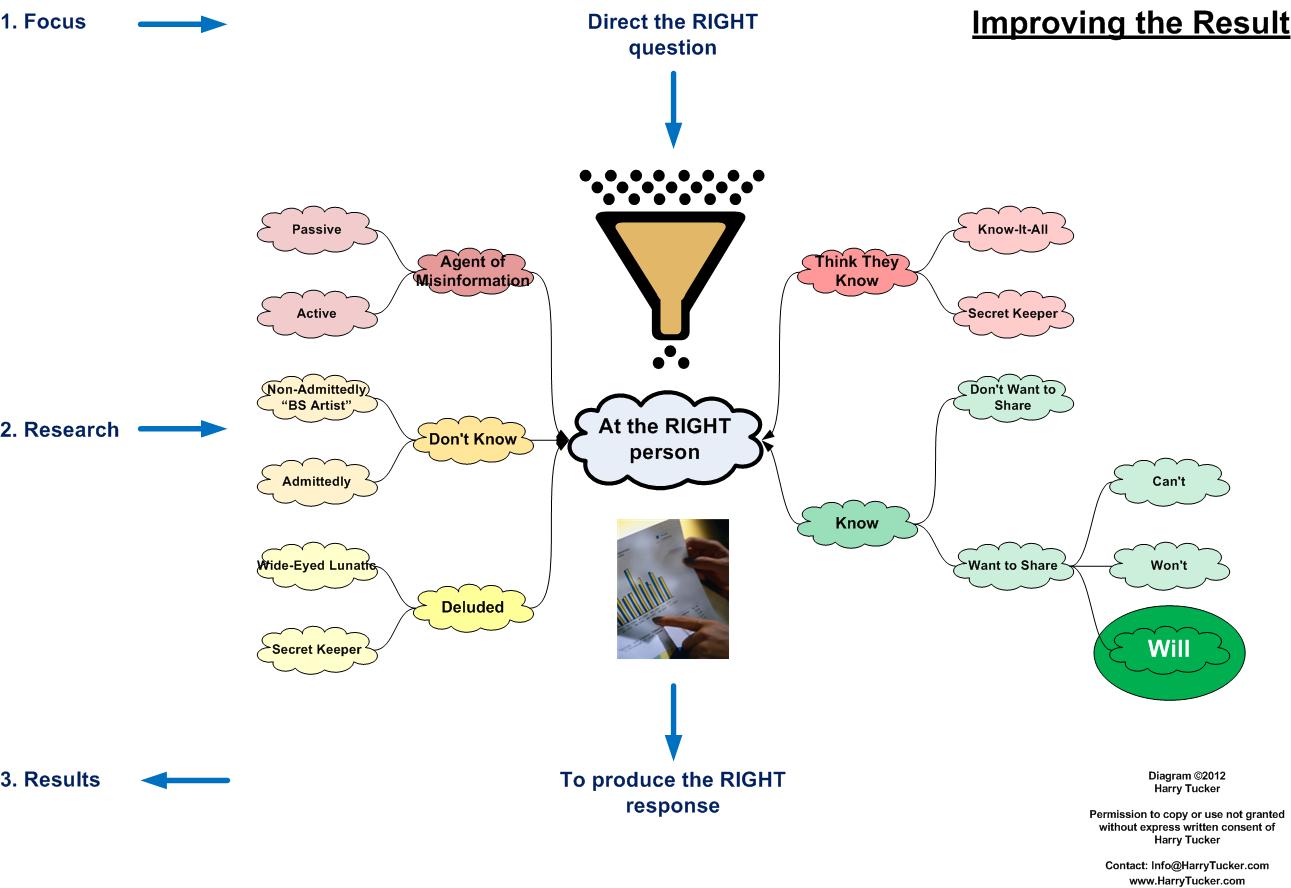
Improving the Result

A colleague of mine the other day was trying to solve a difficult problem with a lot at stake and he was really struggling with why he wasn’t producing the desired result.

In exploring this with him, two things became apparent.

1. In trying to solve the problem, he was not asking the right questions.

2. In asking the questions, he was not directing the questions to the right people who could really help him.

In fact, by not caring if he was directing the right questions at the right people, he has as good a chance at hitting upon a solution as if he consulted one of these:

or one of these:


If one wishes to find a result that meets their needs and expectations, it’s better if one considered a formula similar to the following (click to enlarge):

image

Knowing how to direct the right question to the right person can mean the difference between an answer that looks like this:

or this:

When your reputation, your success, your business, your family or your life depends on it, I think taking the time to do the right thing, the right way, right now is worth it.

Well, it is if you care about the result.

What do you think?

In service and servanthood.

Harry

Addendum

While this was written mostly tongue-in-cheek, a more detailed analysis of this subject can be found here.

Asking Questions That Get Answered

Solving Puzzles–Follow the Breadcrumbs