Showing posts with label 9/11. Show all posts

Tuesday, May 2, 2017

Statistics: The Mathematical Theory of Ignorance

Be able to analyze statistics, which can be used to support or undercut almost any argument. - Marilyn vos Savant

Statistics are no substitute for judgment. - Henry Clay

The #1206 “fiction” series continues …


On a bright, sunlit Sunday in a medium-sized city typical of western civilization, children ran excitedly around, happily exploring police cars, ambulances, MedEvac helicopters and the like.  It was the annual emergency preparedness presentation offered by the city to its citizens and as usual, a fairly large contingent of families had shown up.

“It was”, as one parent mused to another as they meandered by the exhibits, “a great way to kill a Sunday afternoon.”

At one of the exhibits, a group of families listened raptly as a government official explained the government’s latest advances in emergency planning.

“Two key things to remember”, he explained to the group, “Always make sure you have three days of food, medicine, water, toiletries and personal items on hand.”

“And”, he said as he held up his mobile phone, “Always make sure you keep this charged up.  We have an app that you can download that will allow you to receive alerts from us.  You can also use your phone to communicate with emergency officials and family members.”

A tall, thin, pale man wearing dark sunglasses was observing from the sidelines.  When the presenter finished speaking, the thin man approached him.

“Everything you say may be true”, he said to the presenter, “But we all know that in times of emergency, cell phone systems often get overloaded as they are designed for enhanced coverage but not for enhanced capacity. You saw this happen for 9/11, Hurricane Katrina and other situations.  So it is likely that the people here won’t be able to make a call once an emergency event takes place because the networks will become saturated.  Some SMS messages may get through but data and voice communication may become spotty at best so your app won’t work when it is needed most.  As for duration, there have been many emergencies that were not resolved in three days.”

“Well”, replied the presenter, “That may be true but the likelihood of such an event is statistically unlikely.”

“Statistically unlikely”, the thin man said as if he were were digesting the words, “Interesting choice of words.  I will come back to that in a moment.  But back to the mobile systems, the average cell tower only has battery power for 8-16 hours so if a major power disruption of extended duration occurs, your mobile phone won’t be able to connect to anything anyway as the cell towers begin to die.  So people may be prepared for three days but their ability to communicate will cease long before this.”

The presenter frowned at the stranger, clearly agitated by the thin man with his observations.

The thin man pressed his point more firmly.

“Back to your observation regarding statistically unlikely”, he said emotionlessly, “Likelihood is only part of the equation for emergency preparedness when one must also consider the potential scale of such an event.”

“What does that mean?”, asked the presenter.

The thin man frowned at the presenter as if feeling a level of frustration with the lack of knowledge being shown by “the expert”.

“Well”, the thin man pointed out, “If I have an event that is statistically likely or unlikely, knowing the scale of the impact AND to a lesser extent, the cost of preparing for or preventing the event is what determines how much effort goes into mitigation of the event.  If I have an event that is extremely likely but has no impact of merit, then I don’t really care about preparing for it.  If the same event is also expensive to prepare for, then I really don’t want to prepare for it.”

He paused for a minute and glanced around him.  The crowd around him were staring at him in silence.

“Conversely”, continued the thin man, “If I have an event that is statistically unlikely, most emergency preparedness people use this fact as the reason to not prepare for it.  If this statistically unlikely event is also very expensive to prepare for, then emergency preparedness planners claim to have a reason to ignore it completely even if the potential event they are ignoring has catastrophic potential.”

“As they should”, interrupted the planner.

The thin man raised his hand.

“Patience”, he said, “Please allow me to continue.”

“No”, said the planner, “Statistical likelihood and cost are the key measures for emergency preparedness planning.”

The thin man began to respond but was again interrupted by the presenter.

“Give me one example where a major event was unlikely but happened with great significance or impact”, he demanded.

The thin man frowned slightly.

“The event you know as 9/11, the nuclear reactor accident in Japan, multiple suicides by pilots flying commercial aircraft, Hurricane Katrina,some of which I mentioned earlier”, began the thin man but he was interrupted again.

“But we couldn’t have anticipated those”, the presenter said, now clearly exasperated by the thin man.

“Of course you could have and many people in your industry actually evaluated the possibility of them”, replied the thin man, “But they chose the likelihood of it happening as the primary rationale for whether a response plan was needed.  They factored in cost plus the political unpopularity of acknowledging that such a thing could happen and then buried the problem as unnecessary to think about, talk about or prepare for.  To insult people even further, they claimed to be surprised by every major event that happened even though they had evaluated such events and discarded them based on the criteria I just mentioned.”

The presenter turned his attention back to the crowd of people around him.

“Thank you, folks”, he said to the now silent crowd, “I have a brochure here outlining what I shared with you today.”

Members of the crowd took a copy of the brochure and dispersed, some of them looking at the thin man uncertainly.

“What was that all about?”, the presenter demanded as he turned towards the thin man.

“Did I say anything that wasn’t true?”, asked the thin man.

“No”, replied the presenter, “But we don’t like to tell people these things.”

“So you are lying to them”, replied the thin man, “And in doing so, condemning them to some real problems when a large-scale disaster occurs.”

“Not entirely”, replied the presenter, “But putting the people in a panic doesn’t help either.”

“Informing them of reality always helps people”, the thin man replied softly but forcefully, “You need to consider them as your allies and not your enemies, now and in times of emergency.”

“Some people can’t handle truths like this”, replied the presenter.

“Possibly”, the thin man said, removing his sunglasses and looking intently into the eyes of the presenter, “But given that uninformed people become a potential liability when and not if a significant event occurs, I would rather inform the masses anyway instead of choosing to not tell anyone just because a small percentage of people aren’t mentally strong enough to deal with reality.”

The thin man’s eyes were dark and glittered in the sunlight.

The presenter suddenly felt uncomfortable as the thin man stared at him with a strange intensity.

“I think you should leave before I ask security to ask you to leave”, the presenter said.

“No need to be rude”, the thin man said as he put his sunglasses back on, “Someday you will be forced to admit the truth.  I hope that day doesn’t have other complexities that are difficult to deal with for you and your family.”

He turned and vanished into the crowd that was milling around.

The presenter stood in silence and watched him walk away.

He looked down at his cell phone, looked up at the cell tower he could see in the distance, thought about his own family and then pressed a speed dial button on the phone.

“Hi, honey”, he said when his wife answered, “We need to talk about a few things.”

To be continued.


© 2017 – Harry Tucker – All Rights Reserved

Addendum - When the Data is Embarrassing (June 9, 2017)

In a report released this week regarding the fire at Fort McMurray last year, a number of embarrassing things were revealed leading up to and during the catastrophe.  Had you asked people if they were ready to fight a fire, they would have said "yes" with great certainty.  Despite this assertion, whoever was in charge of coordinating readiness failed Fort McMurray.  The people, on the other hand, rose to the occasion as humans often do.  What are the lessons here?  Details regarding the report can be found here - Fort McMurray wildfire reaction marred by communication gaps, says report (Calgary Herald).

Blog Post Background / Supporting Data

The title of this post is a quote from Morris Kline.

Interestingly enough, this conversation actually took place a couple of years ago at an actual “emergency preparedness and planning expo”.

The facts cited by the “thin man” are true.  The possibility of disaster from a hurricane in New Orleans, the likelihood of an event like 9/11, the nuclear disaster in Japan, death of passengers by pilot suicide, and other items have all been evaluated and discarded for the reasons given – statistical unlikelihood, the cost to address and the political damage that could arise should such things be disclosed before they happen.

The facts regarding the cell phone system are also true.

How one prepares for an emergency, whether it be man-made, from Mother Nature, from outer space or from any other source, depends on how much knowledge one has.  And by the way, emergencies are not limited to large scale disasters in our society.  Emergencies can also come in the form of problems with relationships, in business, in personal health, in financial health and the like.

Probability of occurrence is only a small part of preparation.

Time, energy and money to prepare for or prevent the event are important considerations also.

The government’s public promotion of preparedness and how it considers risks ends there.

However, the scale and impact of the event is equally important when evaluating what one should prepare for.  Many times when we are overrun by something, it is because we knew there was a possibility of it occurring but we ignored it for the reasons discussed in this post.  It is the thing that we choose to ignore rather than a surprise that often presents the greatest difficulties for us.

Aristotle often referred to a life well-lived as one that finds the golden mean of excess.  For example, courage is the golden mean between rashness and cowardice.

The golden mean for emergency preparedness falls between doing nothing and exhibiting extreme paranoia.  It can only be found when one informs one’s self instead of relying on data presented by someone with an ulterior motive.

Are you informed for the reason of acquiring knowledge or do you only allow others to inform you based on their needs, intentions and motives?

The answer to this question will determine how prepared you are when, not if, a major event happens in our near or distant future.

Do you care?

How important is your family’s health and safety to you?

What do you need to do, if anything?

Series Origin

This series, a departure from my usual musings, is inspired as a result of conversations with former senior advisors to multiple Presidents of the United States, senior officers in the US Military and other interesting folks as well as my own professional background as a Wall St. / Fortune 25 strategy advisor and large-scale technology architect.

While this musing is just “fiction” (note the quotes) and a departure from my musings on technology, strategy, politics and society, as a strategy guy, I do everything for a reason and with a measurable outcome in mind. :-)

This “fictional” musing is a continuation of the #1206 series noted here.

Related musings:

Thursday, September 10, 2015

9/11 And Lessons Not Learned (A Repost)

History teaches us that history teaches us nothing. – Hegel

That men do not learn very much from the lessons of history is the most important of all the lessons of history. - Aldous Huxley

[This post was originally posted on September 11, 2014 as “9/11 And Lessons Not Learned”.  The original post is reposted here in its entirety.]

As 9/11 approaches and we remember the 13th anniversary of the heinous acts that were carried out on that fateful day, I have decided that my annual musing honoring this day ends with this post.

Like many who lived and worked in the area on 9/11, I take time on September 11 to sit in quiet contemplation and remember the 15 friends I lost on that day, especially Narender Nath, Eric Bennett and Stephen Fiorelli who all died in the WTC and my neighbour's brother, Edward Felt, who was killed on Flight 93.

When we take time to remember and honor those who were lost, whether it be on 9/11 or all those in service to our nation in the form of the military, police, firefighters, EMS and other first responders, we do so to not only remember who they were and what they represented but also with the hope that their loss was not in vain.

However, as we once again bomb a new enemy in Iraq 13 years later, as we test the limits of Russia (and they test ours) in the Ukraine and as we face unprecedented exposure and threat to our safety and national security via cyber attack (amongst other concerns), I can’t help but think that their losses were indeed in vain.

13 years later, we have not learned a damned thing.

Why should we have?  We are creatures of habit and often are unable to change our behaviour until our backs are against the wall.  To expect us to make changes to our culture and behavior merely because of one event, even one as shocking as 9/11, is to ignore a basic understanding of what motivates a human being to action and to ignore thousands of years of history.

Unfortunately, the next time our backs are against the wall, what we face may be too large to stare down or to overcome with human perseverance, ingenuity or whatever else politicians like to offer as empty praise when we overcome a tragedy born of their abuse of power, incompetence, laziness, denial, greed, fear or lack of transparency / accountability.

And while there is MUCH beauty in the world and GREAT stories of overcoming, it is offset by the potential for great threat to our well-being on national and international levels.

It’s important to celebrate what is right in the world and to highlight those who make the world a better place.

But people in my line of work have to keep an eye on the stupid, the ignorant, the criminal and the misinformed who would rather our world not reach its ultimate positive potential.

After all, it only takes one stupid act by a small group of people (elected or not) to wipe out all of the combined great deeds, works of inspiration and the great potential that humanity represents.

The Bottom Line

Just as with 9/11, the threats to our safety are real despite the incredible beauty in our world. Our ability to be informed citizens so as to be able to respond to such threats or protect ourselves from them is insufficient for our needs for a variety of reasons - some valid, some not.  To pretend that the world is only filled with beauty and that peace and love overcome everything (with no other action required) are the beliefs of the misinformed.

And so when I think of the friends I lost and I look at what we are doing 13 years later, I don’t think our actions are honoring them.

In fact, I think our actions are disgracing them, suggesting that their loss was indeed in vain – a tragic, unnecessary loss of Life that is doomed to be repeated for an as-yet unsuspecting, unknowing group of victims.

And when it happens, we will act surprised, shocked and outraged yet again and then we will return to our normal programming.

I think there is a more honorable way to acknowledge the loss of those during 9/11 and it isn’t with pithy writings, emotional memorials, tear-laden get-togethers, shouts reminiscent of “Remember the Alamo” and the like while we continue to sow the seeds that created events like 9/11 in the first place.

It’s with action that truly produces a safer world for our children and not action that guarantees to recreate that which we have already suffered.

It’s with public accountability regarding those in power, elected or not.

It’s with standing up for what we believe is right while we still have something to stand up for and not waiting for someone else to fix it for us.

Otherwise we end up merely proving the old adage:

History is written by the survivors. – Yale Book of Quotations

Hopefully you are one of them.

What do you think?

How badly do you want a better world for your children?

Good – what are you waiting for?

In service and servanthood and in memory of those who were lost on 9/11 or in service to their nation.

Harry

PS (added September 11, 2015) Many of us who were in NYC on 9/11 and who lost friends, relatives and loved ones on that day may wander off in silence on occasion today, we may tell you a story we've told you a thousand times or we may still mist up all these years later. We may tell a funny story, we may cry or we may be angry. It's ok and we're ok - just humor us a little and let us have our moment. You don't have to say anything - just being there matters.


Related posts:


Addendum – Narender Nath - September 11, 2015

I receive many emails about Narender through the years, from family, friends and people who have been made aware of him. For those who may have noticed, he touched me profoundly and as a result, I have written about him many times.  Here are other blog posts (in no particular order) that I have written where I describe Narender’s impact on myself and others.


Addendum 2 – What Have We Really Learned? – September 15, 2015

Articles like these two reinforce (at least to me) that we have learned very little over the years:

Wednesday, September 10, 2014

The NSA–Why They May Be Delivering What You Demanded

Those who deny freedom to others deserve it not for themselves. - Abraham Lincoln

They who can give up essential liberty to obtain a little temporary safety deserve neither liberty nor safety. - Benjamin Franklin

This blog is not a typical blog post but is in fact a paper that I wrote that some asked to see as an example of the material I write outside of public scrutiny.

It is deep, dry and academic.  If you don’t like such things, please come back later. Smile


In the months that followed since Edward Snowden released classified documentation where he revealed the breadth and depth of surveillance activities carried out by the National Security Agency (NSA), there has been much debate about whether the NSA has overstepped its bounds morally, ethically and legally. There is great uncertainty about how far the surveillance actually goes, how far it will go in the future and what the impact will be on the personal freedoms of citizens now and in the future. Some have even suggested that such surveillance is the final piece of evidence implying that the theme of lack of individual citizen rights as expressed in novels such as George Orwell’s 1984[i] are about to be realized.

Whether or not citizens of the United States or other nations are in favor of such surveillance, I posit that neo-institutional theory demonstrates that such surveillance is not only inevitable, but in fact that people inadvertently demand such surveillance or demand it through implication, only to be unhappy when they see what the results of those inadvertent or implied demands are. I also posit that the concept of institutional isomorphism (how an organization forms, develops, spreads, and becomes legitimate) can be clearly applied to the NSA, demonstrating how it may slowly evolve from an institution that people fear, distrust or dislike into an organization that people will willingly submit to in order to protect themselves and their family. I will not be discussing whether such an evolution of the NSA is right or not as such a topic is based largely on perspective.

As context for my discussion, I will be leveraging my 30-year career as a strategy advisor to Wall St., Fortune 25, military and government groups.

In Scott’s Institutional Theory[ii] and Managing Institutional Environments[iii], Scott suggests that institutions exert influence in one or more of three different ways:

1. Regulatory influence - constraining behavior through rules and inducements of behavior.

2. Normative influence – guiding behavior through a logic of appropriateness and a sense of duty or an awareness of what one is "supposed" to do.

3. Cognitive influence – guiding behavior as a result of preconceived notions or conceptions.

When the events of 9/11 had taken place and the initial grieving and outrage had passed, citizens of the US demanded that their government protect them from the possibility of similar events in the future. In order to comply with such demands, the US Government recognized that the sweeping powers necessary to accomplish such a task would require:

1. Regulatory influence, passing the laws to enable what the government perceived to be “the right actions” moving forward.

2. Normative influence, explaining through a massive campaign of information or misinformation (depending on the information and perspective) that what the government and the citizens were doing together was “the right way” for the safety of American citizens and their families

3. Cognitive influence, explaining that action not taken today will produce greater risk for the safety of the nation moving forward, making it imperative to take action “right now”.

In essence, the demand of the American people and the response by the US Government, including the NSA, could be summarized as “we need to take the right actions, the right way, right now”. Unfortunately, there was a disconnect between the implied demand and the response to that demand.

One of the greatest challenges that the NSA and other groups recognized early was that while they were satisfying a “demand” from the people, it was possible that the people might quickly discover that the solution was much more heavy-handed than they had anticipated.

It was therefore deemed imperative that the Government find a way to rationalize their efforts in a manner that appeared to be in alignment with the needs of the people and with that, the Government began a process of using rationalized myths to justify their actions.

Rowan and Meyer in Institutional Organizations: Formal Structure As Myth and Ceremony[iv] described rationalized myths as:

1. Ideas that are rationalized because they are impersonal prescriptions identified with the appropriate means to pursue goals.

2. Ideas that are myths because we accept them on faith, trusting in institutions that we assume represent our best interests.

Therefore, in order to initiate a response to the demands of the people that served the needs of the government, the US Government began a campaign of demonstrating that not only had the US been attacked but it also faced greater danger as a result of:

1. The alleged possession of weapons of mass destruction by nations such as Iraq[v].

2. The intention of groups like Al Qaeda (and the nations that provided them with safe harbor) to commit further acts of violence. It was noted that such groups, or people sympathetic to their cause, might also be active on US soil[vi].

While the second item was conceptually accurate in some areas, the first one was not all but the citizens of the US believed their own government. Once both items were generally accepted, it was a rational, logical conclusion to all parties (including citizens) that an invasion of other nations was required and to the US Government, it was a legitimization to begin a larger campaign of domestic and international surveillance.

As Rowan and Meyer suggest in Institutional Organizations: Formal Structure As Myth and Ceremony[iv], such rationalized myths originated from:

1. The need to deal with ambiguity and uncertainty – to answer the question of “how do we guarantee the security of the nation moving forward, with different solutions perceived as required by the US people and the US government”.

2. Utility – the solutions provided, including new wars and additional surveillance, satisfied everyone’s needs within the “security of the nation” scenario.

3. Diffusion through networks of association – collaborations with other nations were created, thus asserting the “truths” of the actions being taken as different governments agreed on the definitions of the threat and the required response.

Once the US Government initiated their solution, including new wars and additional surveillance, the challenge then became one of sustainability, the notion that events that are consistently expensive financially, politically and in the cost of human lives, would be difficult to sustain over time as citizens began to question the legitimacy of past and future actions.

In order to sustain the mix of truths and rationalized myths that the US Government were promoting, they relied on Scott’s logics of confidence:

1. Avoidance – limiting access to information as requested by citizens by deeming it “classified for reasons of national security” and so information that might weaken the Government’s position or actions was restricted from the American people and information supporting various actions flowed freely and unquestioned.

2. Discretion – information shared for the purposes of carrying out the intentions of the Government were shared only with organizations or nations who were considered to be totally bought into the strategic intentions of the US Government.

3. Integrity – since information disseminated to the people came from sources identified as trustworthy, either through reputation, accreditation or implication, many people assumed that such information must always be true and unquestioned.

So Where Does The NSA Fit Into This Puzzle?

The NSA and other organizations, both predecessors and peer organizations, got their start in the Second World War with the introduction of surveillance of enemy governments and military groups for the sake of obtaining strategic military intelligence. After the war concluded, the mechanisms that had been created continued to be useful, especially in regards to the Cold War adversaries of NATO and the Soviet bloc.

Domestically, surveillance programs such as Echelon were created for the purposes of monitoring domestic criminal activity including but not limited to money laundering and other organized crime activities[vii]. However, after 9/11 occurred, Echelon and other programs quickly expanded their efforts to include counter-terrorism and eventually morphed into today’s modern surveillance programs.

How did such an evolution take place and how did the NSA become the number one brand known for surveillance?

The evolution of the NSA took place in a process that Scott, Rowan et all describe in their process of isomorphism:

1. Competitive isomorphism – the NSA was just one of many organizations competing for government resources (money and people) but without a cause to justify greater actions, they were one of many groups, lost within the complexity of the many departments that exist within the government. The results of 9/11 suddenly gave them “an edge” over their peer government departments in the struggle for resources and recognition.

2. Institutional isomorphism – the NSA recognized that in order to achieve their intentions, they needed support within Capitol Hill and so they began a campaign of creating internal champions such as former Vice President Dick Cheney, former Secretary of Defense Donald Rumsfeld and other powerful people. This allowed them to promote their agenda, garnering support within the population-at-large and American lawmakers for legislative support.

To accomplish this, the NSA took action in three key ways:

1. Coercive actions – the NSA presented themselves to the people and the Government as the focal point of American security. As domestic and international pressure increased suggesting that the American people were threatened, the NSA was able to position itself as a stalwart protector of the nation. They also used legislation to quiet naysayers who questioned their intentions and actions.

2. Mimetic actions – whenever the NSA was questioned, whether it be by the people or by a legislator, it was able to position itself as being similar to other successful groups, referencing their existence as proof of successfully deterring terrorist efforts[viii].

3. Normative actions – by citing recognized experts in the areas of civil defence as well as domestic and international security, the NSA was able to set itself up as the “obvious logical choice” coordinator for national security, justifying their intentions and actions in their own minds.

So Why Is the NSA Despised Now?

In the research of Scott, Rowan, Meyer and others, they suggest that there are five ways to manage both the isomorphic institution and the relationship between such an institution and other organizations (in this case, the American public).

1. Acquiescing – conforming to the needs or intentions of others.

2. Compromising – balancing intentions or negotiating them with other groups.

3. Avoiding – hiding from the inspection of others or creating barriers that prevent such inspection.

4. Defying – blatantly defying the intentions and requests of others who attempt to explore their intentions.

5. Manipulating – changing the “rules of the games” by finding support in other powerful people (corporately, politically or diplomatically), promoting messages of validation (in this case, the threat against the people) and through the use of legislation to enforce the items of “avoiding” and “defying”.

In successful partnerships, whether it is within an organization, between organizations or between an organization and the people it serves, success is usually defined as acquiescing (in the short term, not being sustainable in the long term since someone eventually tires of sacrificing ad infinitum) or finding a true win – win by negotiating a balance via the process of compromising.

The American people, in the days immediately following 9/11, assumed incorrectly that their demands of security would be answered by the government in a manner that suggested either acquiescing or compromising. This assumption was perhaps based on the notion that that is how most people tend to live their lives and it forms a fundamental belief in how their relationships, personal, professional or otherwise are lived.

However, in the days and years that followed, the solution for the problem they demanded a solution for was provided by a group of organizations that chose to follow the models of avoidance, defiance and manipulation.

When people deal with other individuals who live by such models, we tend to avoid such people since the ability to create trust is an innate part of the human experience. This need to trust extends beyond person-to-person relationships but extend to defining the relationships between individuals and organizations as well. Much has been written on the importance of trust, including articles such as Grove’s Maslow’s Hierarchy of Needs Method For Trust-Based Relationships[ix].

When seeds of distrust are planted, an opportunity for tension between participants in a relationship is created. Such distrust can only be nullified through the free exchange of information that, for reasons explained previously, is not permitted when it comes to national security.

The relationship difficulty originated entirely on an assumption – the notion that when someone demands a solution (national security in this case) without identifying the “rules” of the solution, that the solution provided will automatically fit the definition of the person demanding it. In the case of national security, the Government also made an assumption, that they defined the rules by which the solution was provided.

The relationship difficulty is also complicated by the notion that we rely on one of the five relationship maintainers in any relationship (acquiescing, compromising, avoiding, defying or manipulating). Given that the organization that makes the rules (the Government) realized that the first two would not serve their needs, the American people are forced to submit to one or more of the final three, making distrust on both sides inevitable.

The foundation for much of today’s difficulties when it comes to surveillance are contained within these complexities and assumptions that have allowed specific groups to pick and choose their actions at will and for the most part out of sight of the people they claim to serve.

The question of whether conspiracy theory people are right (that groups like the NSA have overstepped their bounds) or that the NSA will ultimately prove to be justified in their actions (creating a verifiable legitimacy within the people) is something that is difficult to answer with our limited access to information.

Moreover, with the continued limited accessibility to information, the answer will probably only be provided by historians who look back upon our past. As to whether such a historical retrospective will be accurate, one should consider the famous words attributed to Winston Churchill when he said, “History is written by the victors.” and this quote from the Yale Book of Quotations[x] where it was noted, “History is written by the survivors. (Social Forbes, 1931)”.


[i] Wikipedia, Nineteen Eighty-Four, Retrieved from URL http://en.wikipedia.org/wiki/Nineteen_Eighty-Four on November 27, 2013

[ii] Scott, Richard., Institutional Theory (pp. 119-120) of Organizations: Rational, Natural and Open Systems, 5th Edition, Prentice-Hall, 2003, Print

[iii] Scott, Richard., Managing Institutional Environment (pp. 213-220) of Organizations: Rational, Natural and Open Systems, 5th Edition, Prentice-Hall, 2003, Print

[iv] J. W. Meyer & B. Rowan, Institutional organizations: formal structure as myth and ceremony, American Journal of Sociology, 83, 1977, 340-63, Print

[v] Wikipedia, Iraq and Weapons of Mass Destruction, Retrieved from URL http://en.wikipedia.org/wiki/Iraq_and_weapons_of_mass_destruction on November 23, 2013

[vi] Huffington Post, Janet Napolitano: Domestic Terrorism is Top Concern, Retrieved from URL http://www.huffingtonpost.com/2010/02/21/janet-napolitano-domestic-terrorism_n_470915.html on November 22, 2013

[vii] Webb, D.C., Echelon and the NSA, Leeds Metropolitan University, UK, 2008, Print

[viii] CNN, NSA Chief: Snooping is crucial to fighting terrorist, Retrieved from URL http://www.cnn.com/2013/07/31/tech/web/nsa-alexander-black-hat/ on November 30, 2013

[ix] Grove, Heidi, Maslow’s Hierarchy Of Needs Method for Trust-Based Relationship Building, Regis University CPS Blog, Retrieved from URL http://cps.regis.edu/blog/maslows-hierarchy-of-needs-method-for-trust-based-relationship-building/ on November 28, 2013 [Editor note: Link has been removed since original paper was published]

[x] Shapiro, Fred R., The Yale Book of Quotations, Yale University Press, 2006, Print

9/11 And Lessons Not Learned

History teaches us that history teaches us nothing. – Hegel

That men do not learn very much from the lessons of history is the most important of all the lessons of history. - Aldous Huxley

As 9/11 approaches and we remember the 13th anniversary of the heinous acts that were carried out on that fateful day, I have decided that my annual musing honoring this day ends with this post.

Like many who lived and worked in the area on 9/11, I take time on September 11 to sit in quiet contemplation and remember the 15 friends I lost on that day, especially Narender Nath, Eric Bennett and Stephen Fiorelli who all died in the WTC and my neighbor’s brother, Edward Felt, who was killed on Flight 93.

When we take time to remember and honor those who were lost, whether it be on 9/11 or all those in service to our nation in the form of the military, police, firefighters, EMS and other first responders, we do so to not only remember who they were and what they represented but also with the hope that their loss was not in vain.

However, as we once again bomb a new enemy in Iraq 13 years later, as we test the limits of Russia (and they test ours) in the Ukraine and as we face unprecedented exposure and threat to our safety and national security via cyber attack (amongst other concerns), I can’t help but think that their losses were indeed in vain.

13 years later, we have not learned a damned thing.

Why should we have?  We are creatures of habit and often are unable to change our behaviour until our backs are against the wall.  To expect us to make changes to our culture and behavior merely because of one event, even one as shocking as 9/11, is to ignore a basic understanding of what motivates a human being to action and to ignore thousands of years of history.

Unfortunately, the next time our backs are against the wall, what we face may be too large to stare down or to overcome with human perseverance, ingenuity or whatever else politicians like to offer as empty praise when we overcome a tragedy born of their abuse of power, incompetence, laziness, denial, greed, fear or lack of transparency / accountability.

And while there is MUCH beauty in the world and GREAT stories of overcoming, it is offset by the potential for great threat to our well-being on national and international levels.

It’s important to celebrate what is right in the world and to highlight those who make the world a better place.

But people in my line of work have to keep an eye on the stupid, the ignorant, the criminal and the misinformed who would rather our world not reach its ultimate positive potential.

After all, it only takes one stupid act by a small group of people (elected or not) to wipe out all of the combined great deeds, works of inspiration and the great potential that humanity represents.

The Bottom Line

Just as with 9/11, the threats to our safety are real despite the incredible beauty in our world. Our ability to be informed citizens so as to be able to respond to such threats or protect ourselves from them is insufficient for our needs for a variety of reasons - some valid, some not.  To pretend that the world is only filled with beauty and that peace and love overcome everything (with no other action required) are the beliefs of the misinformed.

And so when I think of the friends I lost and I look at what we are doing 13 years later, I don’t think our actions are honoring them.

In fact, I think our actions are disgracing them, suggesting that their loss was indeed in vain – a tragic, unnecessary loss of Life that is doomed to be repeated for an as-yet unsuspecting, unknowing group of victims.

And when it happens, we will act surprised, shocked and outraged yet again and then we will return to our normal programming.

I think there is a more honorable way to acknowledge the loss of those during 9/11 and it isn’t with pithy writings, emotional memorials, tear-laden get-togethers, shouts reminiscent of “Remember the Alamo” and the like while we continue to sow the seeds that created events like 9/11 in the first place.

It’s with action that truly produces a safer world for our children and not action that guarantees to recreate that which we have already suffered.

It’s with public accountability regarding those in power, elected or not.

It’s with standing up for what we believe is right while we still have something to stand up for and not waiting for someone else to fix it for us.

Otherwise we end up merely proving the old adage:

History is written by the survivors. – Yale Book of Quotations

Hopefully you are one of them.

What do you think?

How badly do you want a better world for your children?

Good – what are you waiting for?

In service and servanthood and in memory of those who were lost on 9/11 or in service to their nation.

Harry


Related posts:


Tuesday, September 10, 2013

9/11–What Have We Learned After 12 Years?

“There is something fundamentally unfair about a government that takes away so much of people's money, power, and personal control while telling them that life will be better as a result.” - Steve Forbes

“Remember the hours after September 11th when we came together as one to answer the attack against our homeland. We drew strength when our firefighters ran upstairs and risked their lives so that others might live; when rescuers rushed into smoke and fire at the Pentagon; when the men and women of Flight 93 sacrificed themselves to save our nation’s Capitol; when flags were hanging from front porches all across America, and strangers became friends. It was the worst day we have ever seen, but it brought out the best in all of us.” –Sen. John Kerry

As I took my morning walk this morning, I stopped and watched some young children playing at a local playground.

It is a beautiful sunny Tuesday morning and I am reminded that it is almost identical to a beautiful sunny Tuesday morning 12 years ago that became the worst nightmare in US history.

As I watched the children play and my mind replayed the events of 9/11, I reflected on what has changed since then.

And I wonder what we have learned.

Airline Security

Despite the billions we have spent on airline security, including advanced screening equipment and reinforced cockpit doors, there are still easy ways to get bombs on planes as well as techniques that can force pilots to open the cockpit door and give up control of their aircraft.

Our invasion of Libya also caused the “accidental misplacement” of thousands of shoulder-fired surface-to-air missiles capable of downing commercial aircraft.  Many of these missiles are believed to now be in the hands of Al Qaeda-friendly forces.

Ok … so we’re not doing so well there.

International Relations

On the international front, we continue to try random experiments with diplomacy in the hope that things will just work out perfectly by accident, with little or no knowledge or care of the downstream effects of our actions.

Examples ….

We embraced and even promoted the Arab Spring movement and watched it destroy proud nations like Egypt.

Iraq and Afghanistan are no more stable now than ever and in fact, in some parts of those countries, they are more lawless and dangerous now than they ever were.  What did our brave servicemen and women accomplish there despite the great sacrifices they made for themselves and their families?

Libya is now considered to be lawless and in ruin since we removed Gadhafi, with thousands of armed militants roaming the countryside and providing a training ground for tomorrow’s terrorist generation.

The complexities of Syria continue to simmer, with the US government willing to engage in a military strike even before evidence was available as to who “the enemy” was and with the Chairman of the Joint Chiefs of Staff admitting that he had no idea what the objective would be or what the downstream effect of a military strike would be.  Let’s not forget also that with Russia sending in defensive forces to back Syria, it wouldn’t take much to accidentally create a larger global conflagration.

And so our random experiments with diplomacy are doing little outside of creating more countries that are unstable, something proven to be a breeding ground for terrorists.

Hmmmm … we’re not doing so well there either.

Meanwhile back home

Meanwhile back home, our political leaders continue to brew a dangerous concoction that brings no peace to the world nor does it bring additional security to the citizens whom they claim to serve.

And just to complicate things, the threat of domestic terror along the lines of the Boston Marathon Bombing is something that many enforcement officials have indicated is practically unpreventable with current laws.

John Kerry’s 9/11 quote when he was Senator is wonderfully patriotic and yet conveniently glosses over the truth that decisions that he and his colleagues made helped draw the ire of terrorists in our direction in the first place.

It would be like a fireman setting fire to a building and then running inside, saving the occupants and proclaiming himself to be a hero.

The people who participated in the events that led up to 9/11 and who play games of random diplomacy get to enjoy security for themselves and their families for life while innocent civilians who care little for political, diplomatic and military tit for tat exercises pay the ultimate price.

I think of my friends who died that day in the World Trade Center, including but not limited to:

- Narender Nath, who saw the best in everyone.

- Stephen Fiorelli, a Port Authority engineer who stayed behind to guide the brave first responders.

- Eric Bennett, who was constantly helping and serving others as much as he could.

I think of my neighbor’s brother who died on Flight 93.

I think of my other neighbor whose office was across the street from the World Trade Center and who watched many of the people jump from the towers.  He was deeply impacted by the event and 6 months later was dead, having been so traumatized by what he saw that the images that replayed in his mind eventually took his Life.

These wonderful citizens, fathers, husbands and Life partners didn’t give a rats behind about what our diplomats and politicians did abroad and in fact, because of national security constraints, couldn’t have known even if they wanted to.

They didn’t sign up to fight any wars.

They didn’t volunteer to be sent into harm’s way.

And yet they paid the ultimate sacrifice anyway but have “the honor” of being publicly named at patriotic memorials every year.

I wonder if part of the problem is that once our leaders transformed from being those who lead people into battle into those who send people into battle, they become less aware of the real impact of their choices on the innocent.

If our leaders started losing their own loved ones as a direct result of their actions, perhaps they might have an incentive to think and act differently when it comes to the decisions they make. << Dear NSA.  That is an observation and not a threat. Stand down. >>

Perhaps.

Why we remember 9/11

Someone asked me recently why we bother to remember the events of 9/11 and suggested that perhaps we should let it fade into the past and allow healing to take place.

The problem is that when we forget the events that led up to 9/11, we release from accountability those who have helped create it and those who continue to stoke the fire for the next big event.

An event that will probably once again exempt those who helped architect or contribute to it while sacrificing those who have nothing to do with it.

An event that we will claim took us by surprise.

An event that will draw a revenge response on our part.

An event that will add more names of the innocent to the lists that we read during patriotic memorial events.

We all play a role in this

We are not without responsibility in how 9/11 came to pass nor are we without responsibility for preventing such events from occurring in the future.

How we responded to Syria is an indicator that we haven’t learned a damned thing .… yet.

And until we start learning something from that painful day on 9/11, we must accept that the lives of those lost were indeed sacrificed in vain and that we are potentially worse off and in a more precarious situation than ever.

Meanwhile back at the playground

As my mind returns to the children in the playground, I think about the people who worry about the color of their next iPhone or whether their designer coffee has a little too much “whatever” in it and I wonder.

If we spent more time focusing on what is right for the next generation and not what is right for ourselves, I think we would realize the right thing to do, whether it’s in the selection of our leaders or how we hold our leaders to be accountable  in regards to domestic and foreign policy.  We would also know what our own responsibilities are for co-creating a stronger potential for future generations.

I think that the events of the world, while seeming to be chaotic and disturbing, are that way because someone benefits from allowing this to happen or from creating such an environment.  Sometimes the list of those who benefit is not always obvious as Esquire magazine generated extra web traffic this morning by showing this outrageous picture.  The picture is of an unknown man falling to his death from the World Trade Center on 9/11 accentuated with tasteless text added by Esquire.

I think that we need to work harder to be the voice for those who don’t have one (or don’t believe they do), to offer a hand-up to those who have stumbled, to show love to those who feel that love has abandoned them, to stand up for those who feel overcome by the world and to be the champion for those who seek someone to look up to.

I think that we need to work harder at being the light that lights someone else’s path.

I think that we need to work harder at being the salt that seasons the Earth and the great variety of Life that exists on it.

I think that we need to share more with those who have less.

I think that we need to help others follow their dreams as we need others to help us follow ours.

I think that we need to move beyond labels that differentiate us and seek the things that unify and unite us.

I think that we need to model the behavior that we want to see in future generations.

I think that we need to try harder to live every day as if it might be our last …. because eventually that does become our reality.

And finally, even as an optimist I think that the world only gets better when we make a choice to make it that way, that a world of unlimited potential doesn’t happen by accident. 

While it would be great to write a heart-tugging, peace-and-love-overcomes-everything blog, history teaches us that the world and humanity don’t work this way.

Or can I be proven wrong?

I would like to be.

What do you think?

In service and servanthood,

Harry

Addendum – September 11, 2013

In the days that followed 9/11, I found myself repeatedly playing a song by Styx.

The song came to mind again this morning.  Here it is …. “Show Me the Way”.

Friday, September 6, 2013

The Alternate Reality of Politicians

Divide and rule, the politician cries; unite and lead, is watchword of the wise. - Johann Wolfgang von Goethe

A hypocrite is the kind of politician who would cut down a redwood tree, then mount the stump and make a speech for conservation. - Adlai E. Stevenson

I have always been fascinated by the alternate reality that politicians live in.

Take for example, The Minister of Municipal Affairs in Alberta, the Honorable Doug Griffiths.

When asked to comment on Opposition Leader Danielle Smith’s plans to hold a town hall to once again express anger over the RCMP and their seizure of weapons in flood-ravaged High River, Alberta, he made an interesting faux pas when he said:

“I am sick and tired of people like her going around trying to blame people when we’re still trying to rebuild the community. It’s fucking embarrassing.”

One of the rules of politics (and business) is that you never let your opponent see you sweat.  As the Opposition Leader, Ms. Smith is paid to represent her constituents, lead her party AND get under the skin of the government.

When a member of the government drops the f-bomb as a result of her actions, the Opposition Leader can only think “mission accomplished – what else can I do to to continue this momentum?”

In addition, in the business world, such words issued against a colleague would immediately motivate HR to investigate – requiring an apology at best or other disciplinary action, including termination.

This rarely happens in the political world.  Even when an Alberta member of government was found to be using his government influence for the benefit of his own company, he was found to be guilty of unethical behavior but not illegal.

I guess it comes down to realities and rationalization. :-(

And finally, we are always loudly trumpeting anti bullying / anti intimidation legislation, especially legislation designed to create a better world for children.

But it doesn’t matter how much legislation we pass to encourage people to treat others with respect.

People model what they see

Unfortunately, politicians can pass legislation that promotes one idea while living another and not see the difference between them.

Meanwhile in High River …..

Ms. Smith held another town hall in High River where angry residents had another opportunity to vent the anger they have vented repeatedly, the only difference being that this time, they had an opportunity to vent it towards representatives of the RCMP.

The reasons for their anger have been documented and expressed many times since June so I’m not certain that another round of yelling and screaming “moves the ball”.

In the real world, upon first capturing the essence of a problem, a problem solver says “I hear you loud and clear.  I will do what it takes to get this resolved and will report periodically on progress or ask for your opinion should we reach a point where decisions needs to be made”.

But in the political world, while Ms. Smith may have taken some actions on behalf of her constituents, she is still focused on the importance of whipping up anger.

The time for anger has passed.

What matters now is focus on execution and results that benefit the people of High River.

Continued anger and outrage in lieu of results only benefits the politician who encourages it.

In the real world, anyone who has their marching orders but continues to convene meetings to revisit their marching orders will cause people to think:

  • Did this person not hear us the first time?
  • Does this person not know how to solve this problem?
  • We have already expressed our anger over this – why does this person want us to keep revisiting our anger instead of solving the problem?
  • Why are we wasting our time rehashing everything we already know?
  • If we meet enough times, maybe we need to turn our attention to the person who keeps reconvening us.

But this is not the real world.

This is politics, where anger and obfuscation are often more useful than results, as I posited here - Anger: Setting Yourself Up For Manipulation.

Ms. Smith knows what the issues are, she knows the anger that is simmering amongst the citizens and she knows what is at stake.

All that is left are measurable results that benefit citizens – the bane of many politicians.

And speaking of producing measurable results that benefit citizens ….

President Obama is insisting on the need to perform a military strike against Syria when he, John Kerry and their many political and military advisors cannot publicly identify the actual threat to America, the benefit to America in carrying out the attack or the downstream ramifications of what might happen should an attack be launched.

And as I listen to them play chess with our safety and our lives yet again, I think of the 15 close friends that I lost in the World Trade Center almost 12 years ago and the thousands of loved ones who were lost on that day and in the wars that followed.

When politicians use our security, our well being and our lives in the grand scheme of the strategy game they are engaged in, they do it with lots of upside and little downside … for themselves.

My friends cared little for the political, diplomatic and military tit for tat exercises that ultimately produced their death.

Meanwhile, the people who participated in the events that led up to 9/11 have moved on to bigger and better things, safe behind the security only available to those who play God with the lives of others.

The bottom line

The greatest challenge in our world is that the definitions of reality in the real world and the political world will continue to diverge until all politicians are forced to live the realities that they create for others.

Only then will they realize what needs to be done and how quickly it needs to be done in order to create a better world for everyone.

As James Freeman Clarke once said:

A politician thinks of the next election. A statesman, of the next generation.

In service and servanthood,

Harry

Addendum

Minister Griffiths has apologized for his use of the f-bomb as noted earlier.

Tuesday, August 20, 2013

The Power of Regret

Often in Life, we forget the things we should remember and remember the things we should forget – Unknown

As an eternal optimist, someone who strives to see the bright side of everything and someone who is eternally grateful for the Journey that is my Life, I have a confession to make.

Many who think they know me and my outlook on Life may be surprised by my confession.

I must confess that for the many things I have been blessed to experience, I have regrets that I have carried for a long time.

Most of us have regrets but we hide them behind a brave facade of “I don’t regret a single thing in my Life”, “I have turned every difficulty into success”, “I don’t see problems, I see challenges”, etc.

Yawn.

Yeah ..… right.

Back in 2001, I had an opportunity to have potentially prevented someone from being in a position to be killed and I didn’t fight hard enough to prevent it.  As a result, this individual ended up in a place where he shouldn’t have been, being in the wrong place at the wrong time.

I also had the opportunity many times to get together with this same person who was always reaching out to see me but I constantly turned down the invitations because I was “too busy”.

By the time I finally accepted Narender Nath’s invitation to get together for lunch the next day, it was the afternoon of Monday, September 10th, 2001.

Less than 24 hours later, it was too late to honor his invitation.

I have danced with the knowledge of his loss for years, oscillating between feeling grateful for having known him and feeling torn that I should have done more to have prevented him from being on the impact floor of the North Tower of the World Trade Center on the fateful morning of 9/11.

For people who try to coach myself and others out of our regrets, it is easy to offer lines such as :

We should regret our mistakes and learn from them, but never carry them forward into the future with us. - Lucy Maud Montgomery

Has this world been so kind to you that you should leave with regret? There are better things ahead than any we leave behind. - C. S. Lewis

There was nothing you could have done.

It was not your fault.

It was fate.

It was God’s way.

Insert pithy platitude here.

The truth is that we must come to our own terms with our regret as only we know what we are feeling and what in our emotional baggage has tied the regret to how we perceive ourselves and the world.

As the years went by ….

Over the years, I thought I had learned the lessons I needed to learn from this event and was doing my best to live the lessons learned.

But then a call came in from long-time (35+ year) friend, Christopher Richardson.

Christopher is a talented producer and director at Henge Productions, an organization that creates amazing documentary and television programs including the powerful documentary Where’s My Goat?  Spoiler alert (or maybe it’s a warning): Documentaries that can mist up the eyes of this 6’3” Wall St. tough guy are powerful.

Well ….. I say ”mist up”.  We tough guys cry in private when no one is looking. :-)

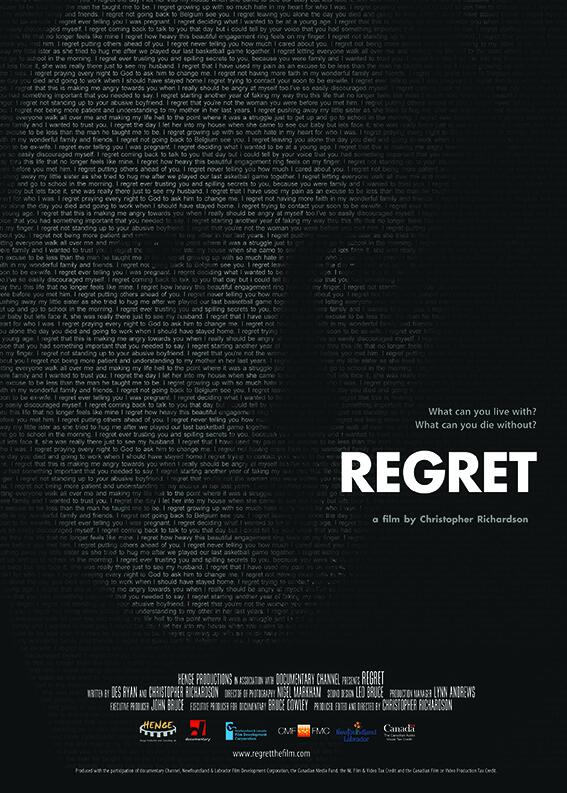
Christopher was exploring the subject of regrets in his Life and the lives of others and wanted to know if I would be willing to go on camera to revisit the regrets I had struggled with regarding Narender.  The film was to be entitled … wait for it …. “Regret”.

“Sure”, I thought.  “I haven’t had an opportunity to rip the scab off that mental wound in a while”.

What followed provided a powerful opportunity for those of us who participated to revisit and relearn (or learn anew) the power that our regrets hold over us – both positive and negative.

Many of us had an opportunity to cry again as we relived our pain.

But we had an opportunity for something else as well.

What was that opportunity?

You will have to check out the trailer for Regret to find out as Christopher prepares to debut the film at the Atlantic Film Festival on Sunday, September 15th.

Regrets can create anchors that weigh you down forever or they can create insight that reveals your greatest potential.

The choice is yours.

Which do you choose?

If you have regrets or know someone who struggles with them, check out Christopher Richardson’s powerful, riveting documentary Regret.  If you don’t have regrets or have never had them, Wayne Dyer and the Dalai Lama are looking for new presentation partners – call them immediately to sign up.

Regrets, like many of Life’s lessons, are better explored with the help, the shoulder and the company of others and the film Regret is no different.

Regret will create many questions within you and yes, it may rip scabs off a few of your own wounds.  It will force you to contemplate what you can live with and what you can die without.

But it may answer a few questions as well and offer a powerful salve for those wounds.

Trust me …. you won’t regret the Journey.

In service and servanthood,

Harry

Addendum

I was intrigued by the poster for the movie Regret – sharing ….

Addendum – September 19, 2013

At the close of voting at the Atlantic Film Festival, the film Regret took the honor as the highest rated film at the event as determined by the Atlantic Film Festival audience. :-)

image

Thursday, March 7, 2013

Why the TSA Knife Policy is a Big Mistake

The TSA announced this week that they will allow knives of a certain size back on aircraft.

Their reasoning is that the cockpit doors, strengthened since the 9/11 attack, are unlikely to be breached by knife wielding terrorists.  As former TSA head Kip Hawley told CNN “Sharp objects can no longer bring down aircraft”.

Personally I am staggered by the ignorance of such a statement.

Oftentimes in business and in Life when we are confronted by obstacles, the best way to overcome the obstacle is to find a way around it if it is indeed to strong to be overrun directly.

I wonder how many pilots, being good husbands, wives, parents and grandparents, could stand to leave the door locked if they suddenly hear the sounds of flight attendants or passengers being attacked by knife-wielding passengers.

Or the sounds of children being tortured.

I couldn’t.  I’d rather open the door and take my chances, otherwise I may be flying a cargo of dead passengers anyway - passengers who died slowly and painfully.

I would imagine that most human beings would be unable to sit there doing nothing and would open the door regardless of what they are taught or ordered to do.  The passengers are in fact the weakest link, being the Trojan Horse that can penetrate any door.

Can we be anything but human when people are in danger?

Human beings are wired to help those in need.

This powerful instinct cannot be easily removed or rewired by a memo or a piece of legislation - thankfully.

After all, isn’t this one of the things that sets us apart from “other” animals ?

Everything happens for a reason

It should be noted that everything in our world happens for a reason.

And in a few years when this tactic is used to commandeer another aircraft, we will all act surprised.

Well … most of us will.

But somewhere it will have served someone’s purpose.

I wonder whose.

We may be surprised to know the answer.

In service and servanthood,

Harry

PS Here is one flight attendant’s view on the matter.  Do you agree or disagree?

Friday, September 9, 2011

Carpe Diem–Do We Know What It Means?

So many people use the phrase “carpe diem” (seize the day) as a personal mantra around manic productivity – that to seize the day means that one should drive one’s self into the ground in an effort to squeeze as much productivity out of the day as is humanly possible.  Some use it as a rah rah in an effort to convince others that they are making the most of their day when in fact they are not.

I have come to learn that carpe diem means something else.

Some years ago, a dear friend of mine by the name of Narender Nath had been trying to get on my lunch calendar for weeks.  While our relationship was very important, I kept deferring him because of my busy calendar.  I finally agreed on a particular Monday to see him for lunch the next day (although I remember thinking at the time “how will I get all this work done if I take a couple of hours for lunch?”).

During the same period, my friend and colleague Eric Bennett had been nagging me about the need to relax and had kept offering to take me to a Yankees baseball game.  He had box seats through his company and wanted to treat me to a night out.  I was too busy living my interpretation of carpe diem and finally called him on a Monday afternoon and left him a message that I would take him up on his kind offer at whatever time worked for him.

I was attending a parent-teacher night one Monday evening and kept running into a friend of mine by the name of Stephen Fiorelli.  As my family wandered from appointment to appointment, I kept passing Stephen in the corridor and at one point, he indicated that he had something important to talk to me about and wondered if I was available for a coffee after the event.  I had had a particularly busy day and asked if we could reschedule for another time, which he happily agreed to.

It was Monday, September 10th, 2001.

24 hours later, it was too late to tell Narender I was sorry for not having gone to lunch with him sooner, to tell Eric that I should have taken him up on his offer to relax and kick back for a few hours or to listen to Stephen as he told me whatever seemed to be on his mind.

There are so many stories I could tell about these guys and the other friends that I lost.

Funny stories like how Narender and I created Yellow Shirt Day in our company, how he taught me to swear in Hindi to defend myself against an abusive corner-store owner in the basement of our building or how he was fascinated by TV commercials when he moved to the US because he believed that commercials provided true insight into the American character.

Stories of dedication about people like Eric Bennett who was the true epitome of a guy who went above and beyond to make sure that his colleagues were successful.   It was his desire to help me be successful in my company that created the opportunity for him to introduce me to Narender.

Powerful moments like when we were at Stephen’s house with his wife, kids, family and friends waiting for news that Stephen was ok ….. at one point the doorbell rang and I looked out the window, seeing policemen and a priest at the door and my heart sank as I then knew otherwise.

Stories of bravery, after hearing that Stephen, as a Port Authority engineer, stayed behind with his team to help the firefighters with floor plans.  They evacuated the building as it began to collapse.  The team survived – he did not.

Stories that will live with me forever.

I learned a lot from these guys but the greatest thing I learned from their loss was the real meaning of carpe diem.

For me, it’s no longer merely mistaking activity for productivity.

It’s recognition that the world is filled with tragedy but it is filled with beauty also.

But unless we take the time to slow down, to enjoy it, to be grateful for it and to share it with the people who matter, then we haven’t really seized the day.

In fact, we’ve let the beauty and potential of the day slip by us.

Carpe diem, to me, is a reminder to focus on what is really important and not just what seems to be important.

I am a better person because of Narender, Eric, Stephen, their families and all the people I have been blessed to know who were lost that day.

Carpe diem calls me to remember them by treasuring each day as a powerful gift of Life.

Carpe diem.

In service and servanthood,

Harry

PS I would be remiss if I didn’t mention the incredible bravery of military servicemen, search and rescue, firemen, policemen, EMS/ EMT and all first responders, both during 9/11 and all who serve so that we may be safe.  I have reminded my children many times that when they see one of these people, they should always walk up to them and say “thank you” for putting their lives on the line, for so little pay and for people they will never meet.  Many of the firemen that I used to wave to as I walked to work in the morning in NYC rushed in to save others and never came out of the buildings.  We are grateful that they serve and sometimes, sadly, willing to make the ultimate sacrifice so that we may live ….. and they do so bravely and unselfishly.


eric       stephen    narender

    Eric Bennett          Stephen Fiorelli                Narender Nath


narender2

Narender in his yellow shirt (it wasn’t yellow shirt day).  I’m in the green shirt.  The guy between us, Tom, was stepping off the PATH train in the basement of the World Trade Center at the moment the North Tower was struck and was able to leave the WTC safely.

Tuesday, September 6, 2011

9/11, Conspiracies and Communication Failure

As I write this today, I am wearing a yellow shirt.  It is, after all, Yellow Shirt Day for me, something a group of us co-created with a colleague who was killed in the World Trade Center on 9/11.

As we approach the 10th anniversary of 9/11, the media is rich with various forms of documentaries including the obligatory set of suggestions of conspiracy.  Apparently people “in the know” know for certain, without releasing their secret sources, that 9/11 occurred because of government conspiracies, aliens, an angry God (or gods for someone), etc.  One guy in a documentary on CBC in Canada said that he believed that WTC 7 was constructed in the 1980’s with the demolition charges already installed in preparation for such an event.

There is no limit to how deep they will dig to find something that resonates with their misfiring mind.

There is, however, ONE thing that does bother me about 9/11.

In 1993, after the bombing of the World Trade Center, I was talking to my former father-in-law (now deceased) about the security threats facing the United States.  As a USAF colonel and former staffer at the Strategic Air Command (before it was folded into another entity), I felt he might have some insight.

He indicated that one of the US military’s greatest concerns at that time was the use of commercial aircraft against buildings and significant landmarks on US soil.  It was a concern, he said, because it was difficult to prevent and would be incredibly disruptive to the American psyche (creating fear that terrorists wish to induce).  There was also a great concern amongst military planners that should the need to shoot down an American commercial aircraft arise, would a USAF pilot be able to do it without hesitation and if he/she did it, what would the ramifications be that an American pilot was forced to kill Americans to protect other Americans?

Eight years later, the US was rocked by 9/11 and a number of us lost treasured friends, family members and colleagues.  President Bush, Vice President Cheney and others claimed we were caught by surprise – that no one could have predicted an attack in this fashion.

And yet I was told eight years prior that this was one of the greatest concerns of the US military and that they were trying to come up with mitigation strategies to prevent it or minimize its impact.

Now ten years later, former leaders are still saying that this attack and the techniques used caught everyone by surprise.

I don’t buy it.  If a civilian (and a non US citizen at that) was told by a senior military officer in 1993 that defending against such an attack was one of the highest priorities of the US military in 1993, then many people knew this was coming.

Maybe the leaders who claim they didn’t know truly didn’t know.  I leave that to conspiracy theorists to toss back and forth.

The fact that some people possibly didn’t know reflects how poorly our communications get when we have too complex a network to communicate across.  Too many people with too many opinions and too many conflicting agendas create too much noise and when this noise is created, important information doesn’t get communicated to the people who need it.  I see this level of confusion in many large organizations that I have helped over the years.  In their desire to over-communicate, they have instead over-inundated and failure of some type becomes inevitable.

Sometimes, such poor communication creates an inconvenience.

Sometimes it may create catastrophic business unit results or total organization failure.

However, there are times it has the potential to produce fatal results.

Such as the day when my friends Narender Nath, Eric Bennett, Stephen Fiorelli and 12 others were 15 of the thousands killed on the morning of 9/11.

I’m not a conspiracy guy.  But if a lowly civilian knew about the probability of these attacks in 1993, then I have to look at the poor communications and the billions spent on intel-gathering leading up to 9/11 as a huge failure in the intelligence community.

That’s not a charge of conspiracy.

It’s one of incompetence.

There is a huge difference.

Thomas Jefferson said it best LONG before 9/11.

I predict future happiness for Americans if they can prevent the government from wasting the labors of the people under the pretense of taking care of them.

In service and servanthood,

Harry

PS For an excellent analysis debunking traditional 9/11/ conspiracy myths, please go here.

Friday, September 11, 2009

Authenticity – A Personal Assessment 8 Years After 9/11

Today, many of us honor those lost during the attack on 9/11.  Regardless of what terrorist theory, conspiracy theory or anything else people subscribe to, what is important today is to honor those who were lost and to offer love and support to those they left behind.

I have some poignant memories of that day and the days that followed that are as fresh in my mind today as they were eight years ago.

A few of the really vivid ones:

  • Watching the ash fall outside my office window – falling like snow and watching people walk through it with their umbrellas up.
  • Telling my team to get home any way they could.  Manhattan had been temporarily sealed off and people were not allowed to enter or leave the island.  We all separated, not knowing what else could potentially happen to us as we made our way home in shock and disbelief.
  • Calling my parents in Canada from the train to tell them I was ok and as I did so, I saw a man sitting on the train – alone – covered from head to toe in white dust.  He was shaking uncontrollably and yet no one spoke to him- we didn’t know what to say.
  • The smell of the fire that burned for days afterward.  My house was 45 miles away and yet the smell filled the neighborhood.
  • The families of the lost who gathered at the National Guard Armory which had been set up as a temporary morgue.  The outside wall was covered with photos of the lost.  Complete strangers would walk up to you as you walked by, would grab you, hold a photo up and look into your eyes as they asked “Have you seen ….?”.  I stopped going by – my heart wasn’t strong enough when I saw the pain these people were in.
  • The memories of the 15 friends I lost in the Trade Center, most specifically:

Eric Bennett – a great friend who worked for Alliance Consulting and only a few days before had been nagging me to go to a Yankees game in his company's box. He was on one of the top floors and couldn't get out.

Narender Nath - my quality assurance guy for the software company that I cofounded in NYC. He was on the impact floor and never had a chance.  He was fascinated by advertising on American TV.  He preferred to watch the ads and would get up to get snacks when the regular programming came on.

Stephen Fiorelli – a dedicated family man and community contributor who worked for the Port Authority and stayed behind to help the fireman with floor plans of the building. He and his team decided at the last minute to evacuate and were in the stairwell when the building collapsed on them. His team survived.

Eight years later, I wonder how we as a society have grown since those people were taken from us.

Greed, apathy, indifference and lack of foresight have allowed us to create one of the greatest financial collapses in history.  The governments tell us that it is near an end.  Tell that to the many who lost everything.

Our appetite for toys grows unabated, even if the toys are destroying the environment.  Many are more consumed by the features of the next gadget than they are about their health, the health of others or the health of the planet.

Disease, hunger and poverty continue to kill millions every year, including 29,000 children under the age of 5 every day for lack of clean drinking water.

Wars continue for the standard reason – primarily political agendas that kill our young people to satisfy the need of some administration or dictatorship.

Now I’m an optimist – perhaps fatally.

Despite all of the things that continue to go on in the world, I believe that we can solve all of these problems.

I also know there are a lot of great optimists in the world striving to solve the world’s challenges.  They need our help to make solutions a reality.

We won’t solve them by simply pretending the world is all good (as in the rose-colored glasses optimist) and assume this will make it so.

We won’t solve it with positive thinking alone although belief in our ability to solve these things is essential.

We won’t solve it by prayer alone although for many, it brings strength.

We definitely won’t solve it by refusing to collaborate with others.  I see too many examples today where people’s egos are so strong, they would rather try and fail than to acknowledge that with some help, they could produce staggering result.

We won’t solve it by expecting something for nothing.  The challenges before us require a LOT of effort and strategic investment of knowledge, collaboration, cooperation, human resources and financial capital.

We can only solve it when we return to a place of authenticity.

The place that says:

  1. The challenges in the world require everyone’s participation to solve them.  In some way directly or indirectly, I contribute to the good and the bad on the planet.  I prefer to amplify the positive impact I have and minimize the negative.
  2. I hold myself accountable for the results I produce.  Maybe I won’t get them done as fast as someone else would like, but I will get them done.
  3. I encourage you to be accountable to  yourself and others, to help you produce the results that you expect of yourself and that others expect of you.
  4. We support each other – offering help and asking for help in order to help us achieve our collective and individual goals
  5. What I say is what I do.  If I can’t deliver, I will tell you why. I will expect the same of you.  We will communicate more openly and with more respect and focus on the outcome and not the ego.
  6. I will hold you accountable for proper results if you are a person in a place of influence, whether it be government, corporation, not-for-profit, education or any group that has significant influence over others.
  7. If I do something wrong, I want you to tell me.
  8. If you do something wrong, I will tell you.
  9. We are all connected and in this together.  Ego must be demoted to allow us to reach our greatest potential.

We have to start naming the elephants in the room when it comes to personal accountability and responsibility.  We must do it with respect and with an eye towards collectively solving the great challenges in the world.

We can’t just name the elephant and say “my job is done”.  Once we name it, we need to play an active role in deciding what to do with it.

If we choose apathy and let people do as they choose, even when we know it is wrong ….

If we choose fear and decide not to speak up for fear of repercussions ….

If we choose compliance and participate in something that we know is wrong ….

If we choose silence and accept that what we are told by this person, that organization, etc. is a load of you-know-what but we say nothing ….

If we choose to believe the PR spin of “everything is close to being solved” or “everything is lost – give up now” …..

Then we choose to allow the world to continue to evolve the way it is evolving – a world of ever-increasing pressure, violence, hunger, pollution and disease.

Then we choose to allow the world to develop without the benefit of the gifts we bring to the table – our knowledge, our talents, our strengths, our passion, our sense of fulfillment and our love for others.

Then we choose to allow our children to deal with the complexities of our mistakes.

Then we choose to allow our phenomenal potential to love, create, cure, share and solve problems to take a backseat to the very things we wish to avoid.

When we choose this, we choose not to be authentic to ourselves or to others.

I know that we all prefer to envision a world of unlimited potential.

I know that my friends Eric, Narender and Stephen believed in this also.

Let’s not delay releasing our fullest potential to make this world a better place.

Let’s do it now.

Isn’t that the best way to honor those who are lost?

Is that not the greatest legacy we can leave to the next generation?

Yours in service and servanthood and in dedication to those who were lost and those who grieve their loss.

Harry

To see the Musings-in-a-Minute version of “Authenticity – A Personal Assessment”, please click here.