Showing posts with label information overload. Show all posts

Monday, November 20, 2017

News Alerts and the Complexity of #FakeNews

When you're young, you look at television and think, there's a conspiracy. The networks have conspired to dumb us down. But when you get a little older, you realize that's not true. The networks are in business to give people exactly what they want. - Steve Jobs

Incompetence is a better explanation than conspiracy in most human activity. - Peter Bergen

A lot of people who are quick to share opinions and slices of their genius have pointed out that the easy way to avoid fake news is to avoid websites like Alex Jones’ with his conspiracy rants, be careful of news feeds from Twitter and Facebook and do other similar “intelligent” things.

It’s simple, they say …. don’t go to the websites in question and you won’t be deluged with fake news.

So imagine my surprise this morning when my Android phone received an alert that the US Marine Corps had invaded CIA Headquarters with the intention of preventing the CIA from overthrowing President Trump.

I don’t hang out on conspiracy websites and I don’t give them the tiniest slice of my brain so my phone wasn’t offering me a snippet of data from some feed that I frequent or subscribe to.

But somewhere, a Google bot that gathers my news alerts was fooled by the disturbing rant of a seriously misguided individual and sent me a conspiracy-laden piece of trash as an important news alert.

Normal, balanced, healthy people will look at such an alert and either calmly disregard it or casually saunter over to CNN to see if it is really happening.

Unfortunately, we are not all like that.

There are many who struggle with mental illness, many who fill their head with conspiracist garbage, many who are filled with hatred because of various inadequacies in their own Life and many who live in more than one of these scenarios simultaneously.

A certain percentage of these people are on a hair-trigger, literally, and their first reaction is to reach for whatever is in their gun locker. 

React first, think later.

Some of those people would have Googled the headline and received a lot of hits, thus confirming some internal bias that this must be true, failing to recognize that it was a bunch of conspiracy websites all cross-posting the same article.

If some misguided individual this morning reacted to the alert, confirmed it with a quick Google search (or didn’t bother), grabbed his guns (or hers, but statistically more likely to be his) and went to his equivalent of DEFCON 1, the media would be having a field day analyzing the trigger that started the whole thing.

Of course, a conspiracist might tell me the story was planted by the CIA as a means of dulling our minds to the truth, that a constant “crying wolf” feed will eventually be used against us in some way that only they understand.

I guess we can make anything fit our circumstance, need and beliefs, can’t we?

And while I am not a fan of censorship and I recognize the slippery slope that comes when we censor the obviously wrong stuff (how that is defined is a slippery slope in itself), I wonder how we can do better to prevent such information from being passed off as an alert of legitimate concern.

The Bottom Line

While I don’t believe in censorship in general, I believe there are certain things that shouldn’t be published, including things that promote abuse of children, violence against women, intentional spread of hatred, etc.

Most fake news are opinions cast off as news with an intent to send our brains in specific directions.  Such information and intent to use information in devious ways has been around long before Facebook, Twitter and the like.  On a side note, can you imagine PT Barnum with a Twitter account?

In such cases, the onus is on us to make sure our brain receives and interprets such information and intention correctly. 

However, when emergency preparedness people tell us that we should have mobile phones handy as part of our emergency preparedness strategy and that same device alerts us to something that is potentially problematic (but which isn’t true), then we need better vetting of what our devices receive and push in our direction ….

…. before someone reacts poorly to garbage alerts and creates their own genuine alert or we all refuse to react to something important because we don’t believe it or because CNN hasn’t gotten around to analyzing it because they are too busy running for cover

In service and servanthood,

Harry

PS I have friends who work at CIA HQ.  They report that all is well there and that it’s just another day of “getting things done”.  I don’t know if that’s a good thing or a bad thing but I will leave that with the conspiracy crowd to figure out.

The real irony here is that if an emergency were really occurring, the mobile phone network would be too overloaded to be used as a means of obtaining important information, as I noted in posts such as Statistics: The Mathematical Theory of Ignorance, but alas I digress.

Monday, December 1, 2014

Oil Prices, Data Privacy and the Price of Information Overload

Information is not knowledge. – Albert Einstein

True genius resides in the capacity for evaluation of uncertain, hazardous, and conflicting information. – Winston Churchill

As someone who is fascinated with how information is acquired, learned, shared and communicated, I have recently found humor in a little message that appears on the dash every time I start my Toyota Highlander.

The message that is displayed on the console is this:

Drive safely and obey traffic rules.

Most of us who would see this message likely fall into one of three categories.

  1. We are safe, law-abiding drivers already and so the message appears to be redundant.
  2. We are not safe, law-abiding drivers and so we feel the message is irrelevant.
  3. We are so busy in our everyday lives that we may not notice the message at all, even after owning the vehicle for years.

I doubt that very few drivers look at this message, pick up their phone and call someone to excitedly proclaim in a grand moment of revelation that they have just realized that they should drive safely and / or obey traffic rules.  If they do, the person on the other end of the call would likely think they had lost their minds anyway.

In many ways, I find the message that the Toyota engineers so kindly provided to their vehicle owners to be a perfect metaphor for Life itself.  In the constant cacophony of information that seeks to overwhelm us daily, most of us are unwilling or unable to separate that which matters from that which does not, leaving us with information that we believe doesn’t apply to us, is irrelevant to us or which we miss altogether.

It is in this maelstrom of information overload that we call Life that the important nuggets of information, whether it be in our personal, professional, financial, relational or societal lives, slip right by us.

Take for example, the potential impact of $40 per oil barrel projections that were announced last week.  The potential impact on nations and the world itself could be profound and not all of it positive (for example, what happens if a cash-starved Russia gets more antsy as its sources of revenue dwindle further).  Despite the potential for serious trouble, most people are either unaware of the projections, unaware of their impact or don’t pay attention to this type of information at all.

Others get consumed by the ramifications of such an announcement and seek as many sources of analysis as they can find, overloading their brain and proving one or both of these two adages to be true:

An economic forecaster is like a cross-eyed javelin thrower: they don't win many accuracy contests, but they keep the crowd's attention. – Anonymous

Economics is extremely useful as a form of employment for economists. - John Kenneth Galbraith

Or this humorous nugget from Despair.com.

Economics - The science of explaining tomorrow why the predictions you made yesterday didn't come true today.

How about the poor serving person I freaked out in a restaurant recently when I demonstrated to her how I could compromise her portable debit machine and skim credit / debit card numbers and pins off it from anywhere in the restaurant?  All she worried about was if she would get in trouble if a transaction wasn’t processed correctly, missing the point that every customer in the establishment was at risk.

Or how about the fact that every week for who knows how many weeks in a row now, a senior government, military or energy spokesperson has expressed concern that we face imminent compromise or collapse of our electricity generation / distribution systems.  Of the 18 critical infrastructures that we have that our society relies upon, 17 of them rely upon one – electricity.  Do you know what your Life looks like if electricity disappears for an extended period of time (think “really” extended period of time)?  Someone is trying to tell you something without actually telling you something.

The list goes on.

And so when a disaster occurs in society, in business, in our personal lives, in our finances or in our relationships, we always end up chanting the tired and worn out cliché that hindsight is 20/20.

However, for those who pay attention, foresight is much closer to 20/20 than many realize, as I demonstrated when I predicted the financial collapse of 2008 in this post, Financial Crisis, or when I explained my prediction process to a reporter as I described in The Secret of the “Soothsayer”.

The Bottom Line

There are very few moments when we are truly caught by surprise and in that surprise, find ourselves at the hands of a disaster or missing the opportunity that “got away”.

More often than not, there are plenty of warnings of trouble or highlights of positive opportunity that are being sent to us constantly.

However, I wonder what kind of businesses, families, relationships and world we could create if we were more proactive regarding what information we took in, how we processed it, what we discarded, what we decided to act on and what action we decided to take?

Would we be better at holding ourselves more responsible and accountable for the results that we produce?

Would we be better at holding others, such as elected officials, business and community leaders more responsible and accountable for the results that they produce?

I think we might.

What do you think?

In service and servanthood,

Harry

PS I am reminded of the blog post Newfoundland–Should We Just Shoot It And Put It Out Of Its Misery? where I cited data pointing to oil falling to $80 a barrel and the ramifications on provincial budgets.  Certain government officials wrote me to tell me to stop spreading gloom and doom and that oil would never get that low.  As I write this blog, it is around $68 a barrel.

Data doesn’t lie to us.

However, how we choose to interpret it or explain it to others may be a different matter.


Thursday, December 13, 2012

The ONE Step Secret To Reducing Information Overload

For years there has been a lot of information floating around that offers tips on how to effectively reduce information overload.  There has been so much published about the subject that I would posit that all the checklists aimed at reducing information overload are actually contributing to it.

I believe there is ONE fundamental principle that, when embraced, truly helps us reduce most of the information overload that we experience.

In order to demonstrate this principle, I would like to ask that you humor me with the following experiment.

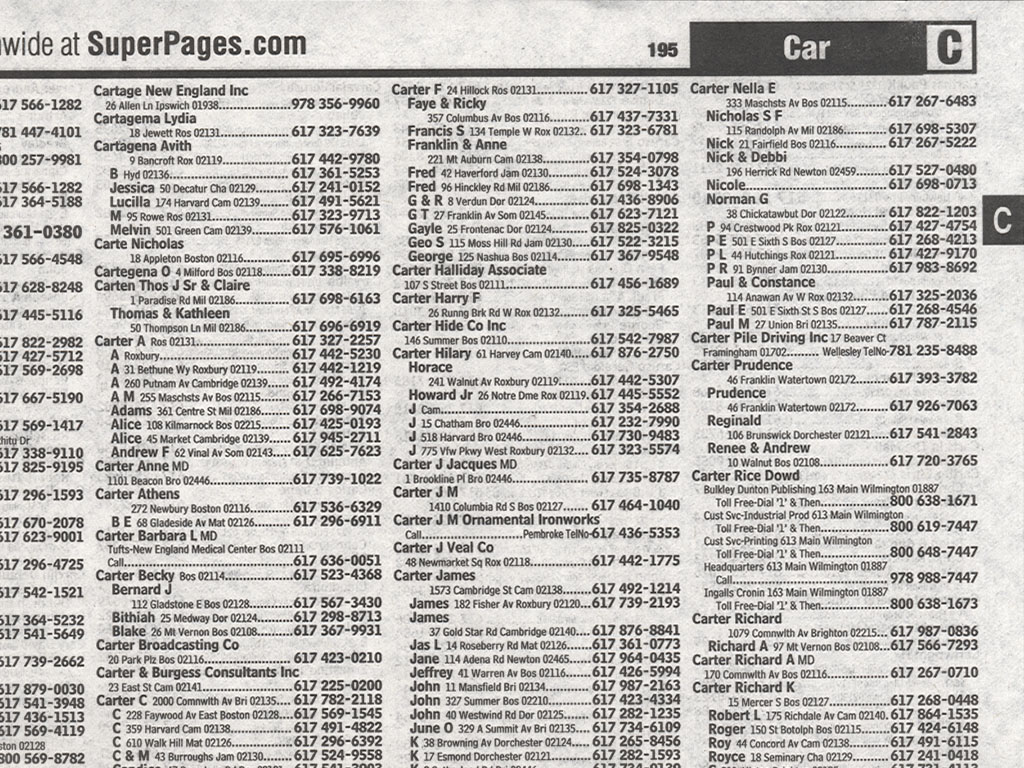
When you click on the sample phonebook page shown below, you will be presented with a larger image of that page.

I want you to look for Becky Carter on the phonebook page, look at the last digit in her phone number, close the page and return to this blog.

Ready? Click on the image to get started.

blogphonebook

Welcome back!

.

.

.

.

.

.


Now … tell me the profession of the person immediately preceding Becky Carter.

In fairness, MOST of you did see the other person.  You had to in order to zero in on Becky.

However …..

Many of you will protest that my question is not a fair one since you were asked to look for different information.

Most will not even recall seeing a profession listed for the previous person.

A lot of you will not even remember the name of the person listed before Becky.

And, unfortunately, some of you have now forgotten the last digit in Becky’s number.

It turns out that Barbara Carter, the name prior to Becky, is an MD.

There are official physiology and neurology-based explanations for what just happened here but complex explanations are not important for now.

Here’s what is important.

When I gave you a specific task, seeking a specific piece of information, you zeroed in on that piece of information and ignored all the other superfluous pieces of information around it.

By the same token, when our Life has specific tasks, wired around purpose, intention and goals, we automatically enable appropriate levels of filtering and discernment, tossing out or ignoring the information that doesn’t meet our needs in moving towards our Life goals.

So “10 steps to this” or “15 steps to that” are all fine when it comes to information overload.

However, once you know where you are going in Life and how you intend to get there, you will find that filtering out fluff is a lot easier and comes much more naturally to you than using the complex processes the “experts” would have you believe you need.

So the next time you are feeling overloaded with information, ask yourself this question instead of seeking out another checklist.

How do I know that my personal or professional goals are defined specifically enough to enable me to be more focused and more discerning?

This question is often far more difficult to answer than the candy-coated, it’s-all-so-easy checklists.

However, being able to answer this question is much more important and will reveal volumes about how you let in so much noise …..

…. and why.

In service and servanthood,

Harry