Showing posts with label information. Show all posts

Monday, December 1, 2014

Oil Prices, Data Privacy and the Price of Information Overload

Information is not knowledge. – Albert Einstein

True genius resides in the capacity for evaluation of uncertain, hazardous, and conflicting information. – Winston Churchill

As someone who is fascinated with how information is acquired, learned, shared and communicated, I have recently found humor in a little message that appears on the dash every time I start my Toyota Highlander.

The message that is displayed on the console is this:

Drive safely and obey traffic rules.

Most of us who would see this message likely fall into one of three categories.

  1. We are safe, law-abiding drivers already and so the message appears to be redundant.
  2. We are not safe, law-abiding drivers and so we feel the message is irrelevant.
  3. We are so busy in our everyday lives that we may not notice the message at all, even after owning the vehicle for years.

I doubt that very few drivers look at this message, pick up their phone and call someone to excitedly proclaim in a grand moment of revelation that they have just realized that they should drive safely and / or obey traffic rules.  If they do, the person on the other end of the call would likely think they had lost their minds anyway.

In many ways, I find the message that the Toyota engineers so kindly provided to their vehicle owners to be a perfect metaphor for Life itself.  In the constant cacophony of information that seeks to overwhelm us daily, most of us are unwilling or unable to separate that which matters from that which does not, leaving us with information that we believe doesn’t apply to us, is irrelevant to us or which we miss altogether.

It is in this maelstrom of information overload that we call Life that the important nuggets of information, whether it be in our personal, professional, financial, relational or societal lives, slip right by us.

Take for example, the potential impact of $40 per oil barrel projections that were announced last week.  The potential impact on nations and the world itself could be profound and not all of it positive (for example, what happens if a cash-starved Russia gets more antsy as its sources of revenue dwindle further).  Despite the potential for serious trouble, most people are either unaware of the projections, unaware of their impact or don’t pay attention to this type of information at all.

Others get consumed by the ramifications of such an announcement and seek as many sources of analysis as they can find, overloading their brain and proving one or both of these two adages to be true:

An economic forecaster is like a cross-eyed javelin thrower: they don't win many accuracy contests, but they keep the crowd's attention. – Anonymous

Economics is extremely useful as a form of employment for economists. - John Kenneth Galbraith

Or this humorous nugget from Despair.com.

Economics - The science of explaining tomorrow why the predictions you made yesterday didn't come true today.

How about the poor serving person I freaked out in a restaurant recently when I demonstrated to her how I could compromise her portable debit machine and skim credit / debit card numbers and pins off it from anywhere in the restaurant?  All she worried about was if she would get in trouble if a transaction wasn’t processed correctly, missing the point that every customer in the establishment was at risk.

Or how about the fact that every week for who knows how many weeks in a row now, a senior government, military or energy spokesperson has expressed concern that we face imminent compromise or collapse of our electricity generation / distribution systems.  Of the 18 critical infrastructures that we have that our society relies upon, 17 of them rely upon one – electricity.  Do you know what your Life looks like if electricity disappears for an extended period of time (think “really” extended period of time)?  Someone is trying to tell you something without actually telling you something.

The list goes on.

And so when a disaster occurs in society, in business, in our personal lives, in our finances or in our relationships, we always end up chanting the tired and worn out cliché that hindsight is 20/20.

However, for those who pay attention, foresight is much closer to 20/20 than many realize, as I demonstrated when I predicted the financial collapse of 2008 in this post, Financial Crisis, or when I explained my prediction process to a reporter as I described in The Secret of the “Soothsayer”.

The Bottom Line

There are very few moments when we are truly caught by surprise and in that surprise, find ourselves at the hands of a disaster or missing the opportunity that “got away”.

More often than not, there are plenty of warnings of trouble or highlights of positive opportunity that are being sent to us constantly.

However, I wonder what kind of businesses, families, relationships and world we could create if we were more proactive regarding what information we took in, how we processed it, what we discarded, what we decided to act on and what action we decided to take?

Would we be better at holding ourselves more responsible and accountable for the results that we produce?

Would we be better at holding others, such as elected officials, business and community leaders more responsible and accountable for the results that they produce?

I think we might.

What do you think?

In service and servanthood,

Harry

PS I am reminded of the blog post Newfoundland–Should We Just Shoot It And Put It Out Of Its Misery? where I cited data pointing to oil falling to $80 a barrel and the ramifications on provincial budgets.  Certain government officials wrote me to tell me to stop spreading gloom and doom and that oil would never get that low.  As I write this blog, it is around $68 a barrel.

Data doesn’t lie to us.

However, how we choose to interpret it or explain it to others may be a different matter.


Wednesday, April 30, 2014

The Wildrose Party – Just the Facts, Ma’am

Get your facts first, then you can distort them as you please. - Mark Twain

Facts are stubborn things; and whatever may be our wishes, our inclinations, or the dictates of our passions, they cannot alter the state of facts and evidence. - John Adams

I was intrigued to see this little invite issued by the Wildrose Party pass through my inbox yesterday.

Hogs from the trough

I found it intriguing given that since it appears to be a Wildrose Party fundraiser for the constituency of Calgary SE, it would suggest that one of the “hogs to be booted from the trough” would be Calgary SE MLA Rick Fraser, Associate Minister - Public Safety and Associate Minister - Recovery and Reconstruction of High River.

While it is the role of political parties to whip up controversy or “live on the edge”, we as citizens should insist that they stick to the facts and the data.

Unfortunately, we have a basic law of democracy that pervades our political culture:

Governments in power rely on facts, data and results while opposition parties rely on emotion and never the twain shall meet.

Also unfortunately, emotions sway people much more easily and effectively than facts.

If one examines Associate Minister Fraser’s record, whether it be in regards to new schools being built in Calgary SE, his tireless efforts in High River (very few people would have wanted this difficult job) and his contributions in other areas, I would posit that his commitment to results and to the people he serves are as good as or better than any politician we will find.

If you examine his expense disclosure reports, they are extremely modest at best, especially given the portfolios he holds as Associate Minister.

And so I would suggest that if other parties are going to take on any incumbent, especially one with a strong track record and a commitment to service, that they do so with specific, measurable counters to the actions, intentions and results of the incumbent and not imply that “dirt” is present when there likely isn’t any for the individual in question.

I also understand that Associate Minister Fraser was allegedly confronted by senior Wildrose Party officials in regards to allegations of corruption and when he reacted strongly about the perceived personal attack, the Wildrose officials backed off and said “We’re not talking about you.  We are referring to members of the PC Party”.

I don’t know about you, but when someone slags a private citizen as being potentially corrupt, it sounds like the basis for a slander or liable suit to me. Sad smile

And while we’re on the subject of revisionism or accusations

I posted on a Wildrose Party official’s Facebook page, asking if the “hogs from the trough” campaign was legitimate and while he admitted that it was, he also altered part of the content of my message.  I questioned why he did it and he responded that he found it interesting that it was possible and that it was good to know such things.

While I’m not sure that the ability to do this is useful (or should even be allowed) and while his alteration was in gest, it caused me to think about social media and it’s powerful influence in the political sphere.  With this in mind and with the intention of proving a point, I in turn changed a Facebook interaction I had with him (with names blanked out for privacy) from this:

FB

to this:

FB

I’ve transformed him from an innocent commenter on a benign post into a traitorous tool against his own party (which I know he is not but subsequent posters to this post will sure be surprised to see his sudden political reversal). Smile

The Bottom Line

We all know that emotion is a more useful and valuable tool than any amount of facts and data.  The sad reality is that most people are so busy making their way from one day to the next that they don’t have time to listen to, understand or comprehend the overwhelming amount of data thrown at them daily (although curiously enough, many of these same people can cite an amazing amount of info regarding the next iPhone).  I mused about the power of emotion in regards to manipulating people in my post Anger: Setting Yourself Up For Manipulation.

However, if we don’t take the time to actually pay attention to the information being sent our way (or to the words that people are putting into our mouths as in my fun little Facebook experiment), then anything is possible.

And the fact that anything is possible does not imply or guarantee that the result is necessarily a positive one.

Nor does it come with a money back guarantee when we cry foul that we didn’t pay attention the first time nor did we read the fine print.

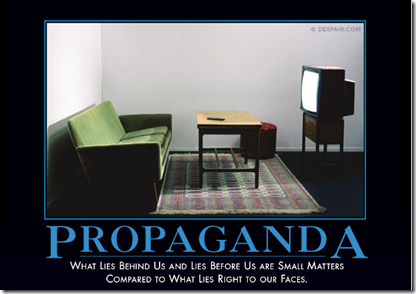
Remember this when someone comes to your door with emotion-laden rhetoric (regardless of the party affiliation) but with no data:

Propaganda - Despair.com

Propaganda: What lies behind us and lies before us are small matters compared to what lies right to our faces.

As the great philosopher Elmer Fudd once said:

Be ve-w-w-wy, ve-w-w-wy careful.

Especially when it comes to information, its sources, the medium used to deliver it and the intention behind it.

In service and servanthood,

Harry


PS My unwitting accomplice in my Facebook example is a good family man, a strong volunteer in his community and believes strongly in his political ideals.  He is what I believe to be a strong contributor to society.  My example was meant to demonstrate how social media can easily twist a good person into something else.  Be cautious about how you embrace social media. 

It is important to define how you use social media – don’t allow it to use or define you.

It is also important to avoid generalizations, especially when describing individuals.  Efforts to tar everyone with a single brush often do more damage to the person wielding the brush than it does the intended subject.


Thursday, September 26, 2013

Story Telling–Applying Personal Context to Data

As a long time strategy guy, I am the type of person who drives people crazy with questions like “why?’ and “how do you know?”.  I have always believed the idea that if the mere existence of a question evokes anger or other emotions in someone, then there is something buried in the emotion that warrants exploration. 

Sometimes when asking questions, what appears obvious to us may not appear obvious to someone else and it is at that point that the best, sharpest and most clearly illustrated data in the world just won’t convince someone of the point that we are trying to make.

It is at this point that we realize that if we don’t find a different way of making our point that we are condemned to an impasse, each side frustrated that they couldn’t “sell” their idea to the other.

This morning I attended a conference call regarding national emergency preparedness for a variety of scenarios.  After getting off the call, I had one of those moments where I just wanted to go throw up somewhere (not all of these meetings are gentle).

Shortly after getting off the call, a friend walked by, saw me, sat down for a moment and we exchanged pleasantries.

When she asked me what I was working on and I told her, it sparked a passionate conversation around her wonderment and bewilderment about why mankind seemed unable to embrace unlimited, unquestioned, unconditional love and trust in all scenarios – that to accomplish this would solve all of our problems.

It seemed so simple to her.

Try as I might to illustrate a response using tons of data and historical references (data is my life), my answers didn’t satisfy her questions at all and we were both getting frustrated with the conversation.

And then I explained it this way.

“Assume you are on a dark street at 3am in the morning and you are alone.  You see a large stranger approaching you in the dark.  What do you do?”

She replied “I blow my security whistle”, as she held up the whistle on her keychain.

Why?”, I asked.

“Because I am afraid he might hurt me”, came her answer.

“And why would you think the worst case scenario and not assume that he was approaching you in perfect trust and love?”, I asked.

“Because of my past history”, she replied.

And as she replied, the light came on.

Sometimes when you find that all of your glorious charts, graphs, tables, decision trees, logical perfection and everything else don’t seem to resonate with your audience, take a step back, pause and then find a way to wrap a personal story around what you are trying to present.

A story tailor-written to the context of the recipient’s Life experiences and not your own.

Because oftentimes the only thing that separates us from clear communication is the common context that best arrives in a good story.

In other words, we must touch the heart in order to influence the mind.

Have you touched any hearts lately?

In service and servanthood,

Harry

Thursday, September 19, 2013

Alberta Health Services–In Need of a Cranial Defibrillator

When Alberta Health Services announced on September 10th that they were initiating a significant reorg of upper management as an initial step to providing better services to patients, partners and stakeholders, many people forwarded the report to me proclaiming it was either the best or worst report they had ever seen.

Upon examination of the report, I must confess one thing.

Without facts and data, how can you tell if it is either?

The report opens with its guiding principles (quoting verbatim):

  • How does this organization and structure further AHS in providing high quality service to Albertans, and secondarily in providing teaching and research opportunities to advance the future of health care in Alberta and beyond?
  • How does AHS provide teaching and research opportunities to advance the future of health care in Alberta and beyond?
  • How to ensure there is effective and enhanced collaboration between AHS and the Ministry of Health.
  • Serve as a roadmap for moving forward.

A very worthy but very broad set of principles, I thought, especially for an organization as wide, as deep, as complex and as important as Alberta Health Services is. 

The report then explains some of the symptoms that prompted the need for a study in the first place, including but not limited to (quoting verbatim):

  • The current organizational design could be improved to more directly support a mandate of putting the emphasis on service to people.
  • It is anecdotally reported that the structure is confusing to navigate for patients and the general public.
  • Community leaders have also expressed concerns that it is unclear who they should turn to inside the organization with local health delivery concerns.
  • There is more emphasis on corporate functions and responsibilities as opposed to clinical functions.
  • Each layer of the organization should demonstrate added value to AHS’s mission.
  • People should want to work in AHS, not simply be employed there because there is no other option.
  • It is not always apparent how AHS works complementary to and in support of the Ministry of Health.
  • It has been my observation that some staff in the organization frequently spend more time than is likely necessary or productive on process and crisis response including the preparation of briefing notes, background documents, media statements, etc.
  • Decision making activity and communication planning have to be focused on people and the overall mandate of the organization.

Whew … that’s a long list and quite an endeavor to undertake.

But then the report has a myocardial infarction.

It immediately proposes a new org chart, based on the principles of:

1. The primary focus is providing health care services to Albertans and secondarily to support teaching and research.

2. Working collaboratively with stakeholders and partners is essential to a continuously high performing health system

3. Any additional layers in the organization structure need to be justified on the basis they are adding value to the organizational objectives.

To jump to the end result without explaining how one got there is like watching the first five minutes of a movie and the last five minutes, leaving the audience to ask “What in the heck just happened here?”.  The producer and director know but that’s not helpful to the audience.

There is not a shred of data that demonstrates how the symptoms were measured nor how the org chart (and the associated firing / reorg of 5 / 75 people respectively) addresses the symptoms in a measurable “how do we know this solves them” way.

To justify the miracle cure, the report goes on to reference textbook-like quotes such as:

It is important here to distinguish between leadership and management – the two are not the same. AHS has a multitude of managers. Leaders, as distinguished from managers or bosses, are people who inspire others to be the best they can be. Someone others look up to as role models. Leadership requires courage, vision, and likeability.

Collaboration and cooperation with key stakeholders is critical moving forward.

For the record, leadership is not merely made up of people who inspire others to be the best that they can be or whom people look up to as role models. The Dalai Lama is a leader to many by this definition but probably wouldn’t have the foggiest idea how to run a health care system.  However, to get into a more valid definition would be to inundate you with more textbook quotes. :-)

The report then goes on to say that there will be reviews of strategy in the areas of:

  • IM/IT strategy
  • People strategy
  • Research strategy
  • Patient centred care strategy

But is the cart before the horse here?

I would posit that the strategies in these areas be examined first as part of a holistic “who are we, why are we here, who do we serve and how do we do it” review and then make appropriate org changes in order to maximize investment, execution and results in each of these areas. 

Perhaps some type of backward induction or backcasting process (click here for an example), starting backwards from a desired end goal to the present to determine optimal capital, processes, human resources, roles, rites, rituals, rewards, etc., could be used to create a baseline.  Existing attributes and processes could then be overlaid over these “theoretical optimums” to determine deviations from optimal, adjustments could be made, etc.  Very complex …. but very effective …. very measurable …. and very transparent.

      Otherwise, the completion of the studies planned within AHS (some of which use less effective “forward looking” processes or the even less effective, very subjective “justification” models) may require undoing / redoing the org changes that were just made.  In other situations, people may find that these studies become tainted as they become an exercise of “Ok – now how do we make these strategies fit into the present org chart even though the org chart should be changed to accommodate these strategies?”.

      How do I know what processes some groups are planning to use?  Read The Coffee Shop–The New Source of Privacy Leaks to find out.

      Then we have other worrisome ideas.  When I attended the Alberta Economic Summit in February past as I described in The Alberta Economic Summit and Tough Decisions, this suggestion was put forward:

      Heather Smith, President of the United Nurses of Alberta, suggested that many problems in Alberta’s economy would automatically be solved if we had more public servants – that bigger is always better. 

      So given all of this, it seems odd to invent a new leadership structure before one has all the data to understand what it is they are leading.

      The Bottom Line

      In the real world, leaders strive to run their organizations such that the organization becomes:

      • the investment of choice
      • the employer of choice
      • the provider of choice

      When a service is mostly a government monopoly (with some exceptions), it is difficult to accomplish these objectives and provide incentive to team members to accomplish such ideals.

      That’s not a call for a private competitor to Alberta Health Services.  It is just an observation of human realities and the fact that we are often at our best when facing competing forces.

      Goldilocks and Data – Not Too Much Or Too Little

      Add to this the complexity that when it comes to informing the electorate as to what one is doing to improve a government-provided service, one walks a fine line between informing the voter and overloading them (if the voters even care about the details).

      However, if we do things in the wrong order or in absence of sufficient data, it is difficult to determine whether the actions chosen will produce the desired outcomes.

      Add to that the fact that if we don’t demand supporting data (and full transparency in general) or pay attention to who really benefits as I mused about in Government and the Death Spiral of Status Quo, then we will never know if the right choices were made at all.

      And then we will never know if the cranial defibrillator being applied to Alberta Health Services is saving it or killing it.

      <rubbing the paddles together>

      CLEAR!

      In service and servanthood,

      Harry

      Addendum

      When it comes to portraying something as salvageable or not, I recall with amusement, Monty Python’s “Dead Parrot Sketch” (warning: strong language).


      I’m not suggesting that AHS is not salvageable because it is a great organization, staffed with great people and it must be saved.  It just needs a little strategic and tactically intelligent assistance to help it reach its ultimate potential.

      However, I’m not certain that a report filled with little data is going to move the ball in a manner that serves the people, the organization or the government in a measurable, known-outcome way.

      However, to the uninitiated, it does have a sense of “feel good”, I suppose … a feeling that “things are happening”.

      Unfortunately, “feel good” is like writing a prescription for pain killers when someone has a broken foot while omitting the need to put a cast on the foot.  It kills the pain for now but potentially leaves the patient lame for the rest of their Life or needing much more expensive treatment options in the future.

      Addendum 2 – Past Performance

      I am on public record three times for reporting privacy breaches by AHS staff and AHS staff (including people responsible for monitoring such breaches) are aware of this. 

      However, no one has ever contacted me to specifically ask what was revealed, by whom and in what manner was privacy contravened.  I wonder if such a lack of urgency (something that a business would get on top of immediately to protect their interests) is indicative of the sense of urgency to be expected in the upcoming reviews.  I hope not.

      Addendum 3 – Competency

      I have received a fair number of emails asking me to describe my thoughts on the overall thoroughness of the report and the competence of the author (Ms. Davidson).  While it is obvious from this blog that I find the report to be disappointing, other opinions that I might offer don’t add to a constructive dialog that would benefit the process of enhancing AHS and the services it offers.

      There is an intriguing event currently developing at the Trillium Health Centre where Ms. Davidson served as President and CEO until December of 2011.  Trillium has recently announced that 3,500 patients are facing potential health concerns as a result of the misinterpretation of mammograms and CT scans by one doctor for the period from April 2012 to March 2013.   I wonder if Ms. Davidson had any input into the processes there (with its supposed checks and balances) that allowed this issue to take place, given that it began a few months after she left. 

      She was also a senior official with the Canadian Red Cross when the tainted blood scandal was being resolved in the late 1990’s according to this bio but curiously omitted from her LinkedIn profile.

      image

      What would she have learned from these incidents that the people of Alberta could benefit from as a result of these incidents?

      Mistakes happen. 

      What we learn from them matters.

      What we share with others matters more.

      Thursday, December 13, 2012

      The ONE Step Secret To Reducing Information Overload

      For years there has been a lot of information floating around that offers tips on how to effectively reduce information overload.  There has been so much published about the subject that I would posit that all the checklists aimed at reducing information overload are actually contributing to it.

      I believe there is ONE fundamental principle that, when embraced, truly helps us reduce most of the information overload that we experience.

      In order to demonstrate this principle, I would like to ask that you humor me with the following experiment.

      When you click on the sample phonebook page shown below, you will be presented with a larger image of that page.

      I want you to look for Becky Carter on the phonebook page, look at the last digit in her phone number, close the page and return to this blog.

      Ready? Click on the image to get started.

      blogphonebook

      Welcome back!

      .

      .

      .

      .

      .

      .


      Now … tell me the profession of the person immediately preceding Becky Carter.

      In fairness, MOST of you did see the other person.  You had to in order to zero in on Becky.

      However …..

      Many of you will protest that my question is not a fair one since you were asked to look for different information.

      Most will not even recall seeing a profession listed for the previous person.

      A lot of you will not even remember the name of the person listed before Becky.

      And, unfortunately, some of you have now forgotten the last digit in Becky’s number.

      It turns out that Barbara Carter, the name prior to Becky, is an MD.

      There are official physiology and neurology-based explanations for what just happened here but complex explanations are not important for now.

      Here’s what is important.

      When I gave you a specific task, seeking a specific piece of information, you zeroed in on that piece of information and ignored all the other superfluous pieces of information around it.

      By the same token, when our Life has specific tasks, wired around purpose, intention and goals, we automatically enable appropriate levels of filtering and discernment, tossing out or ignoring the information that doesn’t meet our needs in moving towards our Life goals.

      So “10 steps to this” or “15 steps to that” are all fine when it comes to information overload.

      However, once you know where you are going in Life and how you intend to get there, you will find that filtering out fluff is a lot easier and comes much more naturally to you than using the complex processes the “experts” would have you believe you need.

      So the next time you are feeling overloaded with information, ask yourself this question instead of seeking out another checklist.

      How do I know that my personal or professional goals are defined specifically enough to enable me to be more focused and more discerning?

      This question is often far more difficult to answer than the candy-coated, it’s-all-so-easy checklists.

      However, being able to answer this question is much more important and will reveal volumes about how you let in so much noise …..

      …. and why.

      In service and servanthood,

      Harry

      Monday, November 26, 2012

      We The People …. Or Not

      I noticed recently that President Obama finally got his Internet Kill Switch law passed.

      No, not the one he was trying to drive through Congress a couple of years ago.  Congress stymied him for so long that he eventually gave up using the system with its checks and balances (and not without its frustration on occasion) and passed an Executive Order granting himself the privilege.

      Executive Orders (aka Executive Directives) are an intriguing idea in US politics.  The President can create them at any time, can leave them in effect as long as he / she wishes, can invoke them as defined within the definition of the Order and the content of the law, including the rights of American citizens while the Order is in effect, are classified.

      These Orders are often even beyond the oversight of the people we elect into government.

      I’m all for passing laws to ensure the security and integrity of the nation.

      In the hands of a good leader taking action to benefit or protect the nation, the laws can prevent an otherwise catastrophic event from bringing a nation to its knees.

      And in the hands of the wrong leader, such laws can undermine the greatest nation on earth.

      Which way the laws can be used is difficult to determine when the people we elect into power can pass laws that are beyond the ability for “we the people” to examine.

      It is difficult to tell when the people we elect into power can circumvent the natural checks and balances built into the system (as frustrating as that system can be sometimes).

      It is difficult to tell when even our own lawmakers in Congress are not permitted to see the content of the Executive Orders.

      It is difficult to tell when one cannot easily determine if elected individuals answer to “we the people” or if it is the other way around.

      And it is difficult to tell when “we the people” don’t bother to be educated when it comes to knowing how the system works or where it is going.

      A nation gets stronger when strong, informed people elect strong, informed leaders.

      When either side of that equation is not as strong or as informed as it should be, the nation doesn’t get stronger.

      It gets weaker.

      In addition to being informed, one has to have the will and the desire to make a nation stronger.  One actually has to care about the future of their nation and provide more than lip service.

      Do you know which way America is going?

      How do you know?

      Are you certain?

      In service and servanthood,

      Harry

      Friday, August 31, 2012

      Being Told What To Think (Worry) About

      A few days ago, I received a news alert to my phone that Hurricane Isaac had claimed its first fatality.

      With no disrespect to the person who lost his or her Life, I made an observation that 24,000 children under the age of 5 die every year from tainted water and my friend Nathan made this observation:

      That really gives me perspective. How often are we fed what to care about?

      I did some number crunching and found that the number of kids who die from tainted water varies from year to year and has ranged from 18,000 to 29,000 annually, depending on who is providing the data and the events happening in the world for any given year.

      The World Health Organization’s 2004 numbers show that a child dies every 15 seconds from a water-borne illness.

      That works out to over 5,700 deaths per day – the equivalent of 20 large airliners crashing daily.

      Now consider these statistics as reported by the LA Times in 2011.

      36,284 Americans were killed in car accidents in 2009.

      37,485 Americans died as a result of inappropriate drug use (either illegal or prescription, whether wilfully or accidentally).

      And one more interesting statistic.

      25,000 Americans die on average each year merely by falling.

      Imagine if we received a news alert every time someone was killed in a car accident (about 100 per day), died from drug usage (about 103 per day) or died from falling (about 68 per day).

      The point is this.

      When the media makes a big deal pointing out that one person was killed and spends hours analyzing how horrific such an event is, this is not meaningful news but for some, it touches the “fight or flight” part of the brain and creates additional worry in an already overloaded brain.

      The impact on each consumer of that information will vary in intensity and impact but the influence occurs all the same.

      Now while every Life is important, one has to wonder what the agenda is of any news agency that will spend hours analyzing a single death when many more die from preventable issues (such as tainted water), issues that don’t even strike the radar of the same news agencies.

      This should cause us to wonder if we wish to participate in this agenda and allow opinions of what matters to be formed for us or whether we wish to be more selective in what information we consume (and demand from these agencies).

      When we decide what information we wish to absorb and from whom we wish to obtain it from, we take a step towards extricating ourselves from someone else’s agenda and moving more towards managing our own purpose on our own terms.

      And perhaps then, we take a step towards creating a more meaningful impact on those in need in the world instead of absorbing another negative statistic that in the grand scheme of things, is not useful, meaningful or helpful in creating a better world.

      Possibly ….

      …. unless you would rather see news about some poor schmo who “bought it” in spectacular or horrific fashion instead of receiving information that inspires and compels you to bring your talents, strengths and skills to bear to make a difference.

      If that’s the case, you are just a cog in someone else’s wheel, serving their agenda at the expense of your own purpose and destiny.

      And who wants to be that?

      In service and servanthood,

      Harry

      Wednesday, May 9, 2012

      Sex and Premature Dissemination

      I was riding public transit recently and seated across from me was a lady in her mid 30s, impeccably dressed with what appeared to be painful abrasions on her knees.

      While it was definitely none of my business to ask how she had acquired them, a lady sitting next to her happened to notice them and asked what had happened.

      In a hushed voice (we all know how “hushed” a voice we can use on a bus, right?), the lady with the scabbed knees went into great detail about Ron ███████, apparently a successful attorney in the city of ███████, and his insatiable but delightful prowess in certain areas.

      While Mr. ███████ may be an awesome lover, his reputation is being destroyed by this woman who happily describes many things about him that the rest of us shouldn’t know.  He should either find a more intelligent woman to hang out with or buy his women carpenter’s knee pads to prevent curious passengers on public transit from instigating dialog.

      Information is a fascinating thing, being a key component to creating success or catastrophic failure depending on how it is used.

      Too much information can make some people paranoid while empowering others to create powerful results.  Too little can allow some people to live a life of ignorant bliss while driving others to rearrange their Life priorities in order to satisfy some craving or need.

      As we immerse ourselves in the age of mobility, preferring to be out-and-about instead of being confined to an office, many are forgetting that such mobility comes with new rules regarding who is around us when we are discussing private matters and who is in a position to obtain and use the information we believe to be private.

      I’ve watched businessmen in coffee shops vehemently complain about how Facebook’s privacy policy is way too lenient and then go into amazing levels of detail about an imminent court case against a specific person while stressing the importance of not telling anyone because they don’t want the potential defendant in the case to be prepared.  Meanwhile, people like me, who could be someone closely related to their target, sits at the table next to them and hears the entire conversation.

      I’ve overheard lawyers explaining loopholes to DUI drivers who had killed others in accidents, accountants showing clients how to hide their money illegally from the system, guys planning M&A (merger and acquisition) intentions with the highest level of confidentiality, investors discussing secret arrangements, lawyers and doctors discussing privileged information (naming their clients) and even observed one possible terrorist preparing a PowerPoint deck containing his thoughts on jihad.

      Then there’s my other personal favorite … the occasional errant email meant for someone else, outlining a highly confidential arrangement that gets emailed to me by accident, followed by a follow-up threat that the information sent to me by accident is privileged and I am not allowed to do anything with it.  They don’t realize that one-way implied contracts have no legal merit nor can they undo the damage that may have been done.  At that moment, they are relying on the values and ethics of the person who received such information in error.  If I were the owner of the information, I’d rather not peg my success on such wishful thinking.

      More than once, I’ve had people who, upon realizing that I had overheard them in a public place, had demanded that I sign an NDA (non disclosure agreement).  Unfortunately, I could not comply with their request.  Signing such a document doesn’t cover up their incompetence.

      Information in the hands of the unknowing is useless and much of it goes by our ears every day without striking a chord with us.  However, information when mixed with context, strategic plans and tactical intention in the right person’s hands becomes knowledge.

      And knowledge is power.

      Who you share it with, who shares it on your behalf and who shares knowledge about you provides the opportunity to amplify or diminish that power.

      I hear a lot of “gurus” tell people about how they are always on the alert to glean things from the information being shared around them.

      Success, personal and professional, also requires one to be on the alert regarding how we share information with others and whom we share it with.

      Instead of focusing solely on people who have access to our private information and being paranoid about what they will do with it, whether it be Facebook, some email provider or the like, we should remember that oftentimes, the greatest disseminator of private information is still the person who owns the information and who therefore has ultimate responsibility for keeping private what is meant to be private.

      When we point our finger elsewhere and demand better privacy oversight from someone else, we should note where the other three fingers are pointing.

      Because oftentimes, that is who we should be expecting more from.

      In service and servanthood,

      Harry

      Friday, August 12, 2011

      The Secret of the “Soothsayer”

      I was contacted this morning by a young lady representing a Northeastern newspaper, looking for a comment on the accuracy of some of my predictions in recent years, most notably the downturn in September of 2008, the current economic struggles and some company successes and failures that I predicted contrary to the predictions of others.

      She seemed to be fascinated that the things I have gone on public record about appear to have manifested as predicted and within the window that I predicted and she wanted to know how I did it.

      In my reply, I mused about the potential sources of my predictions, namely:

      1. Perhaps my Wall St. background and connections give me access to information not generally available.

      2. Maybe its my recent work in predictive analytics, using math models to predict human behavior and the results of that behavior.

      3. It would be nice to claim that I had a red-phone directly to God, but I don’t.

      4. I can’t profess to have any belief in tea leaf reading and other forms of divination so that’s not it.

      5. It could be my 20+ years providing strategy and global technology architecture, in a world where optimism must be balanced by pragmatism and where the art of listening is critical to providing solutions that work.

      6. Maybe its my upbringing in a small community in eastern Canada, where common sense was bred into us (and beat into us if we still didn’t get it).

      Yes, they may have all played a role (except for the red-phone, which hasn’t been installed yet but I have ordered one). :-)

      But then I mused, that maybe, possibly, it is because ….

      1. I can read.

      and ….

      2. I accept that information is just information.  It becomes good or bad news depending on what I choose to do (or not do) with it.

      and finally ….

      3. I am not afraid to ask questions and to speak frankly about the responses that I receive.

      Many people, in an effort to escape the squeeze of daily life, prefer to ignore most the important information around them, filling their life with distractions that are more time-waters or mind-deadeners than anything.  If it looks like bad news (even though it is just information), they avoid it or embrace the mantra “I only read positive, reaffirming material”.

      When I absorb information, I like to explore it, question it, evaluate it and analyze it, filtering out stuff like why some famous person spends $28,000 a week on her hair.  Many times, my questioning makes the owners of the information feel uncomfortable, since my questioning reveals avenues that they hadn’t explored or truths that they hadn’t or don’t want to acknowledge.  They forget that these truths aren’t good or bad – it is still only information until they make choices that turn it into good or bad news.

      When I ask questions, I have a purpose behind them that was well described by my friend Bill H. when he said, “I am not trying to question your faith, I am trying to build mine”.

      And finally, I am not afraid to speak my mind about the results.  I try to present the information objectively, fairly and responsibly, but I share it all the same.  If the emperor has no clothing, I have no qualms about saying it, as long as it is presented in an appropriate fashion.

      Many people today hunger for optimism – if the news is good they want to hear from you as a fellow optimist but if it is bad news (as they perceive it), then they don’t want to hear from you with cries of “away from me, you pessimist”.

      But I believe this is an unfortunate state of denial that doesn’t allow us to manage our lives in a better fashion and is largely responsible for how we have arrived where we are today.

      And so when I examine things in front of me, whether it be the state of the economy or examining an organization to help them be successful (or warn them if the inevitable collapse is approaching), I strip the subjective fluff out of the information and view it as just that.

      Information – pure and raw.

      And then I ask a lot of questions until I am satisfied that I understand what I am looking at and can make appropriate choices with it.

      The information is not good or bad until we make our choices as to how we will use it.

      But if we ignore the information or our right and responsibility to understand it, question it, analyze it and apply it, then the results are VERY predictable.

      And that’s not pessimism.

      It’s reality.

      In service and servanthood,

      Harry