Showing posts with label vision. Show all posts

Friday, April 24, 2015

Alberta Politicians and Their Visions? How About YOUR Vision?

Leadership is the capacity to translate vision into reality. - Warren Bennis

The only thing worse than being blind is having sight but no vision. - Helen Keller

The political rhetoric is heating up in Alberta as the Province gets closer to its provincial election and as usual, social media is aflame with emotion-laced, data-less pleas by politicians and supporters promoting a message of “support my party or suffer doom from your ignorance”.

There are fascinating things I see in the discussions amongst the political minions when it comes to politics:

  1. Few of them understand the complexity of government and what it takes to run one even quasi-effectively.
  2. Few of them understand the plans of any of the parties that are running, including their own party.
  3. Few ask for data to back up political claims by any party, including their own party.
  4. There’s a lot of political Kool Aid being consumed. It has some interesting side effects, including making people wide-eyed and incapable of having reasonable, rational, fact-based conversations.
  5. Too many minions have very strong (translation: rabid) opinions despite lack of data or not being able to verify the data they have been provided with.
  6. Too few people understand this basic truth as expressed by Mark Twain: “Facts are stubborn, but statistics are more pliable”.  Statistics may be “accurately expressed” but it may not be expressing a truth as interpreted / shared by the recipient (often done deliberately by the person delivering the original statistic).  For example, if I earned $1 last year and $2 this year, my revenue is up 100% over last year.  Sounds impressive until you realize I only earned an extra dollar.
  7. Few can define a truly measurable vision for their Province.  PS – “lots of jobs”, “great healthcare” and “strong education” are not measurable – they are hopes and dreams.  Ask them about their next vacation or even their new mobile device, however, and data flows freely and copiously.
  8. Practically all of them demand that politicians create a grand vision that bodes well for the minions in absence of a minion’s own definition.
  9. Minions, without any data and built entirely on emotion, simply know that their leader will guide them to salvation while all other leaders will guide them to hell.
  10. The amazing concept of how many people will vote for / against someone based on a single sound bite or a candidate’s appearance.
  11. The number of people who blindly vote for a party because they have always done it or because “it is their father’s party”.
  12. How many cowards find courage in anonymity on social media, discovering a voice of ignorance that feels encouraged to bash unfairly or spread misinformation / intimidation while hiding behind a nom de plume and a fake photo.
  13. The number of people who spoil a vote, cast a protest vote or don’t vote at all with the intent of “sending the system a message”.  The only message it sends is that you don’t care if your voice is heard or not.  In an interesting coincidence, many of those people are also the loudest complainers about their government.
  14. The number of politicians who get elected navigating / exploiting the nuances contained within the previous points.

It is human nature that we don’t take the time to really understand things around us unless it directly impacts us and while it is true that government does directly impact us, most of us don’t see it that way. 

It is also true that government is very complex, being too complex for almost anyone living on the planet to understand, interpret, guide or predict and if we took the time to understand all the nuances, we wouldn’t have time for other trivial, mundane things … things like living our lives, earning an income, supporting families and all of those other unimportant things.

For this reason, most of us say “you go do your governing thing and leave me to do my thing and we’re all good …. well, until you disappoint me and don’t give me what I want or need.”

Then we get angry, we pay little measurable attention to what politicians offer us in their new definition of our future and then we repeat the process.

Einstein’s Law of Insanity comes to mind, doesn’t it?

Parallels in Life ….

Few of us build a business, design a home or even plan a vacation without knowing exactly where we are going, how we are getting there, how much it is going to cost, how long it will take and how we are going to pay for it.

And yet we allow politicians to do just that when they promote grand plans with nothing measurable in them.

Imagine going to the bank for a loan, telling them that you are going to build “a structure”, you don’t know how big it will be, what it will be used for or when it will be completed.  You also remind them that at any time, you might tear down the structure and start all over or abandon it all together.  Oh … and by the way … you don’t know how or if you will ever be able to pay off the loan.  However, you remind the bank that the structure will be glorious in appearance, it will serve your needs well and will be a legacy for generations to come.

Try not to resist them too strongly as they escort you to the door.

The Bottom Line

Before we get all upset with politicians who exceed the bar in rhetoric but don’t meet the bar in reality, we need to ask ourselves this question:

What measurable vision do WE see for our Province?

If we can’t define a vision ourselves, how can we expect someone else to define one that we like and even if it is one that we like, how can we be sure that they are delivering on the vision instead of delivering a mere dream (or a nightmare)?

We don’t set out on a journey (or allow someone else to take us on one) unless we know where we are going or where we are being taken.

The same should apply to politicians.

Because if we don’t know or care where we are going or how we are getting there, doesn’t it seem a little insane to expect that a complete stranger has the interest, intention and capability to guide or take us there?

Otherwise, we run the risk of proving the lesson that Alice learned:
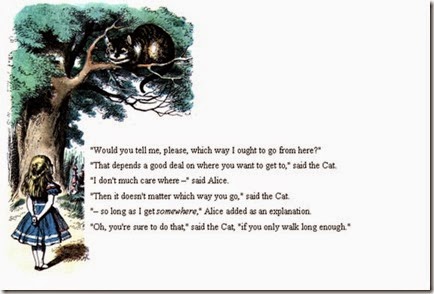
Alice and the Cheshire Cat

“Would you tell me, please, which way I ought to go from here?”

“That depends a good deal on where you want to get to”, said the Cat.

“I don’t care much where ….”, said Alice.

“Then it doesn’t matter which way you go”, said the Cat.

“…. so long as I get somewhere”, Alice added as an explanation.

“Oh, you’re sure to do that”, said the Cat, “if you only walk long enough.”

Do you care where you are going or where you are being carried?

Are you sure?

How do you know ?

What are you doing about it?

Because if you choose to do nothing or you choose to make uninformed decisions, I think you receive the government that you deserve and you therefore have no right to complain about it.

What do you think about that?

In service and servanthood,

Harry

Addendum – Alberta PC Party Goes Down In Defeat - May 6, 2015

Former Premier Prentice guided to the PC Party to a crushing defeat in the Alberta election on May 5, 2015.  Those of us in the PC Party who warned the leadership about the importance of being honest with citizens, about being respectful and to use data instead of fear mongering were told to mind our own business.

I guess a few voters felt the same way also and made it their business to tell the PC Party what they thought of them.

To know the difference between confidence and arrogance is to walk the fine line between great results and embarrassment.

The PC Party just learned the difference.

Monday, October 24, 2011

Whose Eyes Do You See the World Through?

I remember a comic strip years ago where a fraudulent evangelist was hosting one of his high-energy church services.  His altar was at the top of 10 or 15 steps and he invited people to climb the steps to be healed by him.

A man who had spent his entire life walking with the aid of crutches came forward and with great struggle, ascended up the stairs to the altar and begged for his legs to be healed.

The phony evangelist spread his hands, yelled “Be healed” at the top of his lungs and kicked the crutches out of the hands of the man.  As the man stumbled, tumbled and fell down the stairs, arms and legs going everywhere, the preacher yelled out “He’s not only walking, he’s dancing” to which the congregation responded with cries of “Praise the Lord”.

The congregation saw what the evangelist wanted them to see - they were seeing the world through his eyes.

The man with the crutches saw a different reality.

The danger of seeing the world through the vision of others

Sadly, many of us spend most of our lives looking through the eyes of others.  We seek to live values as defined by others.  We choose to accept the “knowledge” of others instead of learning it for ourselves.  We allow people to make sure that their needs are met before considering our own.  And then there is the most insidious form of opinion-forming of all; when we allow others to form our opinions of ourselves.

People in the business of manipulating others count on these things, whether they be people like the fraudulent minister described above, a corrupt business person, a politician serving his or her needs instead of the needs of their constituents or any self-serving individual.

They make it look obvious to everyone that what they proclaim is the truth and if we disagree with the truth, then there is something wrong with us.  Even worse, they convince many around us to think the same way such that eventually, many are afraid to think for themselves with the fear that their idea will be alone, defenseless and considered incorrect at best or idiotic (potentially treason-like) at worst.

What triggered this thought was President Obama’s announcement the other day that all the troops in Iraq were coming home by the end of 2011.

He reiterated that he had kept a campaign promise made during the last election to bring the troops home and now Democrat supporters are rallying around the fulfilled promise of the Commander-in-Chief.

The only problem is that this isn’t quite what happened.

The truth is that the US was negotiating with Iraq for American troops to remain in Iraq (counter to the President’s election promise), some of whom to serve as advisors to the Iraqi military and some to serve as a deterrent in case Iran wanted to cast a covetous eye in the direction of Iraq.  With the failure of the negotiations and the demand by Iraq that the soldiers leave practically immediately, the President is spinning the diplomatic defeat into “bringing the troops home as promised”.

Meanwhile, Afghanistan announced this weekend that should the US take a strong stand against Pakistan for perceived “lack of support in the war against terror”, then Afghanistan under President Karzai would immediately side against the US to defend Pakistan.

With friends like these …….

The wars in Iraq and Afghanistan have cost the US taxpayer an estimated $1.3 trillion with more than 4,00 killed-in-action and 32,000 wounded.

And at the end of the human and financial sacrifice, we are being asked to embrace the positive results that the politicians see.

The only challenge is …. are there really any positive outcomes to see as a result of these actions?

Yes, Osama Bin Laden is dead, something President Obama noted as a victory the other day.

And yet, if this is the primary victory that we cite after all of the sacrifice, surely there has been no more expensive manhunt in world history than this.

Looking through different eyes

If you are a politician, you tell us that Al Qaeda’s ability to wage war has been practically destroyed while asking to be reelected as a protector of the people.

If you are military leader, you tell us that we shouldn’t be so confident, that the enemy is more complex than ever which is why you are asking for permission to build better weapons.

If you are the Department of Homeland Security, you tell us that never before have we been in greater danger at home, thus justifying the need for sweeping changes in personal and physical privacy to assure the safety of the public.

If you are someone on Wall Street making millions each year in salary and bonus, you tell us that bailouts and such are necessary to preserve the American (and in fact the global) system while tightening the screws on the average citizen who can barely survive from one day to the next.

With these and other concepts, many Americans fight each other in coffee shops, the media and lately, with #OWS, in the streets over the truth of these and other statements and their ramifications.

But whose opinions are being used as the basis for the debates?

I find when I discuss these and other issues with people, they often can’t give me their own opinions.  You can usually pick these people out – when they state an opinion and you ask “how do you know?”, they usually get very angry or frustrated and rely on intimidation instead of logic and knowledge to make their point.

In the end, many of them don’t give me their own opinion but rather, they give me someone else’s …. the world as seen through the eyes of the people striving to direct them toward someone else’s preferred outcome.

We can do better – an informed opinion is a powerful one

As long as the best opinion we have is someone else’s, we will never have a chance to create a better world.

If instead, we look through the eyes of the downtrodden, the impoverished, the homeless, the hungry, the abused, the war widow, the fatherless / motherless child whose parent was lost in war, the hardworking person who lost everything through no significant action on their part, etc. , we have an opportunity to see a different world.

Once we truly see it, only then we can change it.

It is true that everyone’s perception is influenced and tainted by their own life experiences.  However, if we are going to allow our opinions to be formed through the eyes of others, then let’s choose the eyes of people whose vision reflects a greater sense of reality for the average person.

And maybe then, even if we insist on not forming our own opinion, we can at least form an opinion of greater value than many of the opinions we are forming or that are being formed for us.

A Great Correction is sweeping through the world, carrying with it a momentum that cannot be stopped.

While it has a life of its own, I believe the result, whether negative or positive, is still within our ability to direct.

Whether we choose to make it a positive or negative result depends on whose eyes we are looking through.

Which in turn determines whether we will truly be dancing at the foot of the stairs or lying at the bottom of the stairs in a crumpled heap when the Great Correction reaches its climactic conclusion.

If nothing else, look through the eyes of our children and then ask ourselves if we are making the right choices.

And then go make them.

In service and servanthood,

Harry

Friday, July 8, 2011

Seeing It Again For the First Time

I was making a turn at an intersection today when I noticed, for the first time, that if I look between two buildings across the street, that I can see the Rocky Mountains in the distance.

I’ve made this turn a gazillion times.

I’ve seen those buildings a gazillion times.

Therefore, I have to have seen the Rocky Mountains between them a gazillion times.

But today is the first time I was aware of them.

A minor event that was occurring across the street as I was making the turn caused me to see them

As I completed my turn and drove on, I got to thinking about how often this happens in life.

Perhaps a similar situation exists in:

…. a relationship that is at an impasse because no one can see a way to heal it.

…. a business challenge that seems impossible to solve because it appears to be too complex.

…. a personal obstacle that one strains to overcome but stress levels or mental baggage prevent an objective evaluation of it.

…. an unexpected event that comes out of nowhere but threatens to delay a personal or professional project in play.

…. a global issue that threatens everyone but contains no obvious solution as people put posturing before solutions since posturing seems like the only way out.

Many times, the answer to the challenge that threatens to undermine the parties involved is right in front of them, literally staring back at them.

However, they have spent so long staring at the answer that they don’t actually see it.

Maybe, sometimes, we need to allow an external influence to help us to really SEE.

The external influence may be a seemingly random, insignificant event that distracts us for the brief moment that allows us to see things differently.

Perhaps it is something as simple as intentionally looking at something else for a short while (not recommended while driving).

Perhaps the external influence may be a fresh set of eyes who haven’t grown weary staring at the same thing that appears to have numbed our ability to see the obvious.

Perhaps …

Here’s an interesting experiment to try.

If you have a phone book (printed, electronic, whatever) look for your name or the name of someone you know who will be in the phonebook.

Scan down through the list until you find the person you are looking for and then scan across and look at their phone number.

Now …. close the book.

And with the book closed, identify the name of the person that appeared two names before the person you were looking for.

Most people cannot.   You saw the name, you processed it for the moment and then you discarded it from your memory as no longer being essential, having served its purpose.

Some things are like that – essential for the moment but not important from the standpoint of being analyzed and remembered.

However, many things are important and yet we still don’t see them or make cognitive note of them.

When an external event, an objective observer or other influence causes you to “stop and see”, make a note of what you are experiencing.  The message contained in what you see may be more important than you realize.

When I sit in quiet contemplation, seeking guidance to challenges and obstacles in front of me, I don’t pray for quick solutions or easy bailouts.

I quietly ask for guidance to help me to see.

What are you observing today?

More importantly, what do you SEE?

In service and servanthood,

Harry

PS.  Maybe when we stop to “see”, we might also discover the beauty that exists in what we previously perceived as “the mundane”. :-)

My Musings-in-a-Minute version of “Seeing It Again For the First Time” is the same as this one and can be found here.